
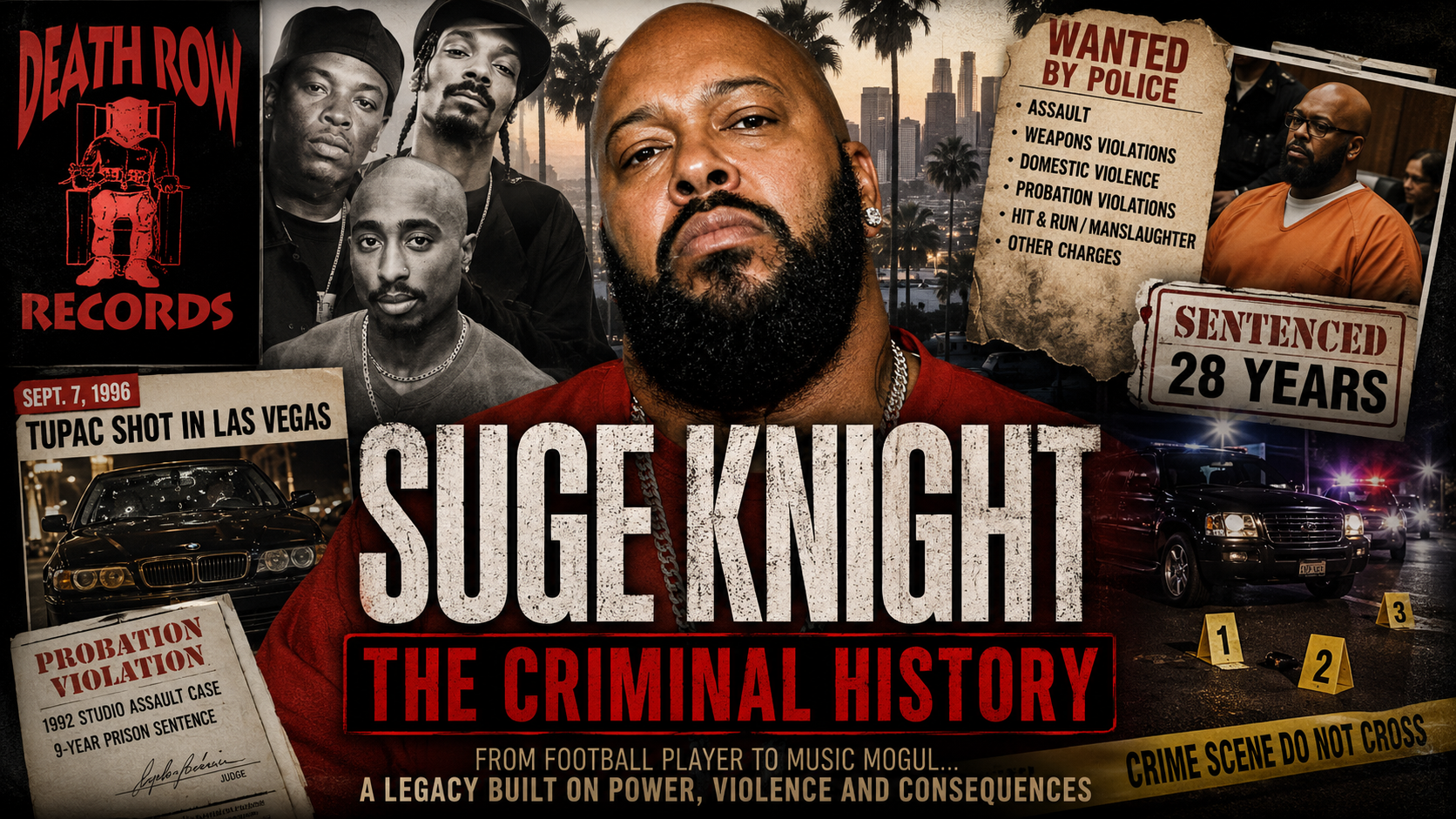
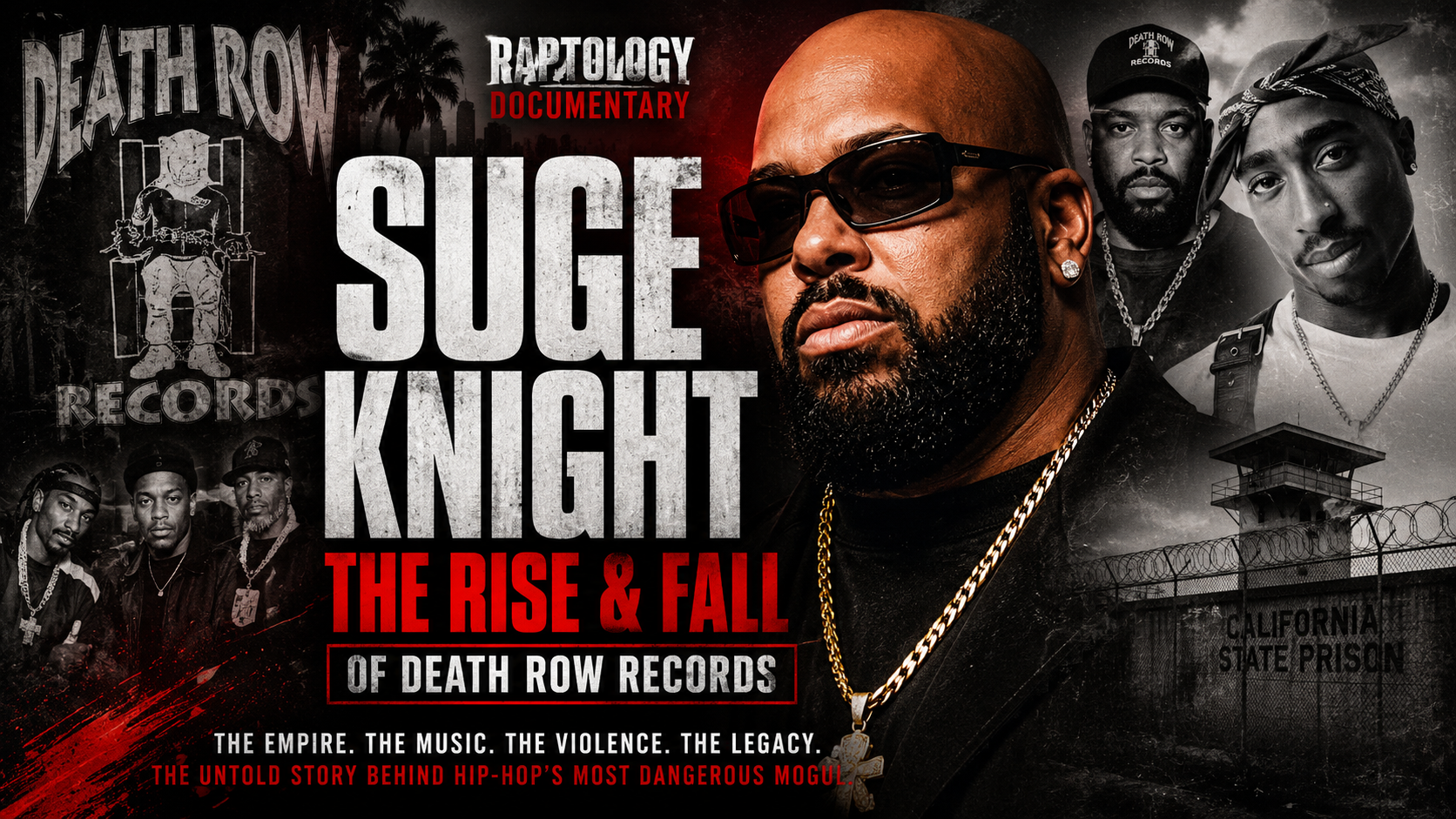
At the height of his power, Marion “Suge” Knight controlled one of the most successful and intimidating record companies in American music. Death Row Records released albums that reshaped hip-hop, generated millions of dollars and turned Los Angeles gangsta rap into an international force.
Dr. Dre’s The Chronic, Snoop Dogg’s Doggystyle and Tupac Shakur’s All Eyez on Me gave Death Row a catalog most labels could only dream of building. Behind that success stood a 6-foot-2 former football player whose name became synonymous with power, intimidation and violence.
Knight presented himself as an executive who protected artists from exploitative contracts. Former associates, rivals, prosecutors and investigators described a different reality: alleged beatings, threats, forced negotiations, gang influence, probation violations, shootings, lawsuits and eventually a fatal confrontation in a Compton parking lot.
The same reputation that made Suge Knight seem untouchable helped destroy his empire. By 2018, the man who once commanded recording studios, nightclubs and boardrooms was sentenced to 28 years in prison for voluntary manslaughter in the death of Terry Carter.
Editorial note: This documentary distinguishes criminal convictions, documented court proceedings, civil allegations, public accusations and disputed theories. Suge Knight has never been convicted of or charged with involvement in the murders of Tupac Shakur or The Notorious B.I.G.
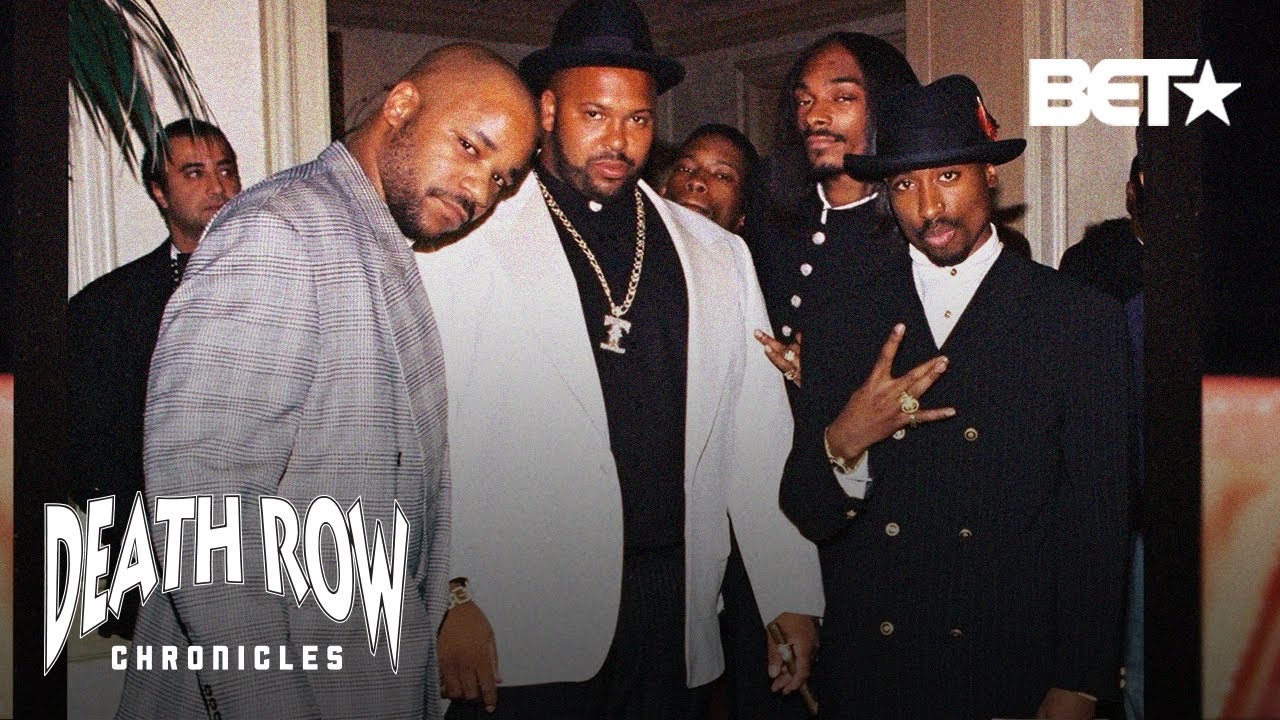
BET’s Death Row Chronicles examines Knight’s transformation from football player and bodyguard into the executive behind Death Row Records. Watch directly on YouTube.
Before Death Row: Sugar Bear From Compton
Marion Hugh Knight Jr. was born in Compton, California, in 1965. His childhood nickname, “Sugar Bear,” was eventually shortened to Suge.
Before his name inspired fear inside recording studios, Knight was known as an athlete. He played football and ran track at Lynwood High School before continuing his football career at El Camino College and the University of Nevada, Las Vegas.
In 1987, during the NFL players’ strike, Knight appeared in two games as a replacement player for the Los Angeles Rams. The opportunity briefly placed him near the highest level of professional football, but it did not develop into a lasting career.
The discipline required to reach professional sports coexisted with a temper and a growing record of confrontations. The supplied source narrative identifies domestic violence, weapons and vehicle-related arrests from Knight’s early adulthood. Some descriptions circulating online lack complete court documentation, but the larger pattern is well established: legal trouble began years before Death Row Records existed.
Knight’s physical size and willingness to confront people soon became more valuable in entertainment than his ability on a football field.
From Bobby Brown’s Bodyguard to Music Executive
After leaving football, Knight worked in concert promotion and personal security. He provided bodyguard services to performers including Bobby Brown and began studying the financial side of the music business.
Being employed by stars was not enough. Knight wanted ownership.
In 1989, he formed a music-publishing company and began acquiring songwriting and publishing interests. His first widely publicized business breakthrough involved “Ice Ice Baby,” the Vanilla Ice hit that became one of the biggest records of the early 1990s.
Mario “Chocolate” Johnson claimed he had contributed material to the song and deserved publishing credit. Knight represented Johnson’s interests and confronted Vanilla Ice over the royalties.
The confrontation produced one of hip-hop’s most enduring stories: that Knight dangled Vanilla Ice from a hotel balcony by his ankles until he agreed to sign away money. Vanilla Ice later disputed the literal balcony-dangling version but acknowledged that Knight brought him to the balcony, intimidated him and pressured him over the publishing dispute.
Whatever occurred inside the hotel, the conflict reportedly ended with publishing money being redirected. The episode established Knight’s formula: business negotiation backed by the suggestion that refusing him could have physical consequences.
The Ruthless Records Confrontation
Knight’s next objective was far larger. Dr. Dre wanted to leave N.W.A and Ruthless Records, but his contract tied him to the company controlled by Eazy-E and manager Jerry Heller.
Knight positioned himself as the man who could free Dre.
Over the years, multiple versions of the negotiation emerged. Some accounts described threats involving baseball bats, pipes or armed men. Other accounts softened the details while acknowledging that Knight’s representatives applied extraordinary pressure.
The result was undeniable. Dr. Dre left Ruthless Records and became the artistic foundation of a new company.
Death Row Records was formed in 1991 through a complicated network of partnerships, legal agreements and outside financing. Knight became the public leader and chief executive. Dr. Dre supplied the sound. Attorney David Kenner helped construct the legal framework. Michael “Harry-O” Harris and Lydia Harris later argued that their investment and work were essential to the company’s creation.
Death Row was not built like a traditional corporate label. Its mythology blended recording contracts, gang relationships, street enforcement and executive ambition.
Raptology Documentaries Explore more true stories from hip-hop historyThe Chronic Turns Death Row Into an Empire
Dr. Dre’s 1992 album The Chronic transformed Death Row from a dangerous new company into the center of West Coast hip-hop.
Dre’s production modernized funk for a new generation. The album introduced Snoop Doggy Dogg to a national audience, helped define G-funk and gave Death Row enormous cultural leverage.
Snoop’s debut album, Doggystyle, followed in 1993. It entered the charts at No. 1 and confirmed that Death Row’s success was not a one-album accident.
The label’s roster also included Tha Dogg Pound, Nate Dogg, Lady of Rage, Danny Boy and other artists whose music expanded the Death Row universe.
Knight now possessed money, influence and access to the largest corporations in entertainment. Interscope Records distributed Death Row’s releases, connecting the label’s street-level mythology to the corporate music industry.
Inside that success, however, fear remained part of the operating culture. Artists, producers and employees later described an atmosphere where gang members moved through offices, disputes could become physical and business decisions were inseparable from Knight’s personal authority.
Dr. Dre’s The Chronic gave Death Row Records its first landmark album. Open the album directly on Spotify.
Snoop Dogg’s Doggystyle confirmed Death Row’s commercial dominance. Open the album on Spotify.
A Record Label Built Around Fear
Knight argued that he was protecting Black artists from record executives who exploited their talent. That message appealed to musicians who had signed unfavorable contracts or believed labels were withholding royalties.
His methods, however, often resembled the exploitation he claimed to oppose.
Former employees and artists described physical intimidation, forced loyalty and financial confusion. Producers who believed Death Row owed them money were often reluctant to confront Knight. Rivals understood that business disagreements could become street conflicts.
Knight’s connections to members of the Mob Piru Bloods became part of the company’s identity. Death Row offices, studios and events reportedly included people with direct gang affiliations.
Knight also opened Club 662 in Las Vegas. On a telephone keypad, the numbers 662 spell “MOB,” a detail widely interpreted as a reference to Mob Piru.
The club reflected Knight’s world at the height of Death Row: celebrity, music, gambling, gang politics and personal power occupying the same room.
The Two Sides of Suge Knight’s Reputation
- He helped artists escape contracts they considered exploitative.
- He built one of the most successful Black-owned rap companies of the 1990s.
- He gave West Coast artists access to global distribution.
- He was repeatedly accused of using threats and violence during negotiations.
- Death Row’s offices were described as environments shaped by fear and gang influence.
- His personal confrontations repeatedly became legal problems for the company.
The 1992 Studio Assault Case
One of Knight’s most consequential early criminal cases came from an assault on two aspiring rappers at a Hollywood recording studio in 1992.
Knight and others were accused of attacking the men. He eventually pleaded no contest to assault-related charges and received probation rather than an immediate prison term.
The sentence gave him another opportunity to run Death Row, but it also created a condition that would later prove devastating: if Knight committed or participated in another violent incident, the court could revoke his probation and send him to prison.
For a man whose identity was built around direct confrontation, probation required a restraint he repeatedly failed to demonstrate.
The 1995 Source Awards Challenge
On August 3, 1995, hip-hop’s regional tension became visible onstage at the Source Awards in New York.
Knight accepted an award and delivered a message aimed unmistakably at Sean “Puff Daddy” Combs. He told artists who did not want an executive producer appearing in their videos, dancing in their videos or talking on their records to come to Death Row.
The crowd understood the insult. Bad Boy Records was dominating the East Coast while Death Row controlled the West. Knight’s comments transformed a competitive business rivalry into a public confrontation.
Suge Knight’s 1995 Source Awards speech became one of the defining moments of the East Coast-West Coast era. Watch directly on YouTube.
The speech did not create the coastal rivalry by itself, but it gave the conflict a recognizable face. Knight became the embodiment of Death Row’s aggressive identity. Combs represented Bad Boy’s polished commercial power.
Artists, media outlets and fans amplified the division until ordinary competition was discussed as a war.
Suge Knight Brings Tupac to Death Row
In 1995, Tupac Shakur was incarcerated while appealing a sexual-abuse conviction. He needed more than $1 million to secure his release on bond.
Knight stepped forward with the money and an offer. Death Row would help free Tupac, and Tupac would record for Death Row.
The agreement created the most explosive artist-executive partnership in rap history.
Tupac emerged from prison angry, energized and determined to record at an extraordinary pace. Within months, he completed All Eyez on Me, a double album that became one of hip-hop’s most important releases.
The album expanded Death Row’s empire, but Tupac brought unresolved conflicts into an already volatile environment. His resentment toward Bad Boy, The Notorious B.I.G. and people he blamed for his 1994 Quad Studios shooting intensified the East Coast-West Coast conflict.
Tupac’s All Eyez on Me became Death Row’s defining commercial triumph. Open the album on Spotify.
Dr. Dre Walks Away
Death Row’s success concealed growing internal division.
Dr. Dre became increasingly uncomfortable with the violence surrounding the company and Knight’s management style. In 1996, he left Death Row and founded Aftermath Entertainment.
His exit was a major blow. Dre had designed the sound that made Death Row successful, but he was willing to abandon the company rather than remain inside its environment.
Death Row responded with insults and diss records. The departure demonstrated that Knight’s power had limits. Fear could keep some people close, but it could also drive away the people most responsible for the label’s music.
Snoop Dogg would eventually leave as well, later describing the company’s atmosphere as dangerous and unstable.
September 7, 1996: The MGM Grand Fight
On September 7, 1996, Knight and Tupac attended the Mike Tyson-Bruce Seldon fight at the MGM Grand in Las Vegas.
After the boxing match, members of the Death Row group encountered Orlando Anderson, a South Side Compton Crip. Surveillance footage showed Tupac attacking Anderson inside the casino while Knight and others joined the confrontation.
The beating would have immediate consequences.
Hours later, Knight was driving a black BMW with Tupac in the passenger seat. While the vehicle was stopped near Las Vegas Boulevard and Flamingo Road, a white Cadillac pulled alongside it. Gunfire erupted.
Tupac was struck multiple times. Knight was wounded by fragments or gunfire but survived.
Tupac died six days later on September 13, 1996.
The Probation Violation That Sent Suge to Prison
Knight’s participation in the MGM Grand assault violated the probation he received in the earlier studio-attack case.
In 1997, a judge sentenced him to nine years in prison for violating probation. He served approximately four years before his release in 2001.
The incarceration removed Death Row’s leader during the most unstable period in the company’s history. Tupac was dead. Dr. Dre had left. Snoop Dogg was preparing to leave. Lawsuits and financial disputes were multiplying.
The empire continued selling records, but its center had collapsed.
Suge Knight’s Criminal and Legal Timeline
Knight’s brief football career ends, and he moves into concert promotion and personal security while accumulating early legal trouble.
Knight enters music publishing, becomes involved in the Vanilla Ice royalty dispute and helps negotiate Dr. Dre’s departure from Ruthless Records.
Death Row Records is formed.
Knight is accused of participating in an assault on two rappers at a recording studio.
Knight delivers his famous Source Awards speech and helps secure Tupac Shakur’s release from prison.
Knight and Tupac participate in the MGM Grand assault on Orlando Anderson. Tupac is fatally shot hours later while Knight drives the vehicle.
Knight receives a nine-year sentence for violating probation.
Knight is released after serving approximately four years.
He returns to custody following a confrontation with a parking attendant that authorities treated as a parole violation.
Death Row’s financial problems intensify, and Knight files for bankruptcy after a $107 million civil judgment involving Lydia Harris.
Knight is shot multiple times at a West Hollywood nightclub and later faces a robbery case involving a photographer’s camera.
Knight drives over Cle “Bone” Sloan and Terry Carter in a Compton restaurant parking lot. Carter dies.
Knight pleads no contest to voluntary manslaughter.
He is sentenced to 28 years in prison.
Knight is expected to become eligible for parole, subject to California’s correctional and parole processes.
Was Suge Knight Involved in Tupac’s Murder?
The fact that Knight was driving the car when Tupac was shot placed him permanently inside the murder story. He survived while Death Row’s most valuable artist died.
Over the following decades, theories accused Knight of arranging Tupac’s death because Tupac allegedly wanted to leave Death Row or because the label owed him money.
Former LAPD detective Russell Poole and other investigators promoted versions of that theory. Some former Death Row associates also made accusations in interviews and documentaries.
No court has proven that Knight ordered or participated in Tupac’s murder. He was wounded during the shooting, and authorities never charged him in connection with Tupac’s death.
In 2023, Nevada prosecutors charged Duane “Keffe D” Davis with murder, alleging that he helped orchestrate the retaliatory shooting following the MGM Grand fight. Davis pleaded not guilty.
That prosecution directs the official case toward the South Side Compton Crip group involved in the casino confrontation, not toward a proven Knight conspiracy.
Last Man Standing explores allegations surrounding Death Row, corrupt police officers and the murders of Tupac and Biggie. Its claims should be treated as documentary theories, not criminal verdicts. Watch the trailer on YouTube.
The Biggie Murder Allegations
Six months after Tupac’s death, Christopher “The Notorious B.I.G.” Wallace was killed in a drive-by shooting in Los Angeles.
Because Biggie was Bad Boy’s largest star and Tupac’s most famous rival, investigators and journalists immediately examined whether his death was retaliation.
Some theories accused Knight of arranging Biggie’s murder while incarcerated. Russell Poole alleged that corrupt or gang-affiliated Los Angeles police officers helped facilitate the killing. Other investigators proposed different suspects and motives.
The Wallace family filed a wrongful-death lawsuit against the city of Los Angeles, alleging police involvement or concealment. The litigation produced years of hearings and disputed evidence but did not establish Knight’s criminal responsibility.
Knight has never been charged with Biggie’s murder.
The continuing mystery demonstrates how Knight’s reputation became larger than the available evidence. Once he was known as the most feared man in hip-hop, almost every unsolved act of violence around Death Row appeared capable of being attributed to him.
Prison Did Not End the Legal Problems
Knight left prison in 2001 promising to rebuild his life and label. His freedom did not last without interruption.
In 2003, he was accused of striking a parking attendant outside a Los Angeles nightclub. Authorities treated the incident as a parole violation, and Knight returned to prison.
He had also faced scrutiny for associating with known gang members while under supervision.
These cases revealed a recurring pattern. Knight would survive a major prosecution, receive probation or parole and then return to custody because of another confrontation.
The criminal-justice system did not need to prove a new murder or major conspiracy. His inability to follow release conditions repeatedly supplied a direct path back to prison.
The $107 Million Judgment and Death Row’s Collapse
Death Row’s decline was not caused by violence alone. Financial disputes destroyed what remained of the label.
Lydia Harris sued Knight, arguing that she and her former husband, Michael Harris, had helped finance and establish Death Row but had been denied their ownership interest.
After Knight failed to comply fully with parts of the litigation, Harris received a judgment reported at approximately $107 million.
The judgment helped push Knight and Death Row into bankruptcy. A trustee gained control over the company, and Death Row’s assets were eventually sold.
The offices that once represented rap’s most powerful empire were emptied. Equipment, memorabilia and even the label’s famous electric-chair imagery became auction material.
Suge Knight Becomes the Victim of Gunfire
Knight’s reputation for violence did not protect him from becoming a target.
In 2005, he was shot in the leg during a party connected to Kanye West at Miami Beach’s Shore Club. The circumstances remained disputed, and Knight survived.
In August 2014, he was shot multiple times during a pre-Video Music Awards party hosted by Chris Brown at a West Hollywood nightclub.
Despite suffering several wounds, Knight reportedly managed to leave the club and reach emergency assistance.
He again refused to provide investigators with the cooperation they wanted.
The shootings reinforced his mythology. Knight appeared able to absorb the same violence that had surrounded his career and continue moving forward.
Fights, Arrests and Public Humiliation
As Death Row collapsed, Knight continued appearing in confrontations that kept him in headlines.
In 2008, he was knocked unconscious during a fight outside a Hollywood nightclub. Witnesses said an argument over money escalated until another man landed a punch that left the former football player on the ground.
Later that year, Knight was arrested near Las Vegas following allegations that he assaulted a woman and possessed drugs. Serious assault-related allegations were later dropped when prosecutors could not proceed without the complaining witness.
In 2009, Knight was hospitalized following another altercation at a Scottsdale hotel. Other men were arrested after police used Tasers to stop the fight.
Traffic violations, marijuana possession, missed court appearances and outstanding warrants added to the record.
The incidents lacked the scale of his 1990s controversies, but together they showed a man unable to escape conflict even after losing his company.
The Photographer Robbery Case
In 2014, Knight and comedian Katt Williams were accused of taking a camera from a celebrity photographer in Beverly Hills.
The case exposed Knight to the possibility of a severe sentence because of his prior convictions. Under California’s repeat-offender laws, conduct that might produce a limited sentence for another defendant could carry dramatically greater consequences for Knight.
The robbery prosecution remained unresolved while a far more serious case took priority.
Get Featured on Raptology
Raptology documents hip-hop history while introducing readers to the artists shaping its future. Artists, managers and publicists can submit music, interviews and campaign materials for editorial consideration.
Submit Your MusicJanuary 29, 2015: The Confrontation That Ended Suge Knight’s Freedom
On January 29, 2015, Knight became involved in a confrontation connected to the production of Straight Outta Compton, the N.W.A biographical film.
Knight was not welcome on the film set. After an argument involving Cle “Bone” Sloan, a security consultant connected to the production, the dispute moved to Tam’s Burgers in Compton.
Terry Carter, a businessman and longtime acquaintance of Knight, was also present.
Surveillance footage captured Knight’s red Ford pickup entering the parking lot. Sloan approached the driver’s side. A confrontation followed.
Knight reversed the truck, striking Sloan. He then accelerated forward, driving over Sloan again and fatally striking Carter.
Knight left the scene and later turned himself in.
Prosecutors initially charged him with murder, attempted murder and hit-and-run. They argued that the truck had been used intentionally as a deadly weapon.
Knight’s attorneys claimed self-defense. They argued that he believed he was being ambushed and accelerated to escape an armed threat.
The video became the central piece of evidence. Whatever fear Knight experienced, the footage showed a vehicle reversing and then moving forward across two men, killing one of them.
CBS Los Angeles reports on Knight’s no-contest plea in the death of Terry Carter. Watch directly on YouTube.
Years of Delays, Health Problems and Changing Lawyers
The homicide case remained unresolved for more than three years.
Knight changed attorneys repeatedly. Court hearings were delayed by disputes over evidence, witness identities and his health.
He experienced blood clots and other medical complications while incarcerated. At different points, he collapsed in court or was transported for treatment.
His bail was initially set at an extraordinary amount before being reduced, but he remained unable to secure release.
Prosecutors also accused Knight of threatening Straight Outta Compton director F. Gary Gray. That charge was eventually dismissed as part of the broader plea agreement.
Two former attorneys connected to Knight faced their own criminal allegations involving efforts to influence witnesses. Those accusations added another level of chaos to an already complicated prosecution.
The Plea Deal
In September 2018, Knight pleaded no contest to voluntary manslaughter in Terry Carter’s death.
A no-contest plea does not formally admit guilt in the same language as a guilty plea, but it allows the court to treat the defendant as convicted.
The agreement eliminated the risk of a murder conviction and a possible life sentence. In exchange, Knight accepted a fixed 28-year term.
The sentence consisted of 22 years for voluntary manslaughter and an additional six years because the conviction qualified as a third strike under California law.
On October 4, 2018, the court imposed the sentence.
Knight receives a 28-year prison sentence for voluntary manslaughter in Terry Carter’s death. Watch the sentencing report on YouTube.
Terry Carter: More Than a Name in Suge Knight’s Story
Coverage of the case often frames Terry Carter’s death as the final event in Suge Knight’s downfall. That framing risks reducing Carter to a plot point in another man’s biography.
Carter was a husband, father, grandfather and businessman. His family described the lasting damage created by his death.
He was reportedly attempting to help resolve the conflict between Knight and people connected to the film production. Instead, he was killed beneath Knight’s truck.
The sentence could not restore him to his family. It only established criminal accountability after years of delay.
Where Is Suge Knight Now?
Knight is serving his 28-year sentence in the California prison system. Public reporting has placed him at Richard J. Donovan Correctional Facility near San Diego.
He is expected to become eligible for parole in October 2034, although eligibility does not guarantee release.
From prison, Knight has continued commenting on hip-hop through telephone interviews and podcast appearances. His voice remains connected to Death Row history, Tupac, Snoop Dogg, Dr. Dre and the people who inherited the industry he once controlled.
He no longer owns Death Row Records. Snoop Dogg acquired the Death Row brand in 2022, producing one of hip-hop’s most symbolic reversals: an artist who once escaped Knight’s company returned decades later as its owner.
Was Suge Knight a Protector or a Predator?
Knight’s legacy cannot be reduced to a single label.
He challenged exploitative music contracts and helped Black artists gain leverage. He built a company that allowed West Coast rap to compete with the largest labels in the world.
He also operated through intimidation, surrounded himself with violent people and repeatedly became involved in conduct that endangered others and himself.
Supporters portray him as a powerful Black executive punished for refusing to submit to the traditional music establishment. Critics portray him as a predator who recreated street extortion inside the recording business.
Both interpretations contain part of the truth.
Knight understood that fear could function as currency. It helped him negotiate contracts, control artists, silence creditors and challenge corporate executives.
Fear, however, is expensive to maintain. It requires constant demonstrations. Every confrontation creates another enemy, another witness, another lawsuit or another criminal case.
The Empire That Could Not Survive Its Founder
Death Row’s music survived because the records were larger than the chaos that produced them.
The Chronic remains a production landmark. Doggystyle remains one of rap’s defining debut albums. All Eyez on Me remains central to Tupac’s legacy.
The company itself could not survive Knight’s management.
Dr. Dre left. Snoop Dogg left. Tupac died. Knight went to prison. Ownership disputes consumed the label’s finances. Bankruptcy removed its remaining assets.
The same executive who promised to create the Motown of the 1990s built an empire that burned through its talent, relationships and money within a few extraordinary years.
The Criminal History That Became the Suge Knight Brand
Most executives attempt to separate their professional identity from criminal accusations. Knight often appeared to merge the two.
Stories about Vanilla Ice, Eazy-E, studio assaults and gang members strengthened his negotiating position. The fear surrounding him became free marketing for Death Row.
Artists believed he could protect them. Rivals believed he could harm them. Corporate partners believed he could deliver records that no traditional executive could create.
That brand worked until courts, creditors and former partners began converting reputation into evidence and financial liability.
The mythology protected Knight in rooms where people were afraid to challenge him. It could not protect him from surveillance footage, probation conditions, civil judgments or California’s three-strikes law.
Fact, Allegation and Myth
What the Public Record Establishes
- Knight co-founded and led Death Row Records during its most successful period.
- He pleaded no contest in the 1992 studio-assault case and received probation.
- His participation in the 1996 MGM Grand assault led to a probation-violation prison sentence.
- He repeatedly returned to custody for parole or probation violations.
- Death Row entered bankruptcy following extensive financial litigation.
- Knight pleaded no contest to voluntary manslaughter in Terry Carter’s death.
- He received a 28-year prison sentence in 2018.
What Remains Disputed or Unproven
- The literal claim that Knight dangled Vanilla Ice by his ankles from a balcony.
- The complete details of how Dr. Dre was released from Ruthless Records.
- Claims that Knight ordered Tupac Shakur’s murder.
- Claims that Knight ordered The Notorious B.I.G.’s murder.
- Claims that every violent incident connected to Death Row was directed by Knight.
- Claims that favorable legal outcomes automatically proved witness intimidation or corruption.
Enter the Raptology Rap Contest
Independent artists can compete for visibility, audience recognition and opportunities across the Raptology platform.
Enter the Rap ContestReader Poll
What ultimately caused Suge Knight’s downfall?
From Gold Records to Prison Bars
Suge Knight began as Sugar Bear, a talented athlete from Compton. He became a bodyguard, promoter, publishing executive and eventually the leader of the most feared record company in hip-hop.
For a brief period, his strategy appeared unbeatable. Death Row controlled the charts. Its artists defined popular culture. Rivals feared the label, and major corporations still wanted its music.
But Knight confused fear with stability.
The violence surrounding Death Row was not separate from its business model. It was part of the model. That made the company powerful in the short term and impossible to preserve in the long term.
Every artist who walked away weakened the empire. Every assault created legal exposure. Every probation violation reduced Knight’s freedom. Every ownership dispute drained money from the label.
Then came the final confrontation at Tam’s Burgers.
Terry Carter’s death transformed Knight’s reputation from hip-hop mythology into a 28-year prison sentence. The executive who once controlled some of the most valuable recordings in rap now lives under the control of the California prison system.
His music legacy remains undeniable. So does the human cost surrounding it.
Reporting, Court Coverage and Media Sources
- Associated Press: Suge Knight sentenced to 28 years in prison
- CBS News: Knight pleads no contest to voluntary manslaughter
- Los Angeles Times: Knight released from prison in 2001
- The New Yorker: Death Row Records and Tupac’s final period
- Vanity Fair: Lydia Harris, Death Row financing and the $107 million judgment
- Time: The Terry Carter case and Knight’s self-defense claim
- BET: Death Row Chronicles, Episode 1
- Suge Knight’s 1995 Source Awards speech
- Last Man Standing official documentary trailer
- CBS Los Angeles: Knight accepts manslaughter plea agreement
- CBS Los Angeles: Knight sentenced to 28 years
- Dr. Dre: The Chronic on Spotify
- Snoop Dogg: Doggystyle on Spotify
- Tupac Shakur: All Eyez on Me on Spotify

Raptology Editorial is the official newsroom voice of Raptology, covering breaking hip-hop news, artist developments, industry trends, and in-depth editorial reports from across the global rap landscape.






Leave a Reply