
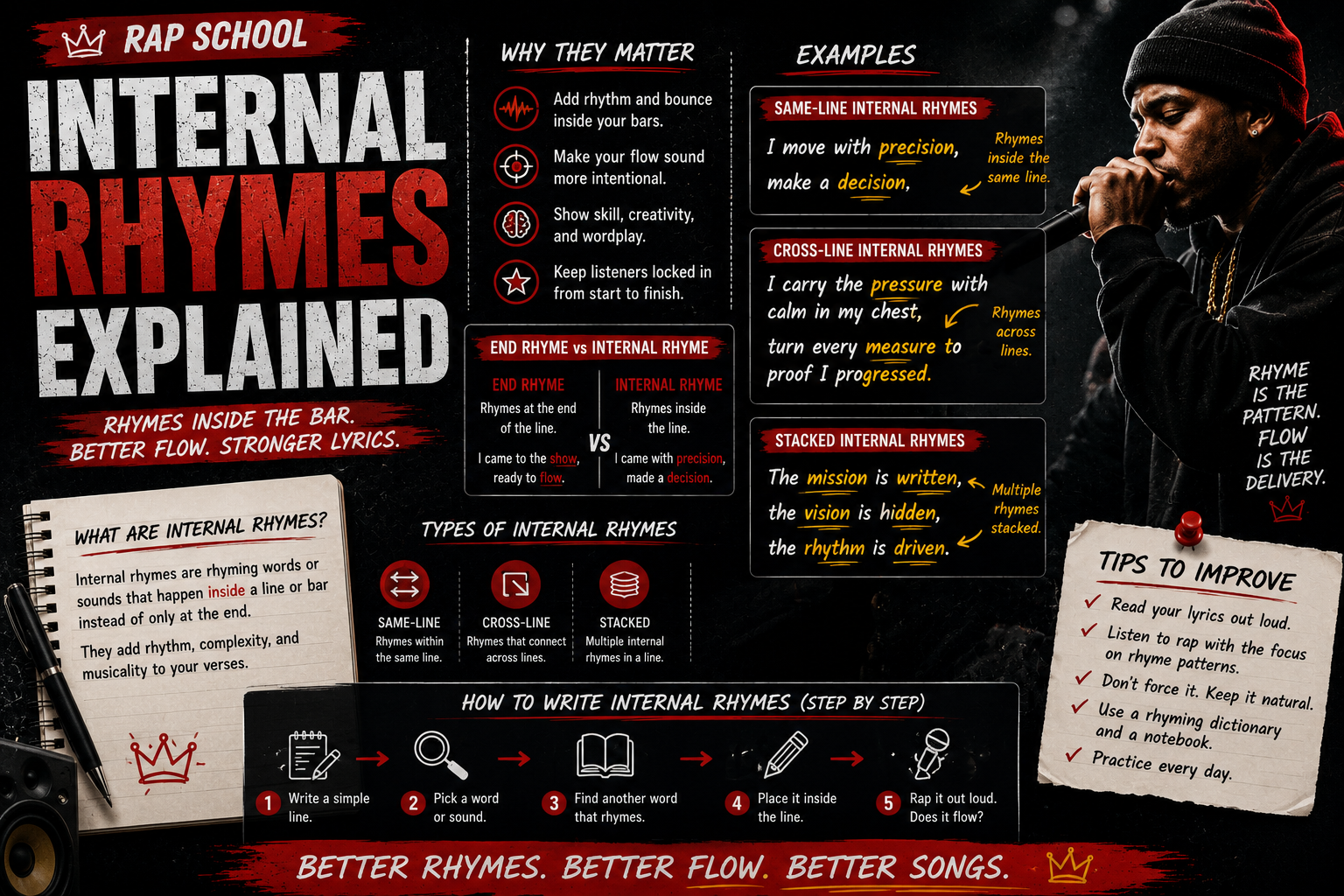
Internal Rhymes Explained
Internal rhymes are rhymes that happen inside a line or bar instead of only at the end. They help rappers create smoother flow, stronger rhythm, and more technical lyricism.
Internal rhymes are one of the key techniques that make rap lyrics sound more advanced. While beginners often rhyme only the last word of each line, skilled rappers place rhymes inside the bar, across the middle of phrases, and sometimes several times before the line ends.
This technique makes verses feel more musical and layered. Internal rhymes can make a flow sound faster, smoother, more complex, or more memorable, even when the rapper is not actually rapping at a very high speed.
Simple definition: Internal rhymes are rhyming words or sounds that appear inside a line, inside a bar, or before the final end rhyme.
What Are Internal Rhymes in Rap?
In rap, an internal rhyme happens when a word in the middle of a line rhymes with another word in the same line, the next line, or somewhere else before the expected end rhyme. This gives the verse more movement because the listener hears rhyme connections throughout the bar instead of only at the end.
Internal rhymes are especially important in hip-hop because rap is built around rhythm, repetition, and sound patterns. A rapper can use internal rhymes to control the bounce of the verse and make the delivery feel more intentional.
Basic end rhyme: I came to the show / ready to flow.
Internal rhyme: I move with precision, make a decision, then switch up the rhythm.
Why Internal Rhymes Matter
Internal rhymes matter because they add texture to a verse. Instead of sounding flat or predictable, the lyrics begin to move with more energy. The listener hears repeated sounds inside the line, which makes the verse feel tighter and more musical.
This is one reason technical rappers often sound impressive even before every word is fully understood. The ear catches the rhyme patterns, the rhythm, and the momentum. Internal rhymes help create that effect.
Internal Rhymes vs. End Rhymes
End rhymes happen at the end of lines. Internal rhymes happen before the end of the line or inside the bar. Both are useful, but internal rhymes usually make writing feel more advanced because they add extra sound connections within the verse.
| Rhyme Type | Where It Happens | Effect |
|---|---|---|
| End Rhyme | At the end of a line or bar | Creates a clear, simple rhyme pattern. |
| Internal Rhyme | Inside the line, phrase, or bar | Adds rhythm, complexity, and musical movement. |
| Multi-Syllable Rhyme | Across multiple syllables | Makes the rhyme sound more detailed and technical. |
How Internal Rhymes Improve Flow
Flow is not only about speed. It is about how words move over the beat. Internal rhymes give the rapper more rhythmic points inside each bar. These rhyme points can make the verse bounce, glide, or hit harder depending on how they are placed.
When a rapper places internal rhymes near drum hits, pauses, or changes in cadence, the verse can feel more locked into the beat. This is why internal rhymes are often connected to strong flow.
Types of Internal Rhymes
Same-Line Internal Rhymes
This happens when rhyming words appear inside the same line. It is one of the easiest ways to begin using internal rhymes because the connection is close together and easy to hear.
I keep the motion in focus while I write with devotion.
Cross-Line Internal Rhymes
This happens when a rhyme inside one line connects with a word inside the next line. It can create a more advanced pattern because the listener hears the rhyme travel across the verse.
I carry the pressure with calm in my chest,
turn every measure to proof I progressed.
Stacked Internal Rhymes
Stacked internal rhymes happen when several rhyming sounds appear close together. This creates a dense, technical feeling and can make a verse sound more intense.
The mission is written, the vision is hidden, the rhythm is driven.
How to Write Internal Rhymes
The easiest way to write internal rhymes is to choose a main sound and place that sound in more than one spot inside the bar. Start simple. Do not try to rhyme every word. Instead, look for natural places where repeated sounds can improve the rhythm without making the line feel forced.
- Step 1: Write a simple line with one clear idea.
- Step 2: Choose one important word or sound from that line.
- Step 3: Find another word with a similar sound.
- Step 4: Place the second rhyme inside the line, not only at the end.
- Step 5: Rap it out loud to make sure it sounds natural over the beat.
Rap School Example
Basic line: “I work every night until I reach my goal.” Improved with internal rhyme: “I work through the night with the purpose in sight till I reach my goal.” The second version has more movement because “night” and “sight” create an internal rhyme before the final idea lands.
Common Mistakes Beginners Make
One common mistake is forcing too many rhymes into one line. Internal rhymes should support the verse, not make it confusing. If the line becomes hard to understand, the technique is getting in the way of the message.
Another mistake is focusing only on perfect rhymes. In rap, similar sounds can often work just as well. Slant rhymes, vowel sounds, and repeated consonants can all help create internal rhyme patterns without making the lyrics sound unnatural.
Do Internal Rhymes Always Need to Be Perfect?
No. Internal rhymes do not always need to be exact. Many rappers use near rhymes or similar vowel sounds because they allow more flexibility. What matters most is whether the pattern sounds good when performed.
Rap is a vocal art form, so pronunciation, accent, delivery, and rhythm can make words rhyme in ways that may not look perfect on paper. The ear matters more than the page.
Final Thoughts
Internal rhymes are one of the most useful tools in rap lyricism. They make verses sound more rhythmic, technical, and memorable by adding rhyme patterns inside the bar instead of only at the end.
For new rappers, internal rhymes are a powerful way to improve flow and writing quality. Start with simple patterns, rap them out loud, and make sure the lyrics still communicate clearly. Over time, internal rhyming can become one of the techniques that gives your style more identity and control.
Continue Learning in Rap School
Visit the Rap School hub for more lessons on rap lyrics, songwriting, music business, royalties, promotion, and hip-hop history.
Recommended next lessons: Multisyllabic Rhymes, What Is Flow in Rap?, and How to Write Rap Lyrics.