
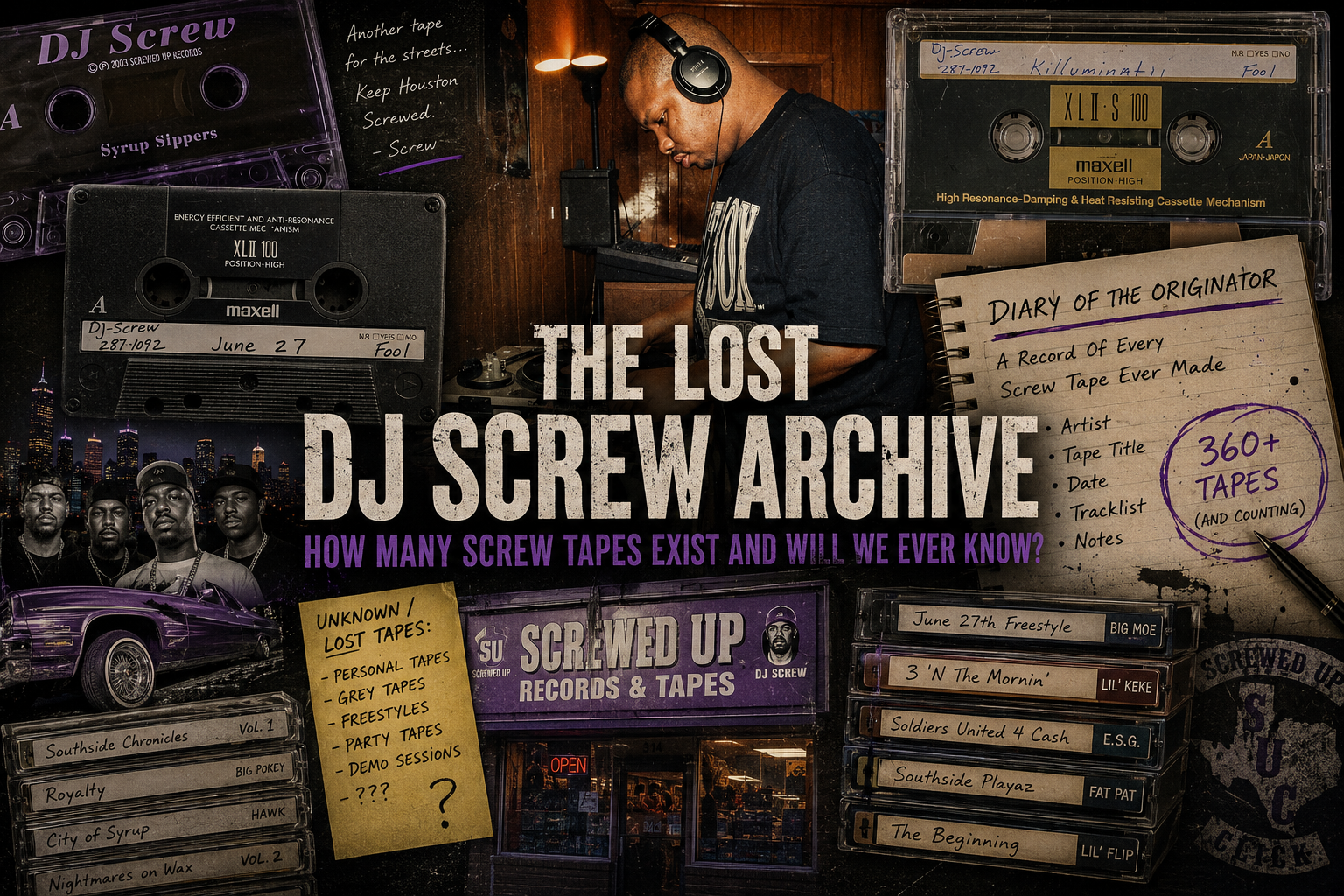
DJ Screw did not just create a sound. He created a city-sized archive of Houston voices, freestyles, dedications, grey tapes, neighborhood legends and handwritten lists. More than two decades after his death, one question still haunts hip-hop historians: how many Screw Tapes actually exist?

Submit Your Music To Raptology
Independent artists can submit music, videos and press materials for editorial consideration.
Submit Your Music Read More DocumentariesThe question sounds simple until you try to answer it. How many tapes did DJ Screw make?
The common answer is usually “hundreds.” Some sources say more than 300. Others say more than 350. Fans, collectors and Houston rap historians often point to the Diary of the Originator series, the official reissue program that turned many original Screw Tapes into numbered chapters. But the deeper you dig, the more complicated the number becomes.
DJ Screw’s archive was not built like a normal discography. These were not traditional studio albums with release dates, label copy, barcode data and fixed credits. They were cassettes made for friends, fans, neighborhoods, birthdays, cars, freestyle sessions, local rappers and late-night Southside Houston traffic. Some were copied again and again. Some were renamed. Some were bootlegged. Some were personalized. Some may still be sitting in private collections. Some may be gone forever.
That is why the DJ Screw catalog has become one of hip-hop’s greatest unfinished archival projects. It is not only about counting tapes. It is about reconstructing a city’s underground memory.
The Man Who Slowed Houston Down
DJ Screw was born Robert Earl Davis Jr. on July 20, 1971. The University of Houston’s DJ Screw Collection notes that he began DJing and making mixtapes as a teenager on Houston’s Southside before developing the slowed-down technique that became known as “chopped and screwed.”
What made Screw different was not just that he slowed records down. It was how he did it. The University of Houston finding aid explains that Screw played two copies of the same record on turntables, slowed them with pitch control, used the crossfader to repeat beats, words and phrases, created a master cassette, and then slowed the tape even more with a four-track’s pitch control. That process created music that felt heavy, haunted, stretched and intimate.
In the early 1990s, Houston did not yet have the national rap infrastructure of New York, Los Angeles or Atlanta. Screw’s tapes helped create one. They gave local rappers a platform. They gave neighborhoods a soundtrack. They turned freestyle sessions into oral history. They made cars, slabs, codeine, Southside slang, birthdays, rivalries and friendships part of the archive.
Among the most famous examples is “June 27th,” the legendary freestyle associated with Big Moe’s birthday. It became more than a tape. It became a Houston holiday, a cultural marker and one of the most recognizable long-form freestyle moments in Southern rap history.
Why The Number Is So Hard To Count
DJ Screw’s tapes were often called “grey tapes” because of the color of the cassettes. They were sold from his home before he later opened Screwed Up Records and Tapes. According to the University of Houston, he opened the store in 1998 to meet demand for his mixtapes, and the tapes helped develop the careers of local rappers who became known as the Screwed Up Click.
This is where a normal discography breaks down. A Screw Tape might have one title in a fan’s collection, another title in an official reissue, another name on a handwritten list, and another nickname in Houston conversation. A tape might be known by the main freestyle, the person it was made for, the neighborhood associated with it, or the phrase fans remembered from it. That makes duplicate counting a constant risk.
There is also the problem of format. Original cassettes deteriorate. Dubs vary in quality. Tracklists can be incomplete. Some tapes have missing labels. Others have fan-made covers, later CD versions, unofficial uploads or collector names that do not match the original title. Even when the music survives, the metadata may not.
The University Of Houston Archive
One reason this story is more than fan speculation is that DJ Screw’s legacy is preserved in a real institutional archive. The University of Houston’s Houston Hip Hop Research Collection says it documents the city’s unique music culture and includes approximately 1,500 vinyl records owned by DJ Screw, along with personal and business papers from Houston artists and visual creators.
The DJ Screw Collection includes personal papers, photographs, creative material, technology, sound recordings and promotional material. Its finding aid specifically mentions lists for Screw Tapes, recording equipment, business documents and photographs. That matters because the archive is not just music. It is infrastructure: lists, objects, papers, evidence of how the music was made and distributed.
The same collection also explains a key preservation issue: because original Screw Tapes are fragile, they cannot be played directly. Digital copies can be accessed in the Special Collections Reading Room. That detail reveals why a complete public count remains difficult. Some materials exist in archival custody, but access, copyright, preservation and privacy issues shape what researchers can hear, copy or publish.
The Diary Of The Originator Problem
For many fans, the closest thing to an official catalog is the Diary of the Originator series. After DJ Screw’s death, many tapes were reissued as numbered chapters. That gave the public a clearer way to talk about the catalog. Chapter numbers became reference points. But the numbering did not fully solve the archive problem.
One reason is chronology. The numbered chapters do not always reflect the exact order in which the tapes were originally made. A tape released as a later chapter may have been recorded years earlier. Another tape may carry a title that fans already knew from a different context. The reissue series created order, but it also created a second layer of cataloging that has to be compared against the original grey-tape history.
The Internet Archive has become one place where fans encounter the series. For example, DJ Screw Chapter 001, Done Deal, is listed with a 1997 publication date and was added to the archive in 2020. Other chapters, such as Chapter 220, Player Memories, show how individual tapes circulate online with dates, topics and track information that may help researchers but still require verification against official and archival records.
That is the heart of the mystery. The Diary of the Originator chapters are essential, but they are not the same thing as a complete, final, universally accepted master list of every tape DJ Screw ever made.
The Screwed Up Click Was Also An Archive
The tapes are not only important because of Screw. They are important because of who appears on them. The University of Houston identifies prominent Screwed Up Click members including the Botany Boys, Fat Pat, HAWK, Lil’ Keke, E.S.G., Big Pokey, Big Moe, Lil’ O, Al-D, Yungstar and Lil’ Flip. For many of those artists, Screw Tapes captured early performances, freestyle chemistry and local fame before national recognition.
That makes every tape a potential document of an artist’s development. A forgotten freestyle might contain an early verse from someone who later became central to Houston rap. A shoutout might confirm a neighborhood connection. A birthday tape might preserve a night that otherwise exists only in memory. A tracklist might show what Houston was listening to before the rest of the country caught up.
This is why the archive question is bigger than a collector’s checklist. If a tape is missing, a piece of the Screwed Up Click story may be missing too.
The Music Problem
Original tapes can be fragile, copied, mislabeled, incomplete or privately held.
The Metadata Problem
Titles, dates, tracklists and chapter numbers do not always line up neatly.
The People Problem
Freestyles, shoutouts and neighborhood references require human memory to decode.
The Access Problem
Some materials exist in archives but are not simple public downloads.
The New Streaming Era
For decades, much of DJ Screw’s catalog lived through physical tapes, CDs, local shops, bootlegs, YouTube uploads and fan collections. That began changing in a major way in 2026. The DJ Screw Estate announced that his catalog was coming to streaming platforms for the first time, with releases beginning through DJ Screw Originals (Volume 1) and more mixtapes scheduled to follow weekly through the end of June.
The Houston Chronicle also reported that most of Screw’s work had previously been accessed through physical tapes or unofficial uploads, making the streaming rollout a preservation and accessibility milestone for new listeners. For longtime fans, however, the streaming era raises another question: will wider availability finally help clarify the count, or will it reveal even more confusion?
Streaming platforms are good at presenting albums. They are less good at explaining cassette lineage, dub history, alternate names, freestyle credits and neighborhood context. A streaming release can make a tape easier to hear, but it does not automatically solve the archival puzzle behind it.
How Many Tapes Are There?
The safest answer is this: no publicly available source has produced a universally accepted final count of every DJ Screw tape. Most reliable summaries describe the catalog in broad terms: hundreds of tapes, often more than 300. Some public discographies and fan lists push the number higher, especially when counting official chapters, alternate issues, dubs, personalized tapes, freestyles and related recordings.
The count depends on what you mean by “tape.” Do you mean only original grey tapes made by DJ Screw himself? Official Diary of the Originator chapters? Personalized tapes made for individuals? Copies sold from the house? Later reissues? Tapes with Screw involvement but not part of the main chapter sequence? Live recordings? Dub versions? Each definition produces a different number.
That is why the Reddit comment that sparked this article was so sharp: “We have no idea how many tapes DJ Screw made.” It may sound like exaggeration, but it points to a real archival problem. The number is not unknown because nobody has tried. It is unknown because the object being counted keeps changing shape.
Why A Complete Index Would Matter
A modern DJ Screw index would be more than a list of titles. To be useful, it would need to connect tape title, chapter number, original date, reissue date, tracklist, featured artists, freestyle participants, known aliases, source format, archive location and audio availability. That is a massive job.
It would also require careful sourcing. Fan uploads can be helpful but imperfect. Discogs listings can document physical releases but may not resolve original recording history. The University of Houston archive can preserve primary materials, but not everything is instantly public. Screwed Up Records and Tapes has historical authority, but retail availability is not the same as a full scholarly catalog. Oral history remains crucial, but memory can conflict.
In other words, a complete index would need to combine community knowledge with institutional preservation. It would need Houston fans, collectors, archivists, music journalists, surviving artists, family members and data people working together.
The Timeline: From Grey Tapes To Global Archive
What Gets Lost When A Tape Disappears?
When people talk about lost music, they often mean lost songs. With DJ Screw, the loss can be deeper. A missing tape may mean a missing freestyle, a missing lineup of rappers, a missing dedication, a missing birthday, a missing local reference, a missing car-club moment, a missing piece of a neighborhood’s sound.
Houston rap was built through independent networks. The city did not wait for coastal validation. Screw’s tapes documented that independence in real time. They captured a version of hip-hop that was slow, regional, social and deeply local before it became nationally fashionable.
That is why the archive matters. It is not nostalgia. It is cultural evidence.
The Archivists Are The New DJs
The modern Screw researcher is part detective, part librarian, part fan and part data worker. They compare uploads, inspect covers, read tape lists, ask older fans, check credits, listen for shoutouts, study freestyle participants and build spreadsheets. What Screw once did with records and cassettes, today’s archivists do with metadata and memory.
That does not replace the original culture. It protects it. Every correct title, date, tracklist and artist credit makes the archive more usable for future fans. It also helps prevent Houston’s underground history from being flattened into a vague phrase like “chopped and screwed” without the people, places and tapes that made it real.
The next great DJ Screw project may not be a remix. It may be a database.
Raptology Hall Of Fame Context
DJ Screw’s legacy belongs in any serious discussion of hip-hop preservation. His tapes are not just releases; they are documents of Houston language, neighborhood identity, independent distribution and Southern rap innovation.
Visit The Rap Hall Of Fame Featured StoriesFinal Word
So how many Screw Tapes exist?
The honest answer is that hip-hop still does not know with certainty. There are hundreds. There are official chapters. There are archived materials. There are online uploads. There are store histories, fan lists, private collections, fragile originals and memories that may never be fully reconciled.
But maybe that uncertainty is part of the point. DJ Screw’s catalog was never just a discography. It was a living network. It moved from hand to hand, car to car, house to house, dub to dub, neighborhood to neighborhood. It was music, but it was also social life.
The lost DJ Screw archive is not lost because it vanished. It is lost because it is everywhere.
Want Your Story Featured On Raptology?
Artists, producers, managers and labels can request editorial features, interviews and promotional coverage through Raptology and FAMED PR.
Request A Feature Contact RaptologyReader Poll: What is the most important part of preserving DJ Screw’s legacy?
University of Houston Libraries: DJ Screw Collection finding aid
University of Houston Libraries: Houston Hip Hop Research Collection
University of Houston Digital Collections: DJ Screw Photographs and Memorabilia
Red Bull Music Academy: DJ Screw — A Fast Life In Slow Motion
Pitchfork: DJ Screw’s catalog coming to streaming for the first time
Houston Chronicle: DJ Screw catalog becoming available on streaming services
Internet Archive: DJ Screw Chapter 001 — Done Deal
Internet Archive: DJ Screw Chapter 220 — Player Memories

Raptology Editorial is the official newsroom voice of Raptology, covering breaking hip-hop news, artist developments, industry trends, and in-depth editorial reports from across the global rap landscape.







Leave a Reply