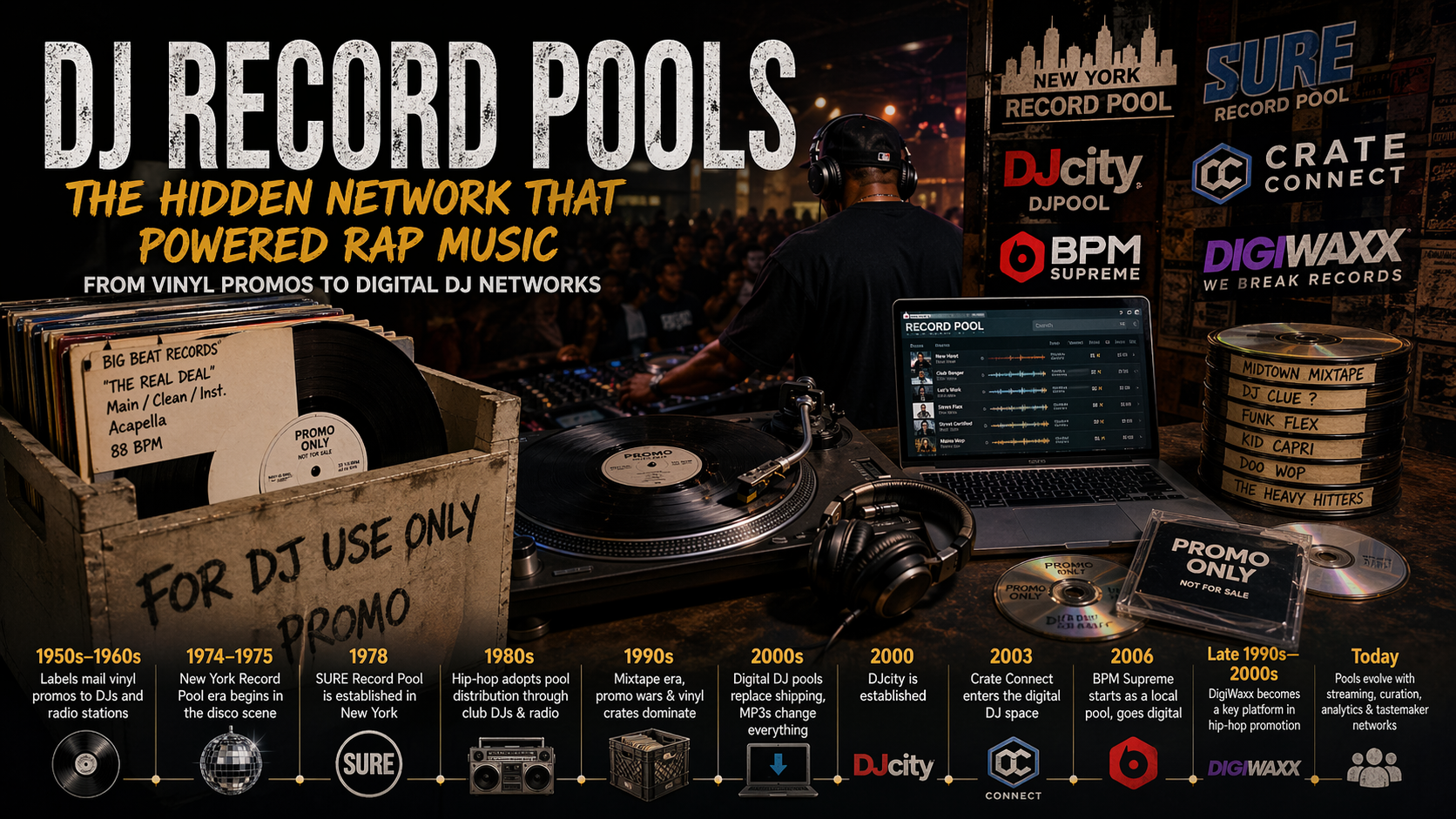
The DJ record pool was born long before anyone could upload an MP3, pitch a playlist or send a link to a thousand tastemakers. In 1975, a group of New York disc jockeys began organizing around a deceptively simple demand: the people who were breaking records in clubs deserved meaningful access to new music. Their experiment linked labels, working DJs and dance floors, then helped establish a promotional model that would later serve disco, house, freestyle and hip-hop. By 2026, the cardboard boxes had largely given way to music libraries and download dashboards. The essential question remained: who gets to hear the record before the public does, and what happens next?
This is the New York story, from David Mancuso’s Loft and the first formal pool to the Bronx organizations that helped rap records travel, and from Judy Weinstein’s influential operation to Digiwaxx and the modern DJ platforms. It is also a story about access and exclusion, because the record pool promised a more democratic industry while introducing a new set of gatekeepers. Where accounts disagree on dates, founders or influence, those disagreements matter.
Before the pool: the DJs knew what the industry did not
To understand the New York Record Pool, start with the way American record promotion worked in the early 1970s. Labels knew how to service radio stations and favored media personalities. A successful radio programmer could introduce a record to enormous audiences at once. The club DJ occupied a less secure position. The audiences might be smaller individually, but an important new dance record could spread from room to room by word of mouth and by the reactions of dancers, long before radio recognized its commercial potential.
New York’s nightlife ecosystem was not one undifferentiated scene. It included loft parties, gay clubs, neighborhood dances, downtown spaces and professional discotheques with different crowds, sonic priorities and levels of industry access. DJs invested in sound systems, dug for rare pressings, swapped discoveries and watched how people actually moved. The ability to read a room was a kind of market research, yet that labor was rarely rewarded with the same promotional attention given to radio. The industry’s existing arrangements favored established names and left other DJs purchasing records they were actively helping to promote.
David Mancuso had been hosting the Loft parties since 1970. His approach placed music, sound quality and the social experience of gathering above celebrity. The Loft helped foster an information network of dancers and DJs who regarded record discovery as something worth sharing. In a later interview about the early Loft, Mancuso explained that the pool grew from connections among a relatively small group of DJs who already talked with one another about records. It was a formal answer to an informal community problem.
June 2, 1975: a new institution at 99 Prince Street
Historical accounts identify June 2, 1975 as the formal inauguration of the New York Record Pool at 99 Prince Street, where Mancuso was preparing the next Loft space. Music historian Tim Lawrence documents the meeting in Love Saves the Day, while a study of record pooling in Business History describes the initiative as the beginning of a new industry practice. Mancuso, Steve D’Acquisto and Paul Casella are central to the founding story. Vincent Aletti, an influential music writer, helped articulate and publicize the emerging relationship between the DJ community and the record business.
The argument was practical. Instead of every label maintaining its own uneven list of DJs, an organization could receive promotional copies, verify working members, distribute music and return useful feedback. A representative DJ could describe a record’s actual dance-floor response rather than report only whether it received polite industry attention. For labels, this meant faster, more organized information. For DJs, it meant a chance to be treated as professionals in their own right.
Do not confuse the 1970 beginning of Mancuso’s Loft parties with the 1975 founding of the formal New York Record Pool. Oral histories sometimes combine the two because the community preceded the organization. Raptology’s own interview with veteran record-pool figure Al Pizarro, for example, recalls the Loft’s earlier informal exchange network while discussing the first pool. That recollection illuminates its roots, but the documented formal inauguration is 1975. The distinction is crucial when discussing the industry’s first organized record pool.
The new organization quickly drew attention. Lawrence’s historical account describes participation from prominent DJs and a June 1975 gathering with record-company representatives. An academic study, “Hey DJ, don’t stop the music”, reports that membership reached 183 as the pool’s significance became clear. The idea spread because it solved a real problem in a fast-growing market, not because it had an elaborate marketing campaign.
Record label → verified record pool → working DJ → club audience → feedback to the label.
The formats and technology would change dramatically, but this basic promotional loop remained recognizable.
How the vinyl economy actually operated
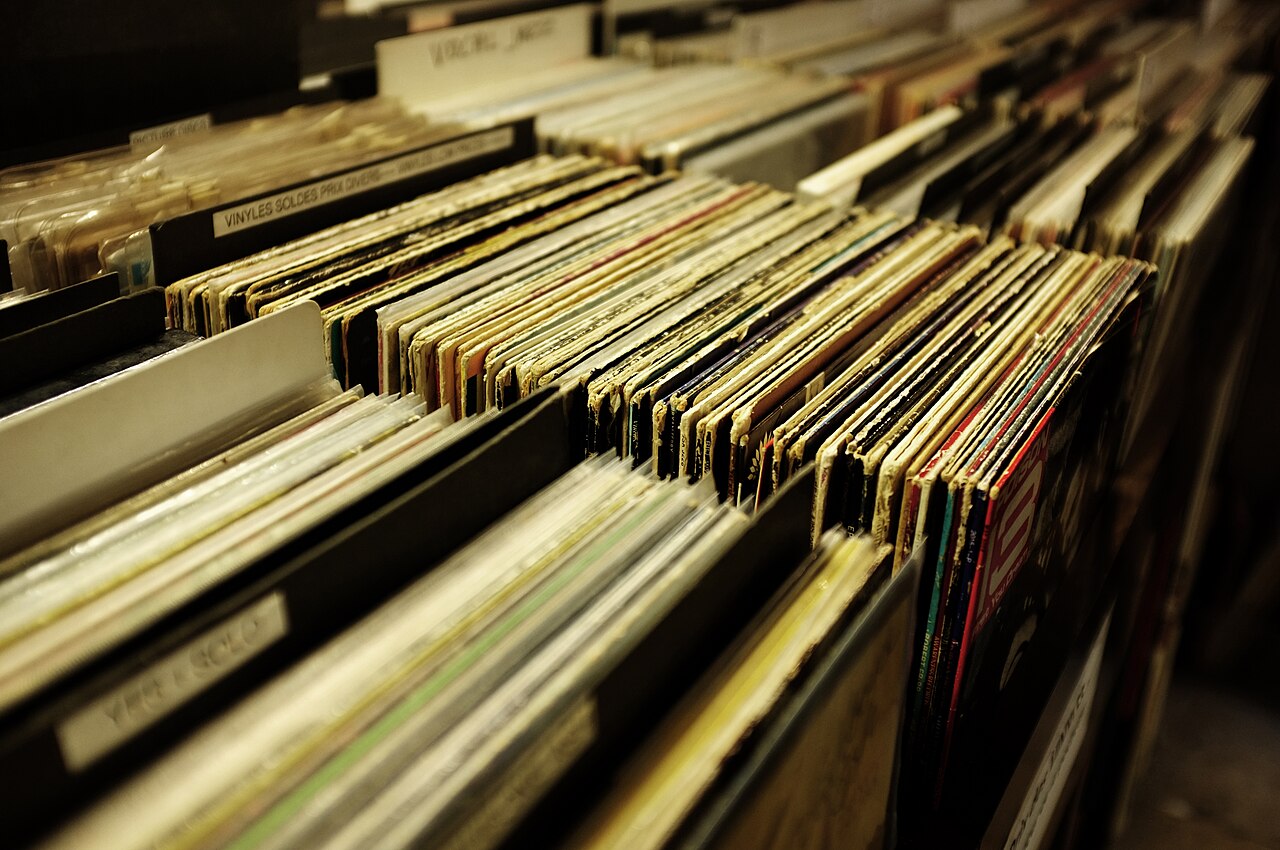
The physical mechanics shaped the culture. Promotional copies had to be pressed, boxed, delivered and tracked. Member DJs were expected to identify where they worked and report which records were effective. The club was a real-time listening laboratory, and the audience supplied the verdict. A dance floor could reject a new release, embrace an obscure B-side or make a record impossible for local radio to ignore. The label could respond with additional promotion, an extended mix or a more targeted campaign.
The system also created tensions. Record companies wanted trustworthy reports and distribution to active DJs, not a supply chain for people reselling free vinyl. Pool operators wanted access for under-recognized members, but they also had to enforce standards and handle hundreds of requests. A pool could expand opportunity while becoming its own selective club. That contradiction followed the industry into later decades and remains relevant whenever an artist pays for access to a professional DJ network.
Financial and organizational pressures eventually overwhelmed the pioneering New York Record Pool. Sources differ slightly on whether to date its collapse to late 1977 or early 1978, depending on whether they mean the operation’s breakdown or its final closure. The important point is not to manufacture a single exact date where the record is less tidy. Within only a few years, however, the idea had inspired independent pools across the country. The initial institution was short-lived; the practice proved durable.
Judy Weinstein and For The Record: the network that outlived disco
Judy Weinstein was among the people who understood that managing access was about relationships as much as record deliveries. After working with Mancuso’s operation, she established For The Record in 1978. Her new pool emerged alongside an increasingly sophisticated New York club circuit, including Paradise Garage, where Larry Levan became one of dance music’s most influential selectors. What Weinstein built was not simply a warehouse for advance records. It was a network where labels could reach discerning DJs and where DJs could compare techniques, discover music and make professional connections.
A detailed Red Bull Music Academy profile recalls how Weinstein’s office became a gathering place for DJs. The names connected with her operation illuminate its reach: Larry Levan, John “Jellybean” Benitez, Tony Humphries and, later, David Morales. Those are not interchangeable figures, but together they reveal the record pool’s link to clubs, radio, production and the music business. Weinstein understood how an act’s performance at a key venue could connect with DJs who were already shaping the next wave of records.
Morales became involved with the pool’s management in the 1980s and increasingly worked on remixes and production. Weinstein eventually moved into artist management, leading to the development of Def Mix, the influential management and production enterprise associated with Morales, Frankie Knuckles and others. A record-distribution business had evolved into an infrastructure for creative careers. The pool was therefore more than an early version of a download service. It offered mentorship, professional credibility and connections at an unusually fluid moment in music history.
For The Record operated until February 2008, according to that same historical profile. Its longevity is a useful corrective to the idea that record pools were merely a disco fad. New York’s nightlife tastes changed repeatedly, but the value of trusted DJ networks survived those changes. Meanwhile, other pools competed across the boroughs and surrounding region, often servicing different genres, venues and working communities.

The Bronx enters the record-pool story
Every history that stops at Mancuso and Weinstein leaves a major chapter underexplored. The formal first pool emerged from downtown dance culture, but other New York organizations became essential to the movement of soul, funk, freestyle and early rap across clubs and radio. The Bronx was not just the place where hip-hop was taking shape at parties. It was also a market where people who played records could help define which new urban sounds crossed over.
In a remarkable piece of contemporary reporting, Lillian Ross visited Bobby Davis and his operation, Spinners Unlimited Record Enterprises (SURE), for a New Yorker feature published in 1984. The profile located SURE above a beauty parlor on Westchester Avenue in the Bronx and described the weekly system of collecting records and feeding observations back to labels. It also reported that there were roughly two dozen record pools in the New York area at the time. These were contemporaneous estimates, not audited totals for every organization.
Davis viewed the professional DJ as an editor and experimenter, somebody who could extend a passage, emphasize a rhythmic element, remix material and make a crowd react differently to a familiar record. His account is valuable because it captures how the language of the club evolved toward the language of rap production. A twelve-inch single was more than a long song: it gave a DJ tools for turning an ordinary release into something that could live on the dance floor.
In that 1984 reporting, Davis credited SURE’s DJs with helping generate early momentum for Afrika Bambaataa’s Planet Rock. It is an assertion by a participant, not proof that a single pool independently created the hit. That difference matters. Rap’s breakthrough records emerged from artists, producers, DJs, dancers, promoters, clubs and stations interacting with one another. The pool was one influential channel within that wider circulation, not a magic switch a label could flip.
Raptology has its own rare perspective on the Bronx chapter. In an extended interview published in 2024, Al Pizarro discussed his involvement with SURE and later VIP, including how smaller-club DJs were sometimes shut out of prestigious promotional networks. He remembered wanting access to records for working DJs who could not meet elite venue requirements. Pizarro also recalled early records from labels such as Sugar Hill and Enjoy circulating through the networks he knew. His comments are firsthand oral history and should be understood as his recollections rather than an independently measured breakdown of who made every release successful.

A bridge between club culture, rap and radio
The connection between disco-era pools and hip-hop was neither simple nor universal. Different DJs served different audiences, and a prestigious downtown dance pool might be devoted to a very different sound from a Bronx organization supporting new rap singles. But both operated on the principle that DJs could move records from obscurity to demand. New York’s radio environment reinforced that process. Hip-hop grew through community and college broadcasts, mixes and emerging commercial programs as much as through traditional promotional channels.
The Hip-Hop Radio Archive documents this evolution through surviving 1980s and 1990s broadcasts, including the importance of Mr. Magic’s Rap Attack. Listening to old radio airchecks reminds us that a song’s journey was not always the linear path imagined by present-day marketing campaigns. A DJ might hear a test pressing, play it for dancers, pass it to another DJ and eventually help it reach a broadcast audience. Records moved through people and places before they moved through databases.
New York’s sound was also changing internally. Club mixing, hip-hop turntablism, freestyle, early electro, emerging house and radio remix culture did not occupy sealed compartments. A Red Bull Music Academy retrospective on 1980s New York radio traces how producers, DJs and stations shared techniques and material. Record pools functioned in this environment as access points for working DJs and as intelligence networks for promotion staff. Their value rested partly on the fact that the best members were deeply embedded in local scenes, not simply accumulating releases.
The limits of the analog system
The same qualities that made record pools valuable also limited them. Physical copies were expensive to produce and distribute; a label could not send a newly mastered track to thousands of DJs at the touch of a button. Membership vetting was uneven. Feedback could be insightful, but it could also reflect personal taste, competitive politics or a DJ’s desire to stay in favor with the pool and its record-company contacts. Labels had finite budgets and could not service every organization on the same terms.
That structure created powerful local gatekeepers. Pool directors could provide exposure to overlooked records, but their choices could also reinforce hierarchies around established clubs and DJs. When new styles emerged from communities outside those networks, specialized organizations and more inclusive operations could become especially important. It would be inaccurate to claim that all record pools functioned the same way. The New York market accommodated very different models, from highly selective downtown groups to borough operations that prioritized a wider range of working DJs.
By the 1990s, the wider music business was facing another technological change. Vinyl had already shared promotional space with other physical formats, and the rise of digital audio made remote distribution more practical. The crucial innovation was not simply moving a file faster. It was figuring out how to preserve trusted membership, promotional accountability and feedback without requiring a DJ to stand in a physical office and pick up a stack of records.
1998 to the mid-2000s: Digiwaxx gives the pool a digital address
One of the strongest connections between New York’s original record-pool tradition and the internet era is Digiwaxx. Corey Llewellyn and his collaborators began building the company in 1998, aiming to promote new music by linking labels and DJs through digital tools. The name itself fused the language of digital delivery with “wax,” the long-standing DJ shorthand for vinyl. It signaled continuity rather than a clean break from the record-pool past.
A Black Enterprise account describes Digiwaxx’s early investment and the move toward MP3 distribution. By late 2005, the company had introduced a more developed web system for supplying music to vetted DJs and collecting reactions. An AllHipHop report from the mid-2000s documented the service’s network and its promise of helping hip-hop artists and labels reach club, mixshow and broadcast tastemakers beyond their immediate geographic areas.
Digiwaxx’s trajectory should not be mistaken for the story of every digital pool. Its model emphasized getting promotional records into the hands of DJs and returning information to the campaign. Other platforms would increasingly focus on professional music libraries that DJs paid to access. Both owe something to the original record pool, but their economics can be different. The distinction matters for independent artists: a platform selling downloads to working DJs is not automatically the same thing as an active record-breaking campaign with reporting and outreach.
Nor did digital delivery erase the importance of relationships. A club DJ who receives hundreds of new tracks still has to decide what is worth auditioning and what makes sense for the room. The scarcity shifted. Vinyl copies had once been scarce; now attention became the resource that labels, publicists and independent artists were fighting to obtain.
INDEPENDENT ARTISTS: READY TO BE HEARD?
Raptology covers new voices and the stories behind the music. Explore editorial feature and music-submission opportunities.
2026: what a record pool means to working DJs now
By November 2026, the phrase “record pool” can describe several overlapping services. Some remain promotional networks in which artists or labels submit music to approved DJs. Others are paid download libraries that offer clean and explicit versions, extended intros, transition edits, instrumentals, acapellas, remixes and tools for preparing sets. A professional open-format DJ may use a pool alongside licensed download stores, personal collections, direct label servicing and streaming platforms. The record pool remains a specialized part of the workflow, not the sole source of music.
DJcity, founded in 2000, describes itself as a professional record-pool service offering DJ-ready music. BPM Supreme promotes an open-format and globally diverse catalog for New York DJs, including hip-hop, R&B, Latin, Afrobeats and dance music. Heavy Hits presents itself as a record pool and music-discovery service. Digital DJ Pool is another active provider, while Digiwaxx continues to emphasize music promotion and its DJ network. Their current websites establish the services’ existence, but their promotional claims should not be mistaken for independently verified results for artists.
This market is not frozen. Catalogs, rates, availability and subscription conditions change. Rather than print a price list that becomes stale, it is more useful to explain what a DJ should verify: the genres and markets covered, actual downloadable file formats, clean and intro edits, catalog recency, search quality, eligibility rules, cancellation terms and whether the service is oriented toward performance downloads or promotional submissions. The features that matter to a wedding DJ playing an open-format room can be very different from those a specialist hip-hop mixshow DJ needs.
One limitation is especially important. DJcity’s own 2026 support documentation explains that its promotional licenses restrict the availability of certain tracks. In other words, joining a pool does not mean gaining permanent access to every recording ever made. A DJ’s legal, usable library may require several sources. That is a modern echo of the original record-pool problem: access depends on licensing, rights holders, eligibility and the way the intermediaries operate.
New York remains a useful test case because its DJs navigate multiple scenes and languages. From Bronx hip-hop parties and Harlem nightlife to Brooklyn clubs and Manhattan open-format venues, one fixed chart may have limited value. The most effective music libraries and tastemaker networks respond to the realities of those communities. The city where record pools began still shows why a mere quantity of downloadable tracks cannot replace context, curation or local knowledge.
What independent rappers should learn from the record-pool era
For an independent rapper, the lesson is not that a DJ pool guarantees a hit. It never did. The 1975 experiment solved a distribution and feedback problem for working DJs, and later iterations solved new versions of the same problem. Access creates the possibility of discovery; it does not force a DJ to play a record or listeners to respond. Any marketing package that promises predetermined spins or treats membership as guaranteed radio rotation deserves close scrutiny.
A practical campaign starts with a song that has a clear audience and properly cleared promotional assets. DJs may need explicit and clean edits, an instrumental or performance-friendly intro, accurate metadata and a meaningful contact for follow-up. Artists should ask whether a service actually distributes tracks to relevant DJs, how members are screened, whether there is substantive feedback, how reports are delivered and whether the opportunity is promotional placement or simply availability in a catalog. Those are different deliverables.
It is equally important to avoid confusing correlation with causation. A song that rises while DJs are playing it may also be benefiting from touring, radio, regional fan support, social media, streaming and other promotion. A credible service can document what it delivered and what feedback it received. It should not claim responsibility for every listener, playlist or sale without evidence. Pool reports, like modern campaign analytics, are most useful when interpreted in context.
Raptology’s broader feature DJ Record Pools and the Rise of Rap Promotion examines the national promotion model and digital networks. The present account focuses on the New York founding, the people who built the infrastructure, and the way that infrastructure intersected with hip-hop’s emergence. Together, the histories explain why DJs still occupy a distinctive position between the music business and the audience.
SUPPORT INDEPENDENT HIP-HOP JOURNALISM
Researching and preserving the stories behind hip-hop requires time, source work and independent editorial judgment. Help Raptology continue documenting the culture.
The original pool’s greatest legacy was collective influence
The founding DJs did not invent record promotion, and they did not invent musical taste. They did something arguably more consequential: they organized workers whose influence had been undercounted by an industry that relied on them. The New York Record Pool showed labels that local dance floors mattered, while For The Record, SURE and other organizations revealed how different communities could build their own channels of discovery. The pioneering organization itself did not survive very long, but its operating principle spread widely.
That legacy complicates the idea that today’s record pools are merely Spotify alternatives for people who want MP3s. The technology is a delivery method. What made the first pool significant was the recognition of DJs as skilled intermediaries with knowledge, audiences and negotiating power. In 2026, software can send a file anywhere instantly. Trust cannot be uploaded at the same speed. The ability to hear something early matters only when someone with judgment is willing to play it, contextualize it and put it before the right people.
New York’s pool story began with boxes of vinyl and arguments about who deserved a copy. It continues in networks, libraries, mixshows and artist campaigns spanning genres and continents. Behind that evolution remains an old New York truth: a record becomes part of culture when actual people decide it is worth passing on.
Related Raptology reading
Exclusive Interview with Al Pizarro: SURE, VIP and Early Record Pools
DJ Record Pools and the Rise of Rap Promotion
Research notes: This history draws on Tim Lawrence’s published research, scholarship on the record-pool business, contemporary reporting from The New Yorker, the oral histories of David Mancuso and Judy Weinstein, Raptology’s interview with Al Pizarro, and documented coverage of Digiwaxx and current DJ services. Statements made by interviewees about their influence are attributed rather than independently assumed to be measurable outcomes. Historic membership figures and estimates describe their original periods, not the 2026 industry.
Raptology Editorial is the official newsroom voice of Raptology, covering breaking hip-hop news, artist developments, industry trends, and in-depth editorial reports from across the global rap landscape.


Leave a Reply