
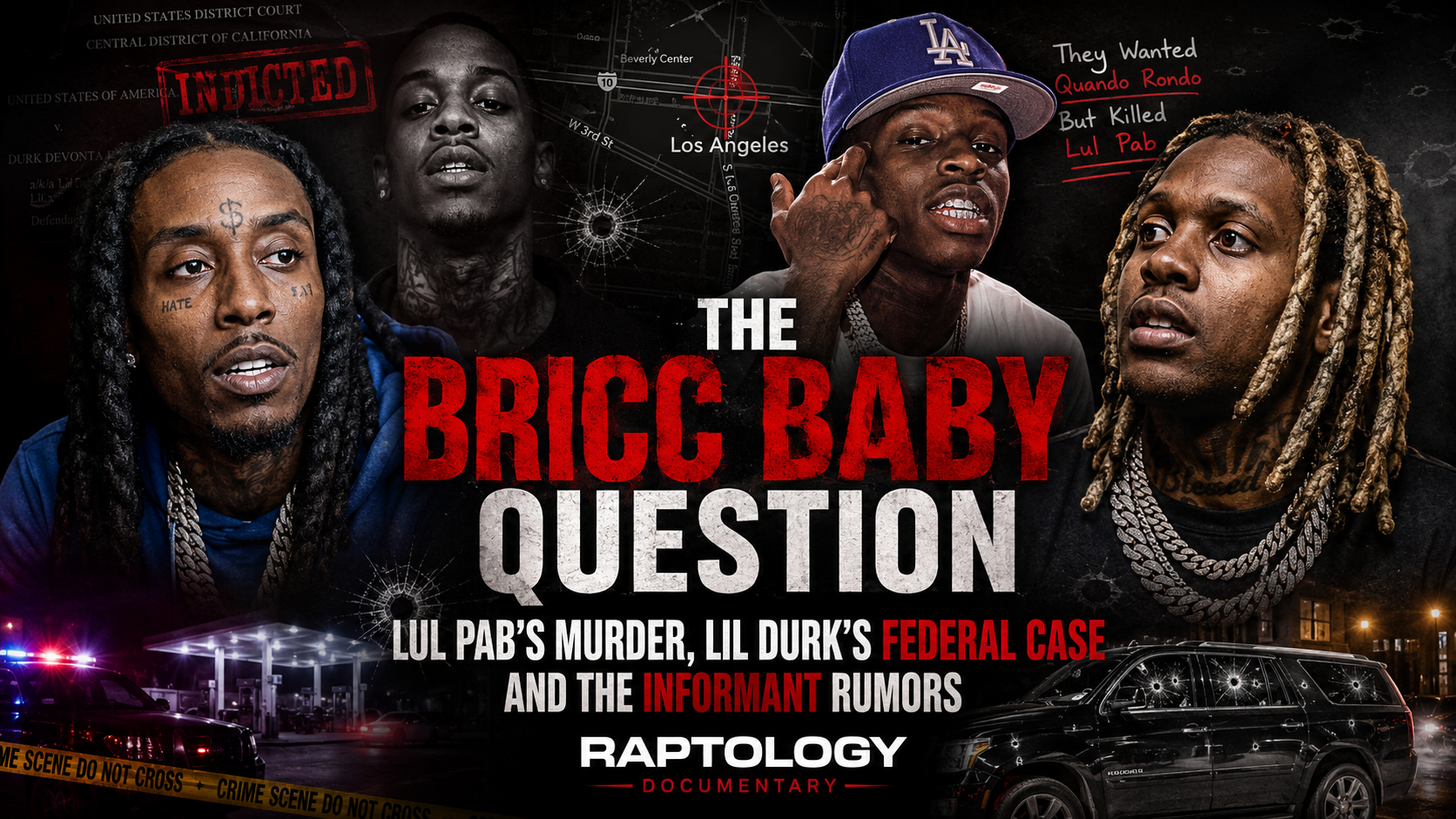
When federal prosecutors accused Lil Durk and five alleged associates of participating in a murder-for-hire conspiracy targeting Quando Rondo, the indictment appeared to confirm that the conflict surrounding King Von’s death had not ended outside the Atlanta nightclub where he was killed.
The alleged retaliation surfaced nearly two years later in Los Angeles. Quando Rondo survived. His close friend and cousin, Saviay’a “Lul Pab” Robinson, did not.
Another name soon entered the online investigation even though it was not included among the defendants publicly identified by federal prosecutors: Los Angeles rapper and Rolling 60s member Bricc Baby.
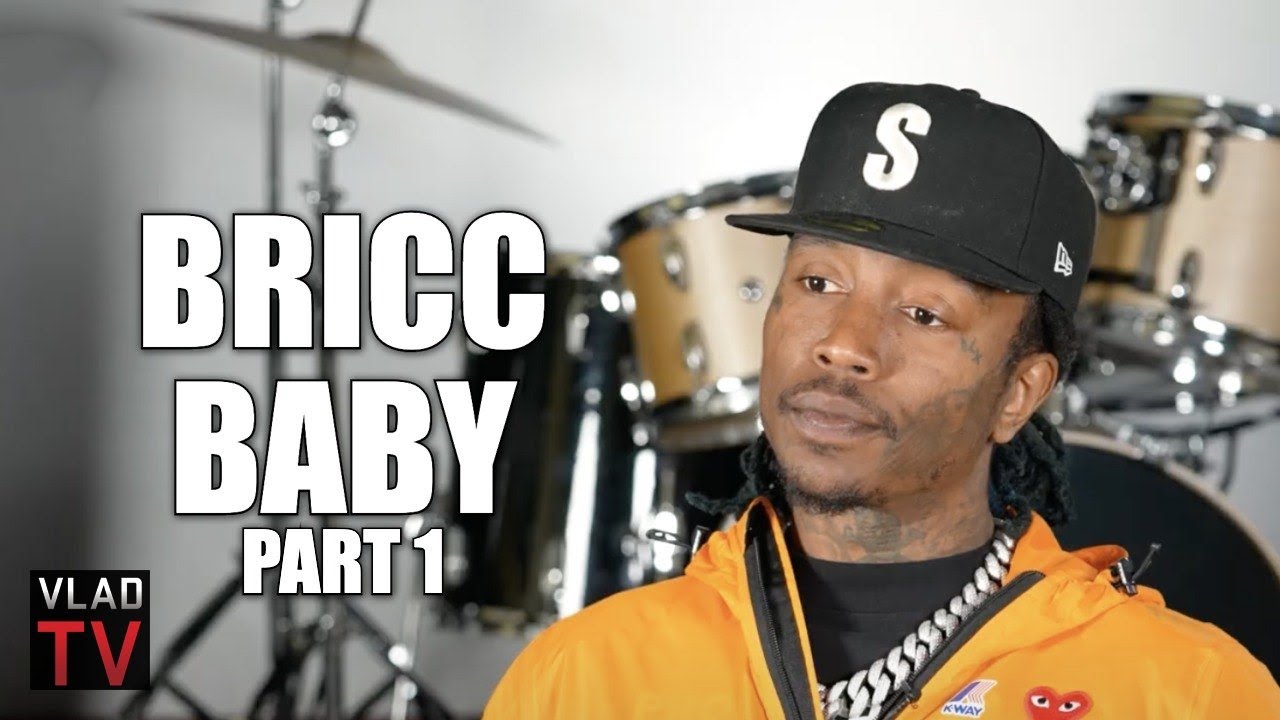
Bricc Baby’s friendship with Durk, his public hostility toward Quando, his reputation as an industry-connected Los Angeles street figure and his own provocative podcast comments created a theory that spread rapidly across YouTube and social media.
Some commentators went further, claiming that Bricc Baby helped locate Quando, facilitated the attack and later cooperated against Durk after facing his own federal gun case.
The public record does not establish those claims. The federal indictment does not identify Bricc Baby as a defendant, shooter, organizer or informant. No publicly available cooperation agreement reviewed by Raptology states that he provided evidence against Durk.
Editorial note: Lil Durk and the other defendants are presumed innocent unless proven guilty. Durk has pleaded not guilty. This documentary distinguishes federal allegations, confirmed public statements and online theories. Bricc Baby is not identified as a participant or informant because the public record does not establish either claim.
Bricc Baby addresses the online theory that he was an unnamed co-conspirator who helped locate Quando Rondo. Watch directly on YouTube.
Who Is Bricc Baby?
Bricc Baby, also known as MPA Shitro, has described himself as a Los Angeles Rolling 60s member with longstanding connections across the rap industry. His public story moves between South Los Angeles, Atlanta, street activity, prison sentences, artist management and podcast notoriety.
According to his own interviews, he was born Zaire Mitchell and grew up around the Overhill section associated with the Rolling 60s. He has said that he attended private school, played competitive basketball and maintained strong grades while becoming increasingly involved in neighborhood activity.
The tension between those identities is central to his story. On one side was a young athlete with access to education and opportunities beyond his neighborhood. On the other was a teenager who says he was already immersed in robberies, extortion and the hierarchy of a nationally recognized street organization.
Bricc Baby has also described early proximity to the Black Mafia Family network through relatives and later relationships in Atlanta. The source narrative portrays him as moving between Los Angeles and Atlanta while developing connections to artists including Peewee Longway, Young Thug, Future, Migos and Lil Durk.
Some of those details come primarily from Bricc Baby’s own storytelling and cannot all be independently verified. What is clear is that he built a public identity around access to both rap celebrities and street politics.
Listen to Bricc Baby’s official Spotify catalog. Open Spotify directly.
From Basketball Prospect to a Life in the Streets
The supplied documentary narrative describes Bricc Baby as a promising basketball player whose athletic path repeatedly collided with criminal cases. It recounts an early weapons arrest in Mississippi, enrollment at Clark Atlanta University and another arrest after he was allegedly caught transporting marijuana through Georgia.
He later returned to Los Angeles, where he says he was shot in the neck and temporarily paralyzed. According to his account, doctors initially told him he might never walk again. Months of treatment and rehabilitation eventually restored his mobility.
That experience could have ended his involvement in street life. Instead, Bricc Baby has described returning to Atlanta and helping expand Rolling 60s influence there. He developed relationships with local artists and became part of MPA, short for Money, Pounds and Ammunition, alongside Peewee Longway and others.
His music-industry role was never easy to separate from his street reputation. Bricc Baby has repeatedly claimed he helped artists find studios, local protection and access to Los Angeles. In his telling, he was one of the people rappers contacted before arriving in the city.
Bricc Baby’s official “Not Enough” video later became part of the online discussion because listeners interpreted several bars as references to the Los Angeles attack. Lyrics alone do not prove participation. Watch on YouTube.
The King Von Shooting That Changed Everything
On November 6, 2020, King Von was killed following a confrontation outside the Monaco Hookah Lounge in Atlanta. Surveillance footage showed the Chicago rapper’s group encountering Quando Rondo’s circle before a physical fight escalated into gunfire.
Timothy “Lul Tim” Leeks, an associate of Quando Rondo, was initially charged in connection with Von’s death. The case later ended without a conviction after prosecutors dropped the charge, but the cultural consequences had already spread beyond the courtroom.
Von was not simply another rapper in Lil Durk’s orbit. He had become one of OTF’s most important artists and one of drill music’s strongest storytellers. His death turned an artist rivalry into a loyalty test debated in music, interviews and social-media posts.
Quando Rondo and Lul Tim were placed on one side. Lil Durk, OTF and Von’s supporters were placed on the other. Whether everyone involved wanted that division or not, the internet made neutrality almost impossible.
Raptology Documentary King Von: The Night Atlanta Changed Drill ForeverBricc Baby Chooses Durk Over Quando Rondo
Bricc Baby’s place in the controversy begins with his own public position. Despite his Rolling 60s identity and Quando Rondo’s association with a Rolling 60s set in Georgia, Bricc Baby made clear in interviews that his loyalty was with Lil Durk.
He argued that Quando was not part of the Los Angeles Rolling 60s structure and dismissed the idea that shared gang affiliation required him to support the Savannah rapper.
Critics saw that as a contradiction. Bricc Baby had publicly spoken about the expansion of Los Angeles gang culture into Atlanta, yet appeared to deny legitimacy to an out-of-state member when loyalty to Durk became more important.
Bricc Baby discusses Quando Rondo, NBA YoungBoy and his relationship with Lil Durk. Watch directly on YouTube.
That position became more significant after the 2022 Los Angeles shooting. Commentators began reexamining everything Bricc Baby had said about Quando, Durk and the meaning of loyalty.
August 19, 2022: The Beverly Grove Ambush
On August 19, 2022, Quando Rondo and members of his entourage were traveling in Los Angeles. At approximately 5:30 p.m., their black Cadillac Escalade stopped at a gas station near Beverly and La Cienega boulevards, across from the Beverly Center.
According to federal prosecutors, individuals associated with OTF had traveled to Los Angeles after learning that Quando was in the city. Prosecutors allege that flights, hotel rooms, rental vehicles and other expenses were arranged as part of a murder-for-hire operation.
Federal filings identify Kavon London Grant, also known as Vonnie; Deandre Wilson, also known as DeDe; Keith Jones, also known as Flacka; David Lindsey, also known as Browneyez; and Asa Houston, also known as Boogie, as defendants alongside Durk.
Prosecutors allege that members of the group followed Quando’s vehicle through Los Angeles. At the gas station, multiple shooters allegedly approached and opened fire. The Escalade was struck repeatedly.
Quando survived. Saviay’a “Lul Pab” Robinson was shot and later died at a hospital.
News coverage of the Los Angeles shooting involving Quando Rondo’s entourage. Watch directly on YouTube.
Television footage showed Quando outside the damaged vehicle in visible distress as emergency responders worked at the scene. The images became part of rap history: an artist who had already lived through one nationally dissected shooting now watching another close friend die.
Timeline of the Federal Case
King Von was fatally shot after a confrontation involving Quando Rondo’s circle outside an Atlanta nightclub.
Prosecutors allege that individuals associated with OTF traveled to Los Angeles after learning that Quando Rondo was in the city.
Gunmen opened fire on the Escalade carrying Quando and his entourage. Quando survived, but Lul Pab was killed.
Five alleged OTF associates were arrested and charged in the murder-for-hire case.
Lil Durk was arrested near Miami International Airport after federal authorities learned he had been booked on international flights.
A superseding indictment added Durk as a defendant and charged him with conspiracy, murder-for-hire resulting in death and firearms offenses.
Durk pleaded not guilty. The allegations have not been proven at trial.
What Prosecutors Say Durk Did
The Justice Department alleges that Durk placed a monetary bounty on Quando Rondo following King Von’s death. Prosecutors claim that people associated with OTF were offered money and music opportunities to kill him.
The indictment describes interstate travel, rental cars, hotel reservations, firearms and the alleged use of an OTF-linked credit card. Prosecutors say those resources were used to carry out the Los Angeles operation.
According to the government, Grant handled major logistical arrangements. The alleged participants flew into California, obtained vehicles and tracked Quando’s movements before the shooting.
Durk is accused of helping direct and finance the plot. His attorneys have denied the accusations, and he entered a not-guilty plea.
An indictment presents the government’s theory. It is not a conviction. The prosecution must prove its claims beyond a reasonable doubt.
Primary Source Read the U.S. Department of Justice release describing the superseding indictmentThe Mystery of the Unnamed Co-Conspirators
The government’s narrative includes unnamed people who allegedly assisted with parts of the operation. Online analysis has focused on unidentified figures said to have helped locate Quando, provide firearms or facilitate payments.
That anonymity created an information vacuum. Commentators began comparing the unnamed roles to people publicly connected to Durk and Los Angeles.
Bricc Baby became a focus because he appeared to fit several surface-level criteria. He knew Durk. He was based in Los Angeles. He publicly opposed Quando. He had described himself as someone with access to visiting rappers. He had longstanding Rolling 60s connections and later made statements that listeners interpreted as inside knowledge.
But fitting an internet profile is not the same as being identified through evidence. Federal prosecutors have not publicly named Bricc Baby as an unnamed co-conspirator.
The Comment That Fueled Suspicion
Following the Los Angeles shooting, Bricc Baby appeared in interviews where OTF, Quando Rondo and retaliation entered the conversation.
In one widely circulated exchange, he suggested that critics could no longer say OTF had failed to retaliate for King Von. Viewers interpreted the remark as connecting Lul Pab’s death to revenge for Von before the federal case publicly laid out that allegation.
The statement became more consequential after Durk’s arrest. Commentators replayed it as possible evidence that Bricc Baby knew more than the public.
There are several possible explanations. He could have possessed direct knowledge. He could have repeated street rumors. He could have made an assumption based on the circumstances. He could also have exaggerated his access to appear informed.
His public persona makes exaggeration impossible to ignore. Bricc Baby often speaks in a provocative style built around street credibility and implied knowledge. That may generate attention, but it makes it difficult to separate reliable information from performance.
Did He Admit He Would Have Helped?
Another clip intensified the theory when Bricc Baby discussed the idea of providing an address to a friend. He questioned what would be wrong with giving his friend the location of someone connected to the death of that friend’s associate.
Critics interpreted the statement as an indirect admission. Legally, it was not one.
Saying that one hypothetically would assist does not prove that one did. It may reveal loyalty, intent or recklessness, but without corroborating evidence it does not establish participation in the 2022 conspiracy.
Still, the comment damaged Bricc Baby’s ability to distance himself from the theory. He publicly described the alleged conduct as something he might not consider unacceptable. Once he placed himself that close to the possibility, every other part of his history became suspicious to online investigators.
The Lyrics Treated as Evidence
The source narrative points to lyrics in “Not Enough” that reference a target attempting to hide, a large number of shots and a payment of more than $1 million.
Rap lyrics are frequently treated by online audiences as autobiographical evidence. Prosecutors have also attempted to use lyrics in criminal cases, creating debate about artistic expression, exaggeration and prejudice.
Lyrics can reflect real knowledge, but they can also borrow from public events, rumors or established rap conventions. Referencing 100 shots after a widely reported shooting does not prove participation.
Without supporting messages, financial records, location data, witness testimony or physical evidence, the lyrics remain suggestive rather than conclusive.
The Calabasas Raid and the Informant Theory
The most serious accusation is not merely that Bricc Baby helped arrange the attack. It is that he later cooperated with investigators and provided information that contributed to Durk’s indictment.
The supplied narrative claims federal agents monitored Bricc Baby before raiding his Calabasas residence in 2023, where a firearm was allegedly recovered despite his status as a convicted felon. It then argues that the apparent resolution or disappearance of that case indicates cooperation.
That conclusion is not supported by a publicly available cooperation agreement, plea filing or government statement reviewed for this documentary.
Criminal cases can be delayed, transferred, declined, reduced, sealed or resolved for reasons unrelated to informing. Avoiding the sentence expected by online spectators is not proof of cooperation.
Wack 100 and other commentators have speculated that Bricc Baby either cooperated or drew investigators toward OTF through his comments. Those remain opinions.
Bricc Baby addresses the allegation that he informed on Lil Durk. His denial does not independently settle the question, but no public court record currently establishes cooperation. Watch directly on YouTube.
Could His Interviews Have Helped Without Formal Cooperation?
This is the more defensible question.
A person does not need to sign an informant agreement to provide investigators with useful material. Public interviews, livestreams, songs and social-media posts can be reviewed without the speaker’s cooperation.
If Bricc Baby publicly connected Lul Pab’s killing to retaliation for King Von, investigators could compare that statement with evidence they already possessed. If he described relationships, timelines or motives, those remarks could suggest areas worth examining.
That would not necessarily make him a formal informant. It would make him a public figure whose words became potentially relevant evidence or an investigative lead.
Why the Theory Became Believable
Why Online Investigators Focused on Bricc Baby
- He publicly described a close relationship with Lil Durk.
- He identified himself with the Los Angeles Rolling 60s.
- He rejected Quando Rondo despite Quando’s Rolling 60s affiliation.
- He described himself as someone with access to visiting rappers in Los Angeles.
- The attack occurred in Los Angeles, where he had longstanding connections.
- He made remarks interpreted as connecting the attack to retaliation for King Von.
- He discussed hypothetically sharing someone’s location with a friend.
- Federal filings refer to unnamed participants whose identities were not publicly disclosed.
- His own federal legal trouble created speculation that he had leverage to trade.
Together, those points create a compelling documentary theory. Separately, none proves the accusation.
True-crime content often moves from pattern recognition to certainty too quickly. Once a person appears to fit a narrative, every statement becomes confirmation. Contradictory evidence disappears, and the absence of evidence is reinterpreted as proof that records are sealed.
That approach can produce entertaining videos. It can also falsely accuse people of murder and federal cooperation.
Quando Rondo Answers the Bricc Baby Narrative
Quando Rondo later discussed Bricc Baby, Lul Pab’s death and the larger conflict in a public interview. His appearance offered another perspective on a story often told almost entirely through OTF supporters, Los Angeles personalities and federal allegations.
Quando Rondo discusses Bricc Baby, Lul Pab’s death and the King Von case. Watch directly on YouTube.
After Lul Pab’s death, Quando posted messages that appeared to distance himself from the Rolling 60s identity. Observers interpreted the posts as evidence that he believed people within the broader affiliation had betrayed him.
That interpretation fed directly into the Bricc Baby theory. If Quando believed Los Angeles Rolling 60s figures had assisted his enemies, Bricc Baby appeared to be the most visible person connecting Durk to that world.
But social-media posts made during grief are not precise legal statements. Quando did not publicly provide evidence identifying Bricc Baby as the person who located him.
Listen to Quando Rondo’s official Spotify catalog. Open Spotify directly.
Lul Pab Became the Casualty of a War Aimed at Someone Else
The federal case centers on an intended target who survived and a passenger who died.
Lul Pab was not the person prosecutors say the alleged conspirators intended to kill. Yet his death is the reason the murder-for-hire charge carries such severe consequences.
Footage showed Quando outside the damaged Escalade, overwhelmed as emergency responders worked. The moment stripped away the online language of “sliding,” “get back” and gang allegiance. What remained was a man watching his family member die.
That reality is often lost when the case is reduced to Durk versus Quando, OTF versus NBA YoungBoy or Chicago versus Savannah. Lul Pab becomes a supporting character in someone else’s retaliation narrative.
His death deserves to remain at the center of the story.
Get Featured on Raptology
Raptology covers emerging artists, hip-hop history and the stories shaping rap culture. Artists, managers and publicists can submit music for editorial consideration.
Submit Your MusicLil Durk’s Career Reaches a Federal Crossroads
Before his arrest, Lil Durk’s career had evolved from Chicago drill survival into mainstream recognition. He crossed into melodic rap, major collaborations and Grammy-winning success while maintaining the emotional identity that made his early music resonate.
Durk built OTF into a label, collective and cultural brand. King Von’s rise strengthened that empire, but Von’s death became one of its deepest wounds.
The indictment asks a jury to accept a darker interpretation of that loyalty. Prosecutors allege that OTF was not only a music organization but an association whose resources were used to facilitate violence.
The defense is expected to challenge the government’s interpretation of OTF, Durk’s communications and the financial evidence. Association with defendants and payment of ordinary label expenses do not automatically prove authorization of murder.
Lil Durk’s Grammy-winning era presented him as an artist attempting to outgrow the image attached to his past. Watch “All My Life” on YouTube.
Listen to Lil Durk’s official Spotify catalog. Open Spotify directly.
Raptology Documentary Lil Durk: The OTF Empire, Chicago Loss and the Federal Case That Changed EverythingWhat Would Be Needed to Prove the Bricc Baby Theory?
A responsible investigation would require more than clips and circumstantial connections.
Relevant evidence could include phone records showing communication with alleged participants during the planning period, location data placing him with organizers, financial records connecting him to payments, surveillance showing meetings, messages discussing Quando’s movements or testimony from a cooperating defendant.
To prove the informant allegation, there would need to be a cooperation agreement, plea arrangement, government filing, courtroom testimony, disclosure from attorneys or reliable reporting based on confirmed sources.
None of that is presently established in the public materials reviewed for this article.
The possibility that additional evidence remains sealed cannot be ruled out. Journalism, however, cannot treat hypothetical sealed evidence as proof.
The Danger of Self-Incrimination as Entertainment
Bricc Baby’s story illustrates a broader problem in modern hip-hop media. Podcast platforms reward the person willing to say the most explosive thing. Street figures are encouraged to name enemies, discuss crimes, reveal relationships and imply inside knowledge because controversy generates views.
The interview may feel informal, but nothing said online disappears. Law enforcement can watch the same clips as fans. Prosecutors can compare statements with timelines. Defense attorneys can use contradictions. Civil litigants can preserve admissions.
A speaker may believe he is strengthening his reputation while unintentionally helping investigators understand the relationships around a case.
Even false bragging can create consequences. Claiming knowledge of a murder may lead agents to investigate someone who had no involvement. At minimum, it forces the speaker to explain why he appeared to know details before they became public.
Three Stories Blended Into One
The online theory combines three separate stories.
The first is Bricc Baby’s biography: Los Angeles gang affiliation, Atlanta music relationships, arrests, prison sentences and a reputation for confronting or extorting rappers.
The second is the alleged OTF murder-for-hire plot: Durk’s grief over King Von, Quando’s presence in Los Angeles, interstate travel, rental vehicles, firearms and the fatal shooting of Lul Pab.
The third is the informant rumor: Bricc Baby’s federal gun exposure, comments about the shooting and speculation that he traded information for relief.
Placing those stories beside one another creates a powerful narrative. It does not automatically create a provable chain of events.
The Questions the Indictment Still Does Not Answer
Who first learned that Quando was in Los Angeles? How was his vehicle located? Who communicated his movements to the alleged shooters? Who supplied the firearms? Who arranged any payment after the attack? Were all alleged participants motivated by money, loyalty or both?
Those questions may be answered through trial evidence, cooperating witnesses or future filings. They may also remain partly obscured if defendants enter plea agreements or evidence stays sealed.
Bricc Baby’s name will likely remain attached to the mystery because he publicly placed himself near its emotional and geographic center. He was Durk’s friend, a Los Angeles Rolling 60s figure and an outspoken opponent of Quando.
But proximity is not guilt.
No Proof of Informing, but Plenty of Loose Talk
The headline claim promoted by some online videos is that Bricc Baby arranged the attack and later informed on Durk. The available public evidence does not support stating either allegation as fact.
What the record supports is more nuanced. Bricc Baby made public comments that appear reckless in light of the indictment. He openly sided with Durk. He entertained the morality of providing a location. He appeared to connect Lul Pab’s death to retaliation for King Von. His background and Los Angeles relationships made the theory believable to viewers.
Those statements may have created investigative interest. They may become relevant if future evidence connects him to unnamed figures. They may also amount to a street-media personality talking beyond what he could prove.
Until prosecutors, court filings or reliable reporting identify him, the honest conclusion is that the theory remains unresolved.
Enter the Raptology Rap Contest
Independent artists can compete for visibility, audience recognition and a chance to be featured across the Raptology platform.
Enter the Rap ContestReader Poll
What do Bricc Baby’s public comments most strongly suggest?
The Verdict Belongs to Evidence, Not the Internet
The Lul Pab case exists at the intersection of grief, rap celebrity, street loyalty and federal prosecution. That combination makes it irresistible to online investigators. Every interview becomes a clue. Every lyric becomes an admission. Every friendship becomes a conspiracy.
Sometimes the internet notices connections that later become important. It can also create guilt through repetition.
Lil Durk faces grave federal allegations, but he has pleaded not guilty. Five co-defendants face their own charges and retain the same presumption of innocence. Bricc Baby has not been publicly charged in the murder-for-hire case.
The responsible conclusion is not that he definitely arranged the attack or definitely cooperated. It is that his own comments, relationships and reputation placed him inside a cloud of suspicion that only evidence can resolve.
For Lul Pab’s family, the case is not a theory. A young man died at a Los Angeles gas station because someone decided that retaliation was worth more than another life.
That remains the central fact, no matter which names eventually appear in court.
Reporting, Interviews and Media Sources
- U.S. Department of Justice: Lil Durk charged in superseding murder-for-hire indictment
- U.S. Department of Justice: Lil Durk arrested on federal complaint
- ABC7 Los Angeles: Quando Rondo mourns friend killed near Beverly Center
- Associated Press: Lil Durk charged in 2022 Los Angeles killing
- Pitchfork: Lil Durk pleads not guilty
- Bricc Baby addresses the Quando Rondo location allegation
- Bricc Baby addresses allegations that he informed on Lil Durk
- Quando Rondo discusses Bricc Baby, Lul Pab and King Von
- Bricc Baby: “Not Enough” official music video
- Bricc Baby official Spotify profile
- Lil Durk official Spotify profile
- Quando Rondo official Spotify profile
Raptology Editorial is the official newsroom voice of Raptology, covering breaking hip-hop news, artist developments, industry trends, and in-depth editorial reports from across the global rap landscape.
Leave a Reply