
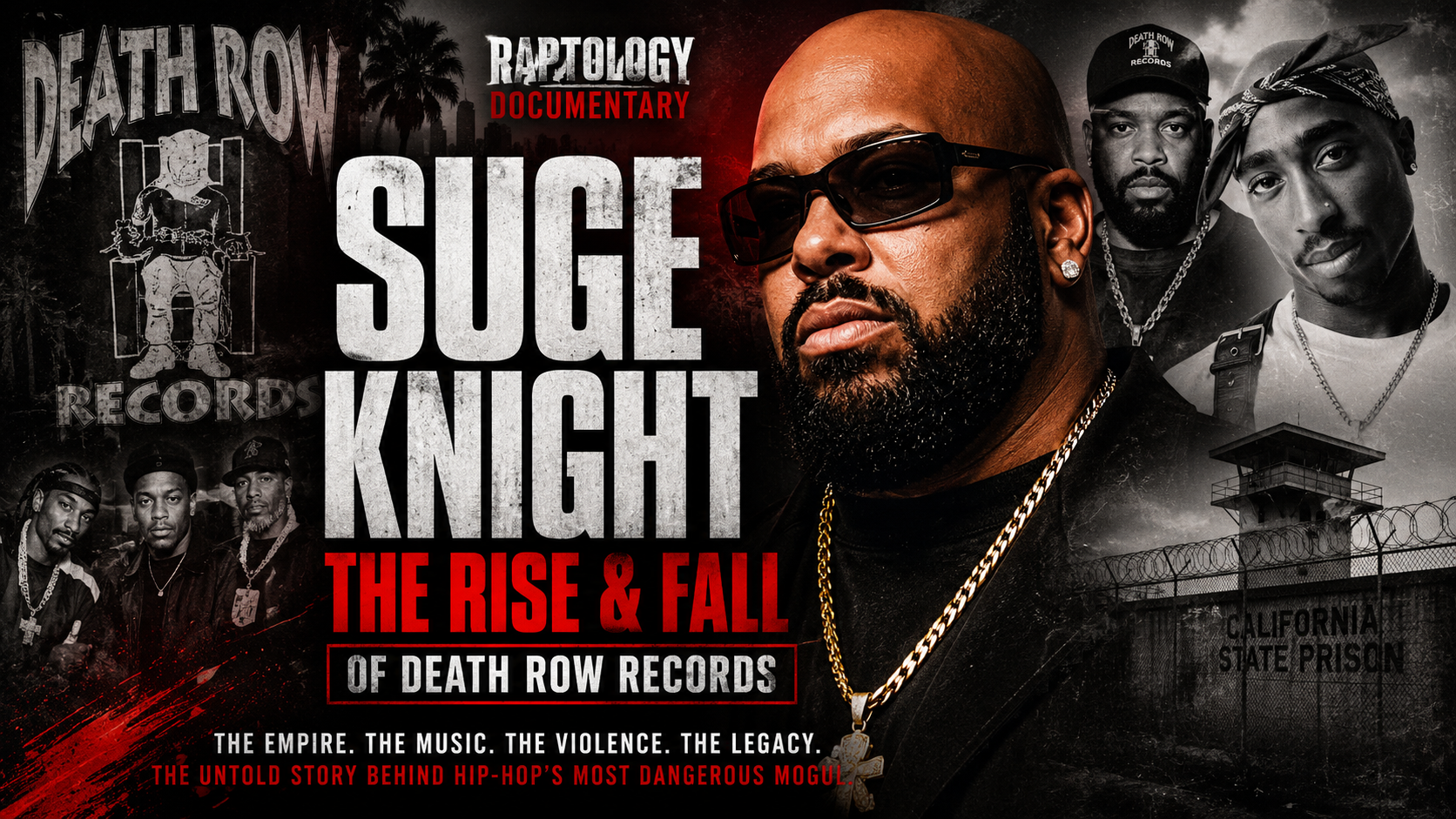
In the 1990s, Suge Knight was not just a record executive. He was a symbol of power, fear, money, street politics, and the dangerous mythology that surrounded Death Row Records at its peak.
Before streaming numbers, viral rollouts, and social media campaigns defined rap success, Death Row Records moved like an empire. The label’s music was everywhere. Dr. Dre’s production changed the sound of hip-hop. Snoop Dogg became one of the most recognizable voices in the world. Tupac Shakur turned his final creative run into a cultural earthquake. At the center of it all stood Marion “Suge” Knight, a former football player from Compton who understood that intimidation could be turned into leverage, and leverage could be turned into business.
For a brief period, Suge Knight looked untouchable. Death Row had the records, the artists, the image, and the fear factor. But the same energy that made the label feel unstoppable also made it unstable. Behind the platinum plaques came lawsuits, assaults, prison terms, parole violations, bankruptcy, violent feuds, and eventually the 2015 hit-and-run case that sent Knight to prison for decades.

Get Featured On Raptology
Independent artists, managers, and labels can submit music for editorial coverage, interviews, and promotional visibility across Raptology.
Submit Your MusicFrom Compton Football Player To Music Industry Enforcer
Suge Knight did not begin as a traditional music executive. He was born in Compton, California, and earned the childhood nickname “Sugar Bear,” later shortened into “Suge.” Before the music business, football was his path. He played at the college level and briefly appeared with the Los Angeles Rams during the 1987 NFL players’ strike as a replacement player.
That football background mattered. Suge was physically imposing, and in entertainment circles that became part of his identity. After football, he moved into security, concert promotion, and music publishing. He worked around artists and learned the business from the ground up, not through a corporate ladder but through proximity to celebrity, nightlife, street relationships, and the complicated economy around publishing rights.
By the late 1980s and early 1990s, Knight had already developed a reputation for aggression. The transcript source behind this documentary describes early arrests and allegations tied to violence, including domestic violence claims, weapons issues, and battery accusations. The details of some early incidents vary across retellings, but the larger pattern became impossible to ignore: Suge’s public image was built around force long before Death Row Records became famous.
Raptology Documentary note: Suge Knight’s story is not simply a crime story. It is also a music business story about how fear, ownership, artist control, and street credibility collided during hip-hop’s most explosive commercial decade.
The Vanilla Ice Story And The Creation Of A Legend
One of the stories that turned Suge Knight into industry folklore involved Vanilla Ice and the publishing connected to “Ice Ice Baby.” According to the long-repeated version, Suge and associates pressured Vanilla Ice over royalties connected to songwriter Mario “Chocolate” Johnson, who claimed a role in the song’s creation.
Over time, that story became exaggerated into one of rap’s most infamous business legends: Suge allegedly held Vanilla Ice over a hotel balcony to force him to sign over publishing. Vanilla Ice has disputed the most extreme versions of the story while still describing the encounter as threatening. Whether the balcony details happened exactly as legend says or not, the point became larger than the incident itself. Suge was now viewed as a man who could turn a music publishing dispute into a moment of fear.
That reputation became currency. In a business where artists often got trapped in bad contracts and executives fought over rights, Suge offered something different: protection, pressure, and a willingness to confront people directly. For some artists, that made him useful. For others, it made him dangerous.
The Birth Of Death Row Records
Death Row Records was founded in 1991 by Suge Knight, Dr. Dre, The D.O.C., and Dick Griffey. The timing was perfect. N.W.A had cracked open the mainstream door for gangsta rap, but internal conflict had fractured the group. Dr. Dre, one of the most important producers in the genre, needed a new platform. Suge needed a superstar creative force. Together, they built a label that would define West Coast rap for the next several years.

Death Row’s early success was almost immediate. Dr. Dre’s 1992 album “The Chronic” became a landmark release, bringing G-funk to the center of American popular music. The album was smooth, cinematic, bass-heavy, and unmistakably West Coast. It made Dre a solo superstar and introduced Snoop Doggy Dogg as the label’s next major voice.
Then came Snoop’s 1993 debut, “Doggystyle.” The album made Death Row feel less like a startup and more like a dynasty. The label had attitude, sound, visuals, and controversy. It also had Suge Knight, whose physical presence and reputation made Death Row feel like more than a company. It felt like a crew, a fortress, and a warning.
Death Row’s Formula: Hits, Fear, And Total Control
The genius of Death Row was not only musical. It was branding. The label sold danger without making it look manufactured. The videos, album covers, interviews, public feuds, security teams, and rumors all worked together. Fans did not just buy Death Row records. They bought into the idea that this was the most powerful label in rap because nobody else moved like it.
But fear is a dangerous business model. It can open doors quickly, but it also burns bridges. Artists began to question money. Partners questioned control. Rivals questioned disrespect. Law enforcement watched closely. The same aura that made Death Row magnetic also made it volatile.
Dr. Dre eventually left Death Row in 1996 and founded Aftermath Entertainment. That move was one of the clearest signs that the empire was cracking. Dre had helped create the label’s sound, but he no longer wanted to operate inside its atmosphere. Snoop Dogg would also leave later. Death Row still had Tupac, but the foundation was shifting.

The Source Awards And The Bad Boy Feud
One of Suge Knight’s most famous public moments came at the 1995 Source Awards. Standing in front of the hip-hop industry, he aimed a sharp comment at Sean “Puff Daddy” Combs and Bad Boy Records. Suge criticized executives who appeared in their artists’ videos and records, then invited artists who wanted a different kind of label to come to Death Row.
That moment became a defining symbol of the East Coast-West Coast rivalry. It did not create the feud by itself, but it gave the feud a stage, a soundbite, and a villain depending on which side people were watching from. Bad Boy had The Notorious B.I.G. Death Row had Snoop, Dre, and soon Tupac. The rivalry became bigger than music. It became geography, ego, money, loyalty, and danger.
Hip-hop had always been competitive, but the mid-1990s turned competition into a media spectacle. Magazines, radio, award shows, interviews, diss records, and street rumors all fed the fire. Suge understood theater. He also understood that in rap, perception could become power. But perception can also become a trap.
Tupac Shakur Enters Death Row
In 1995, Tupac Shakur was incarcerated while appealing a conviction in a sexual abuse case. Suge Knight helped secure his release by arranging bond, and Tupac signed with Death Row. It was one of the most important signings in rap history. Tupac was already famous, controversial, politically aware, and emotionally intense. Death Row gave him the machine to become even bigger.

The result was “All Eyez on Me,” released in 1996. The album was massive, aggressive, charismatic, paranoid, and commercially dominant. It captured Tupac in his Death Row era: newly free, fully charged, and surrounded by enemies real and imagined. Songs like “California Love” helped turn the label’s movement into a national takeover.
For Suge, Tupac was more than another artist. He was the star who could keep Death Row at the top after Dre’s departure. Tupac brought urgency, media attention, and a sense of war-time momentum. But he also brought conflict. The Death Row era intensified everything around him.
September 7, 1996: The Night That Changed Hip-Hop
On September 7, 1996, Tupac attended the Mike Tyson vs. Bruce Seldon fight in Las Vegas. After the fight, a confrontation took place at the MGM Grand involving Tupac, Suge Knight, members of the Death Row entourage, and Orlando Anderson, a Southside Compton Crips member. The altercation was captured on surveillance footage.
Later that night, Tupac was riding in a BMW driven by Suge Knight near the Las Vegas Strip when a car pulled alongside them and gunfire erupted. Tupac was struck multiple times. Suge was grazed. Tupac died six days later, on September 13, 1996. He was 25 years old.
Tupac’s murder remains one of the most significant tragedies in hip-hop history. Orlando Anderson was long discussed in connection with the case, though he denied involvement and was killed in 1998. In 2023, Duane “Keefe D” Davis was charged in connection with Tupac’s murder and pleaded not guilty. Suge Knight was never charged in Tupac’s killing.
Still, Suge’s presence in the car made him permanently tied to the event in public memory. He was not only Tupac’s label boss. He was the driver that night, the man sitting beside him when the shots were fired, and the executive whose label became inseparable from the violence surrounding rap’s most famous unsolved wounds.
Biggie’s Death And The Conspiracy Cloud
Less than six months later, on March 9, 1997, The Notorious B.I.G. was shot and killed in Los Angeles. The timing made the two murders feel historically connected, even as the legal facts remained complicated. Biggie’s death deepened the trauma of the East Coast-West Coast era and turned the rivalry into a permanent cautionary tale.
Over the years, Suge Knight’s name has appeared in theories, lawsuits, books, documentaries, and police-related speculation about Biggie’s murder. Former LAPD detective Russell Poole advanced theories that included Knight. Others have pointed in different directions. The Wallace family’s lawsuit against the City of Los Angeles brought additional attention to allegations of investigative failures and possible corruption.
But responsible reporting must be clear: Suge Knight has never been convicted of killing Tupac Shakur or The Notorious B.I.G. The theories are part of hip-hop history, but they are not the same thing as a conviction. The legal record around Knight is already serious enough without turning every allegation into fact.
Prison, Probation, And The Collapse Of The Empire
The MGM Grand altercation had consequences beyond Tupac’s death. Suge Knight was already on probation from an earlier assault case, and the Las Vegas fight violated the terms of that probation. In 1997, he was sentenced to nine years in prison. He ultimately served several years before being released in 2001.
By the time Suge returned, Death Row was no longer the same machine. Tupac was gone. Dre was gone. Snoop was gone. The label’s catalog was historic, but its future was damaged. Suge still had his name, his reputation, and the Death Row brand, but the cultural momentum had moved elsewhere.
The 2000s brought more legal and financial trouble. Knight faced parole violations, assault allegations, traffic arrests, bankruptcy proceedings, and civil disputes. Death Row, once the most feared label in rap, became tangled in courtrooms and money problems. One major financial blow involved Lydia Harris, who argued that she had been cheated out of a share of Death Row’s ownership and profits.
The irony was brutal. A label that once symbolized control was now being controlled by judges, trustees, creditors, and legal filings. Suge had built an empire on power, but the system was slowly taking that power away.
More Raptology Documentaries
Explore more long-form hip-hop stories in the Raptology Documentary archive.
Featured Stories
Read artist profiles, industry stories, and deep dives in Featured Stories.
Latest Rap News
Follow current headlines and breaking updates in Latest Rap News.
A Timeline Of Suge Knight’s Rise And Fall
The 2015 Terry Carter Case
The final case that changed Suge Knight’s life happened on January 29, 2015. Knight had been involved in a dispute connected to the production environment around “Straight Outta Compton,” the N.W.A biopic that revisited the very era he helped shape. Later that day, in a Compton restaurant parking lot, Knight drove a red pickup truck into Terry Carter and Cle “Bone” Sloan.
Carter died. Sloan survived with serious injuries. Knight’s defense argued that he feared for his life and was trying to escape. Prosecutors argued that the act was intentional. Surveillance footage became central to the case. The trial process was delayed by attorney changes, medical issues, and courtroom complications.
In September 2018, Knight pleaded no contest to voluntary manslaughter. The plea avoided a murder trial, but the punishment was still severe. He received a 28-year prison sentence. Older reporting listed parole eligibility later in the 2030s, while newer public reporting has cited October 2034. Either way, Suge Knight is expected to remain incarcerated deep into old age unless the legal situation changes.
Enter The Raptology Rap Contest
Think your music deserves a bigger platform? Submit your track and compete for visibility on Raptology.
Join The ContestWhy Suge Knight’s Story Still Matters
Suge Knight’s story still matters because it forces hip-hop to examine one of its most uncomfortable questions: what happens when violence becomes marketable? Death Row’s music was brilliant. Its impact was undeniable. But the label’s danger was not just a backdrop. It became part of the product.
The industry benefited from that danger. Fans were fascinated by it. Media outlets amplified it. Rivals responded to it. Artists lived inside it. For a while, the combination of fear and talent made Death Row feel bigger than every other rap label. But fear cannot build stable institutions forever.
That is the tragedy of Death Row. The label gave the world classics that still define West Coast hip-hop. It also became a case study in how quickly power can rot when intimidation replaces trust. Artists need protection, but they also need freedom. Labels need leadership, but they also need order. Death Row had greatness, but it did not have peace.
Snoop Dogg And The New Death Row Era
In 2022, Snoop Dogg acquired Death Row Records, creating one of the most symbolic full-circle moments in rap business history. The young artist whose debut album helped define the original Death Row era became the public face of the label’s new chapter.
That acquisition did not erase the label’s past, but it reframed the future. Death Row was no longer only Suge Knight’s empire. It became part of Snoop’s legacy, too. For fans, the move felt like a form of cultural restoration. One of the artists who survived the chaos now had a chance to guide the brand without the same shadow hanging over it.

The Legacy: Classic Music, Real Damage
The legacy of Suge Knight cannot be reduced to villainy, and it cannot be cleaned up into genius. It is both more complicated and more disturbing than that. He helped create conditions for some of the greatest rap music ever recorded. He also created and participated in an environment where threats, violence, and legal trouble became almost inseparable from the business.
Without Suge, Death Row may not have existed in the form that changed music. Without Death Row, the careers of Dr. Dre, Snoop Dogg, Tupac, Nate Dogg, Tha Dogg Pound, and many others would have unfolded differently. But without Suge’s volatility, Death Row may also have lasted longer, protected its artists better, and avoided becoming a symbol of both brilliance and destruction.
That contradiction is why the story remains so powerful. Suge Knight was not a background executive. He was a character in the drama, sometimes bigger in public perception than the artists themselves. He moved like a boss, talked like an enforcer, and built a company that sounded like the streets and operated like a kingdom.
Then the kingdom fell.
The Final Image
The final image of Suge Knight’s story is not a platinum plaque, an award-show speech, or a Death Row chain. It is a prison sentence. It is a man who once stood at the center of hip-hop power now defined by court records, parole dates, and the memory of what his label once controlled.
Death Row Records promised dominance. Suge Knight embodied that promise, but he also revealed its cost. The music survived because it was too great to disappear. The empire did not survive because fear was never strong enough to replace structure, trust, and discipline.
In hip-hop history, Suge Knight will always be tied to the rise of West Coast rap, the genius of Death Row Records, the tragedy of Tupac Shakur, the trauma of the East Coast-West Coast era, and the criminal case that finally ended his freedom. His story is not just about how high one man climbed. It is about how fast power can collapse when the same force used to build an empire becomes the force that destroys it.
What defines Suge Knight’s legacy the most?
Vote below and see how other Raptology readers respond.
Rap Hall Of Fame
Explore the legends who shaped the culture inside the Raptology Rap Hall Of Fame.
Rappers A-Z
Browse artist histories, career guides, and profile pages through Rappers A-Z.
Contest Winners
See rising artists gaining attention through the Raptology Rap Contest Winners page.

Raptology Editorial is the official newsroom voice of Raptology, covering breaking hip-hop news, artist developments, industry trends, and in-depth editorial reports from across the global rap landscape.







👔🪙 Transfer of funds to your name. Receive a funds transfer >>> graph.org/TRANSACTION-05-05-6?hs=eccd943edaff64fade7afdc9c1d0472a&
6t00er