
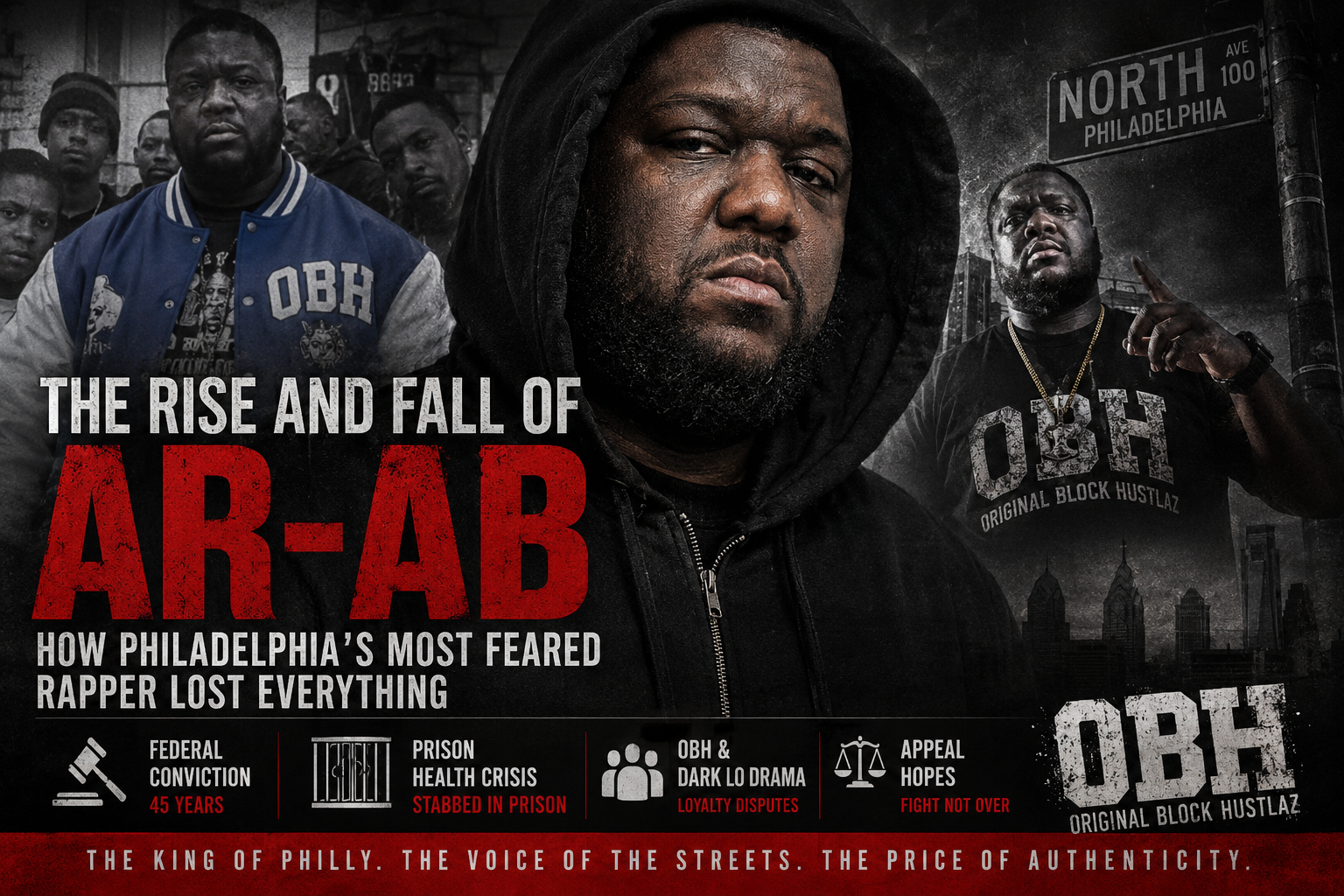
Before AR-AB became a federal inmate serving a 45-year sentence, he was one of Philadelphia’s most feared and debated rap figures – a street rapper whose reputation, music, crew, interviews, and legal trouble all became impossible to separate.
Abdul Ibrahim West, known to hip-hop fans as AR-AB, did not become famous through polished radio singles or industry-safe branding. He rose through North Philadelphia’s underground rap scene with a voice that sounded heavy, lived-in, and dangerous. His music was raw because his public image was raw. He spoke like someone who had survived violence, understood street politics, and had no interest in softening his story for mainstream acceptance.
To supporters, AR-AB was the “King of Philly,” a rapper who represented a city often overlooked in national rap conversations. To prosecutors, he was the leader of Original Block Hustlaz, or OBH, a crew they described not as a music movement but as a violent drug-trafficking organization. To fans watching from the outside, his story became one of the clearest examples of how rap authenticity can become both a career engine and a legal trap.
Get Featured On Raptology
Independent artists, managers, and labels can submit music for editorial coverage, interviews, and promotional visibility across Raptology.
Submit Your MusicThe North Philadelphia Environment That Shaped Him
AR-AB’s story starts in North Philadelphia, a place with deep musical history but also a long public association with poverty, violence, drug markets, and neighborhood survival. For many rappers from environments like that, music becomes more than entertainment. It becomes a witness statement, a warning, a résumé, and sometimes a confession in the eyes of law enforcement.
AR-AB leaned into that reality. He did not present himself as removed from the streets. He presented himself as the streets. Interviews and freestyles often carried the same message: he was not a character created for rap, he was a person formed by the blocks he came from.
That authenticity helped him build a fan base. It also made him a lightning rod. Every line, every interview clip, every social media post, and every public declaration became part of the larger AR-AB mythology. He was admired by fans who believed he represented an unfiltered version of Philadelphia. He was watched by authorities who believed the music was attached to something much more serious.
Raptology Documentary note: The transcript behind this article includes several claims from AR-AB, his family, and online commentators. In this documentary, prison health claims and OBH internal allegations are presented as claims or reported statements unless established in court records.
The Birth Of OBH
Original Block Hustlaz, better known as OBH, became the center of AR-AB’s movement. To fans, OBH was a rap crew and independent label. It represented North Philly hunger, loyalty, street experience, and underground credibility. Artists like Dark Lo helped give the movement its own sound and identity.
OBH was never marketed like a clean corporate brand. Its identity was rooted in toughness. The name itself carried the feeling of a block-level brotherhood. The music was grimy, direct, and heavy with survival talk. That was exactly why listeners believed it.
But federal prosecutors would later argue that OBH was not simply a music group. The government described it as a drug-trafficking organization that operated around Philadelphia while using rap as part of its public identity. That disagreement – music movement or criminal enterprise – became central to AR-AB’s downfall.
How AR-AB Built His Reputation
AR-AB’s rise was fueled by a reputation that felt almost impossible to manufacture. He spoke publicly about being shot multiple times and surviving situations that would have ended other lives. In the transcript, the speaker refers to AR-AB’s history of being shot and injured as part of the legend surrounding him. Those survival stories became part of his brand.
In hip-hop, credibility has always mattered. For AR-AB, credibility was not subtle. He positioned himself as someone who had already lived through the violence many rappers only describe. His voice, delivery, and public presence gave him an authority that helped him stand out in an era crowded with street rappers.
His name also circulated through rap beef and industry moments. Fans connected him to Philadelphia’s larger rap conversation, including the city’s competitive energy and its complicated relationship with national attention. But AR-AB was never just another rapper trying to get noticed. He became a symbol of a specific type of street authenticity that people either respected, feared, criticized, or questioned.
The Drake, Meek Mill Era And National Attention
AR-AB’s name reached a wider national audience during the Drake and Meek Mill feud. When Drake mentioned AR-AB in the middle of that battle, a large number of listeners outside Philadelphia suddenly wanted to know who he was. For underground fans, AR-AB was already known. For mainstream rap listeners, the mention made him a mystery worth investigating.
That moment showed how reputation can travel faster than a traditional hit record. AR-AB’s name carried weight because it already had a history attached to it. Drake’s reference did not create AR-AB’s image, but it amplified it to a much larger audience.
For a while, it looked like that attention might push AR-AB into a different level of the rap business. He had industry relationships, street respect, and a recognizable brand. But the same visibility that can help a rapper cross over can also increase scrutiny.
The Federal Case Begins
In October 2018, federal authorities announced charges against AR-AB and several alleged associates. The indictment accused the group of distributing drugs in North Philadelphia, including cocaine, crack cocaine, methamphetamine, and heroin. Prosecutors alleged that AR-AB, whose legal name is Abdul West, led the organization.
The case was not presented as a simple possession case or a minor street-level arrest. Federal authorities described OBH as a large-scale operation. The DOJ later said the group “doubled as a group of aspiring rap artists” while functioning as a drug-trafficking organization.
AR-AB’s supporters argued that prosecutors misunderstood the culture, exaggerated the meaning of lyrics and public image, and treated rap expression like evidence of guilt. Prosecutors argued that the case was not about music alone, but about conduct, testimony, drugs, violence, and the structure of the organization.
Conviction And The Fight Over Lyrics
In November 2019, AR-AB and several co-defendants were convicted at trial on conspiracy and drug-trafficking charges. The government said the evidence showed that the defendants distributed cocaine, crack cocaine, methamphetamine, and heroin in and around Philadelphia while publicly presenting themselves as OBH artists.
The case revived a familiar debate in hip-hop: when do lyrics become evidence? Rap has always included exaggeration, persona, metaphor, and violent storytelling. But prosecutors have repeatedly argued in cases across the country that certain lyrics, videos, and social media posts can reflect real conduct when matched with other evidence.
AR-AB addressed that tension directly in court. According to sentencing coverage, he argued that outsiders did not understand gangsta rap culture and that artists from his world do not rap about “flowers and rainbows.” That statement captured the central cultural conflict: hip-hop fans often understand street rap as performance mixed with reality, while prosecutors may treat the same material as corroboration.
More Documentaries
Explore long-form hip-hop stories in the Raptology Documentary archive.
Featured Stories
Read artist profiles and deep dives in Featured Stories.
Latest Rap News
Follow current updates in Latest Rap News.
The 45-Year Sentence
On April 15, 2021, U.S. District Judge Michael M. Baylson sentenced Abdul “AR-AB” West to 45 years in prison, followed by 10 years of supervised release and a $5,000 fine. The DOJ described him as the leader of Original Block Hustlaz and said the federal case against OBH was nearing its end with his sentencing.
The sentence was devastating. For fans, it felt like watching a rapper disappear into the federal system for what could be the rest of his life. For prosecutors, it was the conclusion of a case they framed as a major drug-trafficking prosecution. For AR-AB, it became the moment his entire public image collided with the power of the federal court system.
Reporting from The Philadelphia Inquirer noted an important detail: prosecutors alleged AR-AB had ordered a 2017 killing, but the judge repeatedly stressed that the alleged killing was not considered in the sentence. That distinction matters because it separates the allegations surrounding the broader case from the conduct the court said it was punishing at sentencing.
The Prison Stabbing And Health Crisis Claims
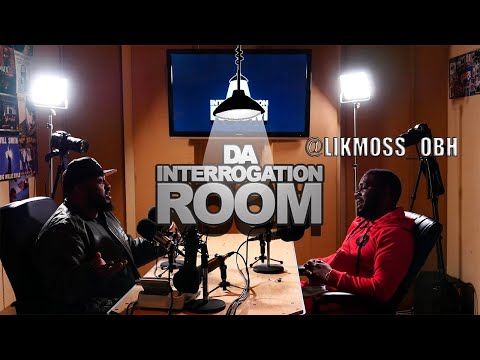
After conviction, AR-AB’s story shifted from the streets and courtroom to life behind bars. According to his brother Lik Moss and other supporters, AR-AB was attacked in prison by another inmate while using the phone. The transcript describes the attacker as mentally ill and claims AR-AB was stabbed in the back of the head.
Family members and supporters later claimed that AR-AB’s medical condition worsened after the incident. Online hip-hop outlets reported on Lik Moss’ statements alleging that AR-AB suffered severe health problems, swelling, skin discoloration, bleeding, and possible kidney-related concerns. Those claims came from family statements and interviews, not a public court finding.
The story spread because it touched on a larger concern: prison medical care. Even people who believed AR-AB was responsible for his choices questioned whether he was receiving proper treatment while incarcerated. In that sense, his case became part of a broader conversation about what happens to inmates after the headlines fade.
OBH Without Its Leader
AR-AB’s incarceration did not only affect him. It changed OBH. The movement had been built around his presence, authority, reputation, and voice. Once he was gone, the unity around the brand became harder to maintain.
The transcript describes public tension involving Dark Lo, Lik Moss, and disputes over loyalty, paperwork, statements, and what should or should not count as cooperation. These types of disputes often become explosive in street rap because reputation is everything. A rumor can damage an artist almost as much as a conviction.
Dark Lo, one of the most recognizable artists connected to OBH, faced his own federal legal trouble. DOJ reporting in 2019 stated that Charles Salley, also known as Dark Lo, had been arrested and charged in a related witness-tampering matter during the broader OBH case. That development added another layer of pressure to a movement already damaged by AR-AB’s conviction.
The Dark Lo Controversy
The Dark Lo controversy became one of the most painful chapters for OBH fans because it played out publicly. Allegations and counter-allegations moved through interviews, diss records, social media posts, and online commentary. The transcript describes Lik Moss criticizing Dark Lo and AR-AB later pushing back on the idea that anyone else could remove Dark Lo from OBH without his approval.
That detail matters because it shows how AR-AB still viewed himself as the final authority even from prison. In his mind, OBH remained his movement. No public argument, diss track, or interview could change that unless it came from him.
But prison changes leadership. Even when a person still has influence, they no longer control timing, access, movement, or communication. AR-AB could speak through calls and interviews, but he could not sit everyone down in the same room. That physical absence allowed conflicts to grow.
Appeal Hopes And Legal Arguments
AR-AB has continued to express hope that he can challenge his conviction or sentence. The transcript references his belief that there may have been legal issues involving representation and cross-examination. Appeals in federal court are difficult, and most convictions are not overturned, but AR-AB’s supporters continue to follow any sign of possible legal relief.
For many fans, the appeal represents more than a technical legal process. It represents hope that the sentence could one day be reduced. A 45-year federal sentence can feel final, but hip-hop history has shown that long-running legal campaigns can keep an artist’s name alive and keep pressure on the system.
Still, as of this article, the official legal reality remains clear: AR-AB is serving a 45-year federal prison sentence connected to his OBH conviction.
Where Is AR-AB Today?
Today, AR-AB remains one of the most discussed incarcerated rappers in hip-hop. His music continues to circulate online. His interviews still draw views. His name appears in debates about lyrics as evidence, federal rapper prosecutions, street authenticity, and the cost of living the image that sells records.
Supporters say his health has improved in more recent updates, with AR-AB reportedly focusing on exercise and rebuilding himself physically. Those updates stand in contrast to earlier claims about serious medical problems behind bars.
The contradiction has become part of the story. AR-AB’s image was always tied to survival. The prison chapter has only extended that theme.
Timeline: The Rise And Fall Of AR-AB
Enter The Raptology Rap Contest
Think your music deserves a bigger audience? Submit your track and compete for visibility on Raptology.
Join The ContestThe Legacy Of AR-AB
AR-AB’s legacy is complicated because he represents both the power and danger of street rap authenticity. He proved that a rapper could build a devoted following without softening his image, chasing mainstream approval, or pretending to come from somewhere cleaner than where he was raised.
But his case also shows how quickly that same image can be used against an artist. The words that attract fans can attract investigators. The videos that build a movement can appear in court. The persona that makes a rapper believable can become part of the government’s story.
For Philadelphia rap, AR-AB remains significant. His name is connected to a specific era of the city’s underground scene, one where the internet allowed local street movements to reach national audiences without traditional industry approval.
For hip-hop more broadly, his story belongs beside other cautionary tales about fame, law enforcement, street ties, and the blurred line between art and evidence. AR-AB did not become a superstar in the traditional commercial sense, but his impact lasted because his story felt real, raw, and unresolved.
The Final Word
The rise and fall of AR-AB is not a simple story about a rapper going to prison. It is a story about environment, identity, ambition, loyalty, violence, prosecution, and the cost of being believed too much.
He built his name by convincing people that his music was not fiction. Then the federal government built a case in a world where that distinction mattered. Fans heard authenticity. Prosecutors saw evidence. The court handed down decades.
Whether AR-AB is remembered as the King of Philly, the face of OBH, a victim of overcharging, a man punished for his choices, or a cautionary tale depends on who is telling the story. But one thing is undeniable: his name is permanently written into Philadelphia hip-hop history.
Rap Hall Of Fame
Explore the legends who shaped hip-hop culture inside the Raptology Rap Hall Of Fame.
Rappers A-Z
Browse artist histories, profiles, and career guides through Rappers A-Z.
Contest Winners
See rising artists gaining attention through the Raptology Rap Contest Winners page.
Reader Poll: What ultimately caused AR-AB’s downfall?

Natalia is a Rap and Hip Hop enthusiast. After graduating from The New School of New York’s Public Relations Program and taking a course in Journalism at Michigan State University, she decided to dedicate her life to the music publishing business and to the discovery of new talent. She helps new artists gain exposure to the masses via online marketing and publications.
Leave a Reply