
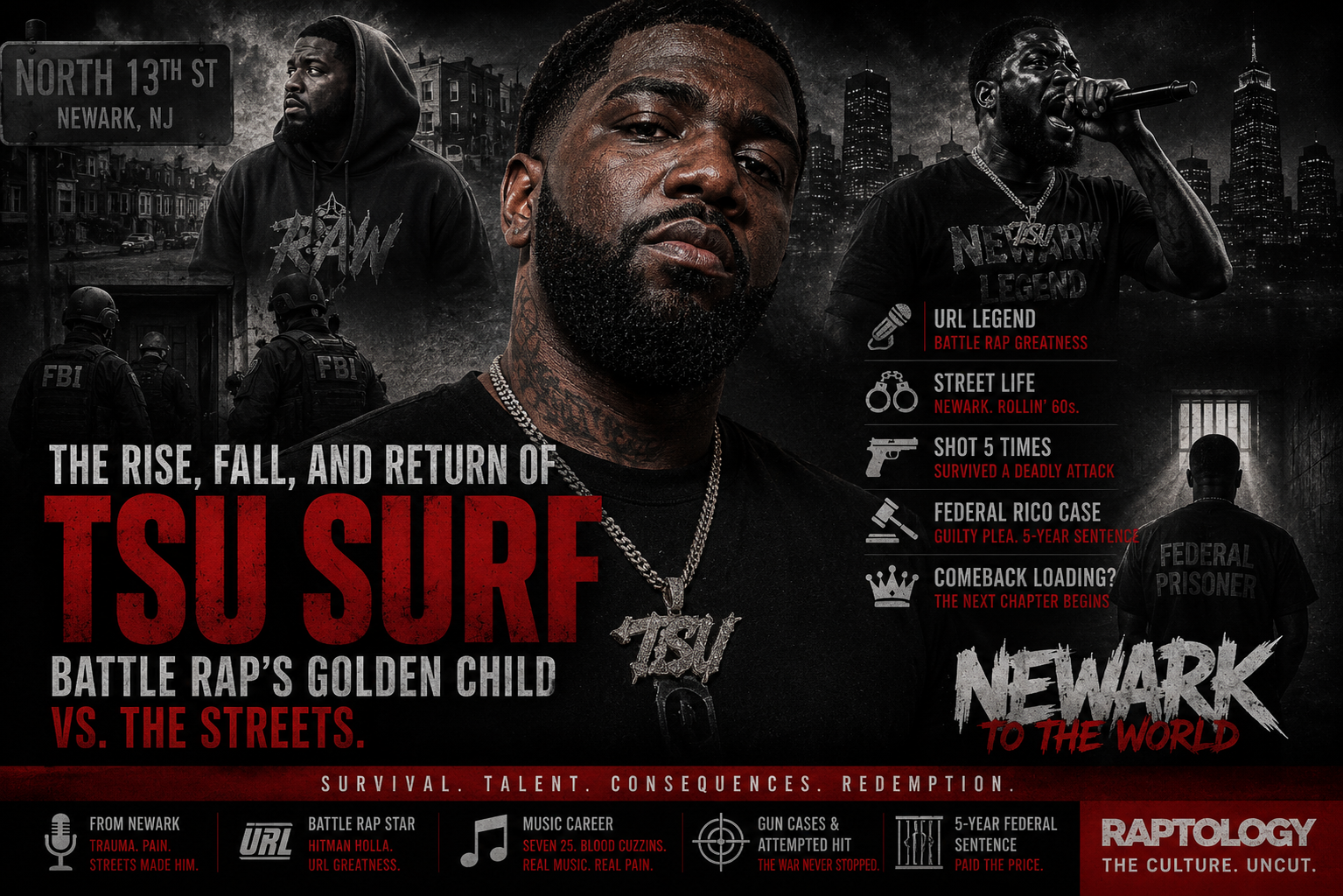
Before Tsu Surf became one of battle rap’s most magnetic stars, before the URL classics, before the music industry co-signs, and before the federal RICO case, he was Rahjon Cox from Newark — a young man shaped by trauma, street politics, survival, and a gift for words that could have saved him from everything.
Tsu Surf’s story is one of the most painful contradictions in modern battle rap. On one side, he had everything the culture rewards: charisma, star power, lyrical aggression, stage presence, a loyal fan base, and the rare ability to turn battle rap fame into a real music career. On the other side, he carried the weight of the streets that made him believable in the first place.
That tension became the center of his life. The same authenticity that made fans believe every bar also kept pulling him back toward danger. Gun cases, a near-fatal shooting, attempted murder allegations, gang ties, and eventually a federal RICO case turned his rise into a cautionary tale about talent trapped between survival and self-destruction.
Now that Tsu Surf has served years behind bars and the hip-hop world is watching his next move, the question is no longer whether he was one of battle rap’s greatest stars. That part is settled. The question is whether he can finally become bigger than the environment that almost took everything from him.

Get Featured On Raptology
Independent artists, managers, and labels can submit music for editorial coverage, interviews, and promotional visibility across Raptology.
Submit Your MusicNewark Made Him
Tsu Surf was born Rahjon Cox and came up in Newark, New Jersey, a city with a long history of toughness, talent, poverty, pride, and street politics. For Surf, Newark was not background scenery. It was the world that shaped his instincts, his relationships, his language, and his pain.
The transcript describes Surf witnessing graphic violence at a young age, an image that stayed in his mind and became part of the trauma he carried into adulthood. Moments like that can change a child’s emotional wiring. Fear becomes normal. Hyper-awareness becomes survival. Violence stops being a distant concept and becomes something that could happen any day.
Surf’s story is not simply about a rapper “choosing the streets.” It is about a teenager learning to survive inside an environment where the streets often feel like the only available structure. School, family, and normal life existed, but the block offered identity, protection, status, and belonging. For a young person already carrying trauma, that kind of belonging can be powerful.

According to the transcript, Surf became affiliated with the Rollin’ 60s Crips while still young. That affiliation later became one of the defining pieces of his federal case. But long before prosecutors used those words in court filings, the identity already lived inside his music, interviews, friendships, and public image.
That is the dangerous part of street credibility. It can help a rapper sound real. It can also make it harder to separate art from alleged conduct once law enforcement starts building a case.
Raptology Documentary note: This article discusses public reporting, court records, transcript claims, interviews, and allegations. Claims that have not been proven in court are described as allegations or reported claims, not established legal facts.
The First Gun Case And Becoming A Father
After graduating high school, Surf was arrested on a gun charge at 18 years old. The transcript describes a long legal process: one year fighting the case from jail, time out on bail, then a sentence that eventually led to prison time. Surf has described jail as another world, a place where young men are forced to grow up around grown men carrying their own violence, pressure, and survival codes.
The experience did not reform him in the clean way society likes to imagine prison works. Instead, it hardened him. Jail can teach consequences, but it can also deepen the same identity that led a person there. For a young man from Newark already carrying street ties, prison often becomes a continuation of the same world under different rules.
During that period, Surf also became a father. According to the transcript, his daughter was born while he was dealing with the case, and he met her when she was three months old after coming home. That detail matters because it shows the other version of Surf’s life — not the battler, not the gang member, not the federal defendant, but the father trying to exist inside a life that kept pulling him in different directions.
Key tension: Tsu Surf’s life kept presenting two paths at once: music, fatherhood and survival on one side; street loyalty, legal pressure and danger on the other.
Battle Rap Becomes The Escape Route
Surf always wanted to rap. The transcript describes him as someone who had been rapping since childhood, with his mother buying him a karaoke machine and even his eighth-grade yearbook pointing toward rap as his future. He did not stumble into music. He believed he was a rapper before the world had any reason to agree.
Battle rap gave him the perfect arena. It rewarded aggression, memory, timing, confidence, disrespect, performance, and emotional control under pressure. Those are skills that can come from talent, but they can also come from surviving tense environments. Surf had both.
His URL debut came in 2010 against Young Ill, during a period when he was still dealing with legal issues. That combination defined him from the start. He was not entering battle rap as a clean industry product. He was entering as someone already carrying street weight, legal baggage, and raw talent.
Behind bars, according to the transcript, an older inmate encouraged him to take his talent seriously instead of wasting it. That kind of advice can change a person’s life. Surf did begin taking music and battle rap more seriously, but the problem was never talent. The problem was whether talent could fully pull him away from the life that had already claimed so much of him.
The Hitman Holla Battle And Becoming A URL Star
Among battle rap fans, Tsu Surf versus Hitman Holla remains one of those matchups that still gets referenced years later. It had everything battle rap is supposed to have: tension, performance, star power, crowd reaction, memorable writing, and the feeling that both men understood the moment.
For Surf, that battle helped cement him as more than a talented battler. He became a star. His presence felt cinematic. He could talk street, talk pain, talk arrogance, and make it feel effortless. Even when fans debated wins and losses, they rarely debated whether Surf mattered. He mattered every time he stood on stage.
Battle rap fame is different from mainstream rap fame. It is built on moments rather than radio records. One room can change an artist’s entire reputation. One round can live forever. Surf understood that better than most. He had a way of making his best moments feel like scenes from a movie.
From Battle Rap To Music
Surf’s talent was not limited to battles. He also built a music catalog that connected with fans beyond URL. Projects like Seven 25, Blood Cuzzins, MSYKM, Until Further Notice, and DISPARU showed a different side of him: more reflective, more melodic, more personal, and more focused on pain than punchlines.
That crossover matters because many battle rappers struggle to make music that lives outside the battle world. Surf had something rare. He could make songs that sounded like a man who had been through things and was finally trying to process them. The voice that made him dangerous on stage made him compelling on records.
He toured, sold merchandise, built a fan base, and reached a point where battle rap was no longer just a hobby or a street escape. It became a business. He was making legal money from his name, his voice, and his audience. That should have been the turning point.
But the streets were not finished with him.
More Documentaries
Explore long-form hip-hop stories in the Raptology Documentary archive.
Featured Stories
Read artist profiles and deep dives in Featured Stories.
Latest Rap News
Follow current updates in Latest Rap News.
The 2017 Attempted Hit Charge
In 2017, Surf faced one of the most serious legal battles of his life when he was arrested on an attempted murder-related charge. According to the transcript, the allegation involved retaliation after someone close to him was shot. Surf fought the case and eventually beat it, but the cost was heavy.
He has said he spent tens of thousands of dollars on legal fees while already dealing with another gun possession case. That detail reveals a pattern: Surf was talented enough to earn money legally, but still close enough to street conflicts that the money kept being drained by lawyers, bail, and survival.
This is where the warning signs became obvious. He was no longer a teenager with no options. He was a known artist with real opportunities. He had fans. He had money coming in. He had battle rap status. Yet the same conflicts kept appearing around him.
That is one of the hardest truths in stories like this. Success does not automatically remove a person from the psychology of the environment that raised them. Sometimes success only gives them more visibility while they continue moving the same way.
The 2018 Shooting That Almost Ended Everything
In 2018, Tsu Surf was shot five times at a traffic light. According to the transcript, he had been dropping someone off and ended up passing through an area connected to his enemies. He later described the moment in detail: hearing the first shot, seeing a bullet go through his arm, then being hit multiple times in the ribs and stomach.
The shooting was nearly fatal. One bullet reportedly pierced his colon, and he needed surgery that left him with a long scar and dozens of stitches. The transcript describes him flagging down a car and being driven to the hospital while calling someone close to him to say he had been shot.
Moments like that usually create a choice. Some people take surviving as a sign to leave the streets completely. Others take it as proof that the war is still active and that they need to remain guarded. For Surf, the shooting appears to have pulled him in both directions.

On one hand, he understood the blessing of being alive. On the other hand, survival can deepen paranoia. If enemies tried to kill you once, the fear does not disappear just because you have a music career. That fear can become the justification for staying armed, staying surrounded, and staying connected to the very lifestyle that keeps you in danger.
The shooting became one of the defining events in Tsu Surf’s public story: proof of survival to fans, but also proof that the street conflicts around him were not just lyrics or battle rap performance.
Bars On I-95 And The “Golden Child” Problem
After the shooting, Surf continued building his profile. His Bars On I-95 freestyle era showed why fans believed he could become bigger than battle rap. He had pain, delivery, charisma, and the ability to make street trauma sound cinematic without losing lyrical sharpness.
But around the same period, Surf also gave interviews that prosecutors and fans would later look back on differently. In one interview, he described moving with his “pack” and being the “Golden Child.” In street terms, the meaning was obvious to fans: he was the breadwinner, the visible one, the person people around him protected because his talent brought money and attention.
That idea is common in street rap. The artist becomes the golden ticket for the crew. But it can also become a trap. If the artist is protected by the pack, the artist remains tied to the pack. If the pack is involved in illegal activity, prosecutors may later argue that the artist is not separate from the enterprise.
Surf may have been trying to describe loyalty and survival. The government later described a criminal enterprise. That gap between cultural language and legal interpretation became one of the most dangerous parts of his story.
The 2022 RICO Arrest
In October 2022, federal authorities arrested Tsu Surf in New Jersey as part of a broader case targeting alleged members of the Rollin’ 60s Neighborhood Crips. Early reports said agents approached the home where Surf was staying and that he initially did not come out, prompting negotiators before he eventually surrendered.
The charges were serious. Federal authorities alleged that from 2015 through September 2022, the enterprise was responsible for acts of violence and controlled-substance distribution in New Jersey and elsewhere. Surf, born Rahjon Cox, was charged with RICO conspiracy and possession of firearms and ammunition by a convicted felon.
For battle rap fans, the arrest felt unreal. Surf had become one of the culture’s biggest stars. He was supposed to be on stages, not facing a federal indictment. But to those who had watched the warning signs, the arrest felt like the consequence of a life lived too close to the edge for too long.
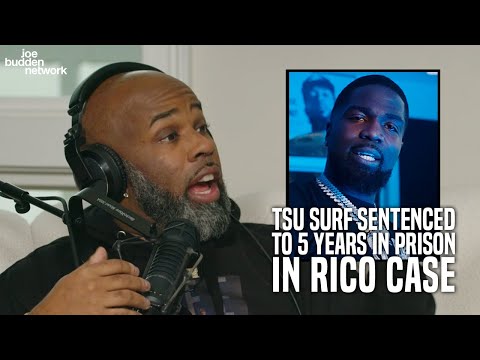
Confirmed public record: The U.S. Attorney’s Office for the District of New Jersey said Rahjon “Tsu Surf” Cox pleaded guilty to RICO conspiracy and possession of firearms and ammunition by a convicted felon. He was sentenced to five years in federal prison in December 2023.
The Guilty Plea And Five-Year Sentence
In April 2023, Cox pleaded guilty by videoconference before U.S. District Judge Susan D. Wigenton. The plea covered RICO conspiracy and possession of firearms and ammunition by a convicted felon. Federal prosecutors said he held a leadership role in the enterprise, fired at a gang rival in 2017, and possessed two loaded firearms in Essex County in 2019.
In December 2023, he was sentenced to five years in prison. For many fans, that sentence was not as devastating as the worst-case fear. At the time of the arrest, people speculated about decades behind bars. A five-year sentence still meant losing years of prime career momentum, but it also left open the possibility of a return.
The sentence became another turning point. Surf was no longer fighting rumors or speculation. The federal case had a resolution. The question became what kind of man, artist, and public figure he would be when he came home.

What The Case Says About Battle Rap And Street Identity
Tsu Surf’s case belongs in a larger conversation about rap, street identity, and federal prosecution. In battle rap, exaggeration, aggression, threats, and violent imagery are part of the form. A battler can say outrageous things on stage and the audience understands it as performance, competition, and persona.
But Surf was not only a battle rapper. He was also a public figure tied to real street affiliations, real legal history, real shootings, and real firearms cases. That made the separation between performance and reality much harder.
Prosecutors did not need to prove that every bar was literal. They only needed to connect him to the enterprise through evidence, conduct, communications, and admissions. That is why artists in street-centered genres face unique risks. The culture may understand code-switching, metaphor, and persona. Courts often do not care about the cultural nuance if other evidence supports the case.
Battle Rap Persona
In battle rap, aggression and violent imagery are part of performance, strategy, and crowd control.
Street Reality
Surf’s real legal history and affiliations made it harder for outsiders to separate art from alleged conduct.
Federal Court
Once a case enters federal court, lyrics and interviews can become part of a larger narrative when matched with other evidence.
The Return Question
Recent reports and fan discussion have focused on Surf’s release and what comes next. After serving years in custody, he returns to a battle rap landscape that still remembers him as one of its biggest stars. The culture has changed, but the demand for Surf has not disappeared.
The temptation will be obvious. Fans will want battles. Promoters will want moments. Media will want interviews. The internet will want a comeback story. But the most important question is not whether Surf can still rap. He can. The question is whether he can move differently.
Coming home after a federal case requires more than talent. It requires discipline, distance, and a willingness to let certain relationships, habits, and conflicts stay in the past. That may be the hardest battle of his career.
Enter The Raptology Rap Contest
Think your music deserves a bigger audience? Submit your track and compete for visibility on Raptology.
Join The ContestTimeline: The Rise, Fall, And Return Of Tsu Surf
Frequently Asked Questions
Who is Tsu Surf?
Tsu Surf, born Rahjon Cox, is a Newark rapper and battle rap star known for his URL performances, music catalog, street storytelling, and federal RICO case.
What was Tsu Surf charged with?
He pleaded guilty to RICO conspiracy and possession of firearms and ammunition by a convicted felon in federal court.
How long was Tsu Surf sentenced to?
In December 2023, he was sentenced to five years in federal prison, followed by supervised release.
The Legacy Of Tsu Surf
Tsu Surf’s legacy is complicated because it is still being written. As a battle rapper, he is already one of the most important figures of his generation. His style, presence, and catalog of battles helped make URL feel cinematic during one of battle rap’s most important eras.
As a recording artist, he proved that battle rappers can make music with emotional depth and real replay value. He did not sound like someone trying to escape battle rap. He sounded like someone expanding the story that battle rap only allowed him to tell in fragments.
As a cautionary tale, his story is painful. Surf had the talent to leave the streets behind, but leaving is rarely as simple as deciding to do better. Trauma, loyalty, fear, enemies, identity, and reputation can all pull a person backward even after success gives them a way out.
That is why his return matters. It is not just a comeback for a rapper. It is a test of whether a man whose life has been shaped by survival can finally choose peace without losing the fire that made him great.
The final battle for Tsu Surf may not be on a URL stage. It may be proving that the golden child can outgrow the streets without losing his voice.
The Final Word
The rise, fall, and return of Tsu Surf is not only a battle rap story. It is a Newark story, a prison story, a fatherhood story, a trauma story, and a warning about what happens when talent and street loyalty are locked in the same body.
Surf survived gun cases. He survived being shot five times. He survived federal prison. But survival is not the same as freedom. Real freedom will depend on whether he can move differently now that the world is watching again.
Battle rap gave him a stage. The streets gave him scars. Federal court gave him consequences. What comes next will decide whether Tsu Surf is remembered mainly for what almost destroyed him — or for what he became after he survived it.
Rap Hall Of Fame
Explore the legends who shaped hip-hop culture inside the Raptology Rap Hall Of Fame.
Rappers A-Z
Browse artist histories, profiles, and career guides through Rappers A-Z.
Latest Rap News
Follow new developments in hip-hop through Latest Rap News.
Want A Raptology Feature?
Raptology covers rising artists, independent rappers, producers, DJs, and major hip-hop stories. Submit your music today for editorial consideration.
Submit Your MusicReader Poll: What defined Tsu Surf’s story the most?

Raptology Editorial is the official newsroom voice of Raptology, covering breaking hip-hop news, artist developments, industry trends, and in-depth editorial reports from across the global rap landscape.








Leave a Reply