
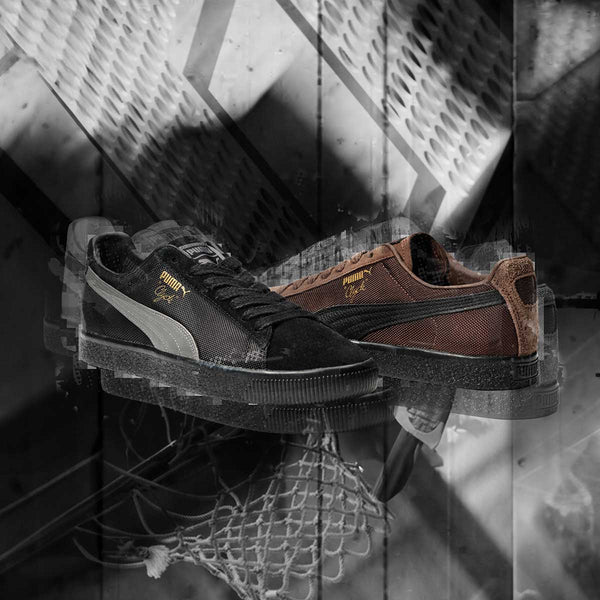
Before sneaker collaborations became an expected part of a rapper’s rollout, a low-cut suede basketball shoe was already moving between New York courts, dance floors and neighborhood style. The PUMA Clyde and its closely related Suede silhouette offer a revealing history of how hip-hop made sportswear its own. This was not a marketing campaign engineered around a celebrity musician. The relationship grew from the people wearing the shoes.
From Walt Frazier to the street
PUMA’s own history of the Suede traces the Clyde designation to New York Knicks guard Walt “Clyde” Frazier. His association with the shoe connected a basketball signature to a wider sense of metropolitan style. PUMA explains that the Clyde name eventually gave way to Suede in international markets because the company did not retain worldwide rights to the player’s nickname. The naming distinction matters: the Clyde and Suede share a lineage, but a historian should not treat every vintage pair, colorway or marketing name as identical.
Frazier’s wardrobe was already an attraction beyond the court. His personal style helped establish the shoe as more than functional equipment. Yet it would be misleading to claim he single-handedly invented the silhouette’s street appeal. Hip-hop’s adoption depended on dancers, neighborhood retailers and ordinary wearers who were not necessarily featured in advertising.
The dancers who gave the shoe another life
As breaking developed into an internationally recognized element of hip-hop, footwear became part of the practical vocabulary of performance. A dancer needed a shoe that could move, flex and grip appropriately while enduring repeated floor work. PUMA identifies the New York City Breakers and Rock Steady Crew among the influential groups that adopted the Suede. This is the manufacturer’s retrospective account, useful evidence of the brand’s historical positioning but not proof that every member wore the same model or that one shoe dominated all early breaking.
The Smithsonian National Museum of American History preserves a pair of PUMA Clyde sneakers worn by B-Girl Laneski around 1984–1985. That museum object makes the story more concrete. Rather than relying entirely on nostalgic advertisements or later celebrity testimonials, we can point to footwear associated with an identified dancer, dated by a collecting institution and described in a public museum record. The Smithsonian notes that the Clyde was popular with graffiti artists in the 1970s and hip-hop performers in the following decade.
Laneski’s story also complicates a familiar account that treats early breaking as exclusively male. The museum describes her as a pioneering B-girl whose development of difficult moves challenged the assumptions of the scene. Her shoes are therefore evidence of both fashion and participation. They belong to a history of women making hip-hop culture rather than simply appearing in its imagery.
Why hip-hop style was never only about endorsements
The Suede’s journey illustrates an important distinction between cultural adoption and formal sponsorship. A shoe may become essential to a scene because performers choose it, not because a company pays them. The evidence here points toward grassroots credibility before the later model of artist-led product launches became widespread.
Consider the adidas Superstar, another basketball-derived sneaker whose association with Run-DMC became a defining example of hip-hop influencing commerce. The group’s 1986 recording “My Adidas” and subsequent relationship with the brand helped turn visible street preference into a formal business opportunity. The history reported by MR PORTER describes how the trio’s stage presentation borrowed directly from street fashion. The point is not to declare a winner between PUMA and adidas. Both histories show musicians and dancers giving athletic footwear new cultural meanings.
Nike’s Air Force 1 supplies a third comparison. Nike’s archival description identifies the model’s basketball origins, while Sotheby’s account details its later connection to Harlem style, record sleeves and rap. A comparison of these three shoes reveals that there was no single sneaker uniform across hip-hop. The details changed with borough, era, dancer, rapper and community.
The difference between a historical artifact and a promotional image
One challenge in writing sneaker history is the temptation to use a modern product photograph to illustrate a specific historical pair. A current PUMA Suede can help readers understand the broad silhouette, but it does not document what an individual B-boy wore in 1982. Likewise, a reissued Clyde should not be captioned as an original pair without provenance. The Smithsonian’s Laneski object is unusually valuable because the institution identifies the wearer and approximate period.
Even that museum record carries an important practical limitation: the page says image reuse is restricted. Its metadata may be openly available, but that does not automatically grant permission to reproduce the photograph. For this article, the museum record should be linked as a source until a reusable image is identified or permission is secured.
What the Clyde and Suede left behind
Modern sneaker culture often celebrates the collaboration: the artist’s name on a box, the limited quantity, the resale premium and the release-day queue. The Clyde and Suede story offers another way of measuring influence. It asks who wore a shoe when nobody was paying them to wear it, and why that choice spread. In the history of breaking, the people on the floor mattered at least as much as the names on the billboard.
That is also why an archival account should not collapse all of hip-hop into one decade or one city. New York supplied crucial early scenes, but regional styles and international breaking communities developed their own visual languages. A careful account can identify the PUMA Suede as important without calling it the definitive shoe of every B-boy or B-girl.
Help Raptology document the artists, dancers and overlooked innovators who shaped the culture.
Independent artists seeking editorial consideration can get featured on Raptology. Explore more hip-hop culture reporting, our sneaker coverage and featured stories.
Editorial research note: This working draft requires additional original reporting, verified period imagery, and a full minimum-word-count expansion before publication. It should not be treated as a finished historical feature.

Zayed “Zod” Chowdhury is a writer, entrepreneur, and lifelong hip-hop student, born in the Bronx and raised in Queens during one of the most influential eras in rap history. His perspective was shaped by New York City’s golden-era energy, street fashion, mixtape culture, lyrical competition, and the rise of rap as a global force. With a voice rooted in authenticity and cultural memory, Zod writes about hip-hop through the lens of history, business, lyrics, influence, and impact. His work breaks down artists, eras, and debates with the eye of someone who lived the culture, studied the music, and understands why hip-hop still drives the conversation.







Leave a Reply