
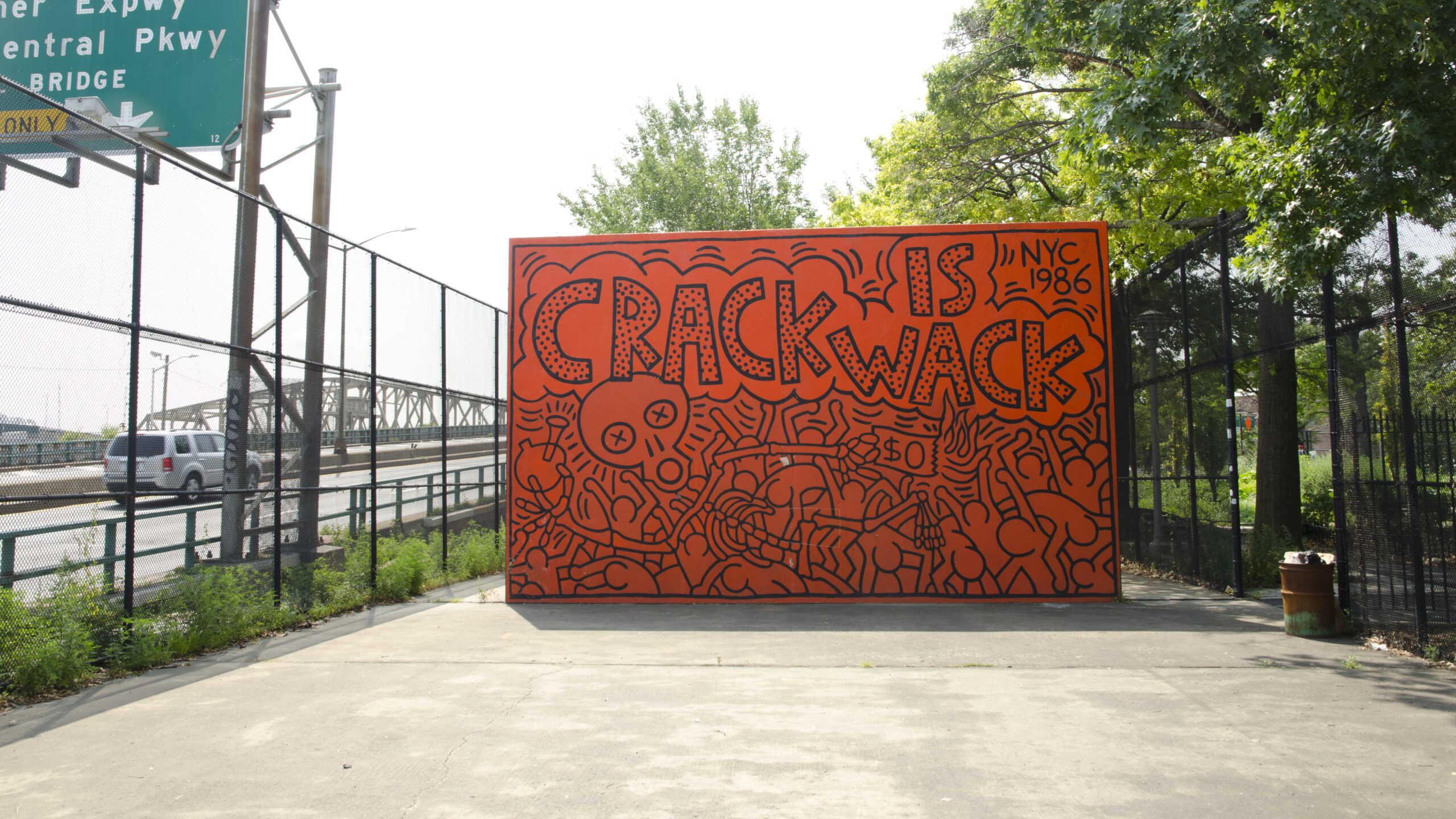
In the summer of 1986, Keith Haring painted a warning about crack cocaine on a handball-court wall beside the Harlem River Drive. New York City painted over the first version. Months later, the city invited him back. The orange-and-black mural that survived became one of the most recognizable pieces of public art in New York, but the story behind it is more complicated than the slogan.
Watch: Why Keith Haring Painted Crack Is Wack
A short visual explanation of the mural’s origins and the story behind its message, from The Canvas.
A Warning Beside the Highway
The wall was never supposed to become a monument. It belonged to a handball court in East Harlem, close enough to the Harlem River Drive that passing motorists could catch its message without slowing down. In 1986, Keith Haring covered it with urgent lettering, electric color and figures that seemed to collide with one another. The words were direct: Crack Is Wack. In a city living through a devastating crack-cocaine crisis, the mural functioned as an intervention in public space rather than an object waiting for a gallery wall. That distinction explains much of its enduring power. Haring made art for people who might never enter a museum, and he used the visual vocabulary he had developed in New York’s streets and subway stations. The resulting work was confrontational, immediately readable and impossible to separate from the neighborhood and the moment in which it appeared. Its history also has a remarkable twist: the version most visitors see today is not the first painting Haring placed on that wall. The original was erased within months of its creation. The replacement survived because the same city that initially treated the work as vandalism ultimately invited the artist to return.
The Artist Before the Wall
Keith Haring was born in Reading, Pennsylvania, in 1958 and grew up in Kutztown. His early interest in drawing developed into a distinctive system of animated figures, thick outlines and signs that could communicate across language barriers. After moving to New York in 1978, he became part of an unusually fertile downtown art environment. The city’s subway system offered him a canvas: unused advertising panels covered in black paper, on which he drew with white chalk. The images could be seen by commuters and disappeared as the advertising cycle moved on. Their temporary nature was part of the proposition. Art could exist outside ownership and formal exhibition. Haring’s practice intersected with the same New York creative landscape that produced graffiti writers, dancers, DJs and early hip-hop performers. Those connections matter, but they should not be exaggerated into a claim that all street art and graffiti share the same techniques or histories. Haring was a particular artist with a recognizable style, and he worked in conversation with an already thriving culture of urban visual expression. His later fame did not erase the public-facing impulses of the subway drawings.
New York in 1986
By the middle of the decade, crack cocaine had become a major public-health and social crisis in New York City. The effects reached families, schools, housing developments and street corners, while public debate often relied on fear, punitive slogans and sensational news coverage. The city’s response unfolded alongside a wider national War on Drugs whose consequences remain intensely debated. Haring was not approaching the crisis as a distant commentator. The Metropolitan Museum of Art and the NYC LGBTQ Historic Sites Project connect the mural to Benny Soto, a young Puerto Rican studio assistant from the South Bronx who struggled with crack addiction. The personal connection is central to understanding the work. The mural was meant as a warning to young people, but it was also an expression of concern for someone in the artist’s immediate circle. Haring’s message should not be mistaken for a complete policy program or a medical explanation of addiction. It was an artist’s urgent response to suffering he could see around him. That combination of personal concern and civic confrontation gives the piece its emotional force.
June 27: The Unauthorized First Version
The original Crack Is Wack mural was painted on June 27, 1986, according to the NYC LGBTQ Historic Sites Project and the Metropolitan Museum. Haring did not have permission from the New York City Department of Parks and Recreation. He chose a concrete handball-court wall at East 128th Street near Second Avenue and the Harlem River Drive, a location whose visibility was part of its appeal. The work did not depend on viewers recognizing the artist’s name. Its bright surface and large words were meant to interrupt the everyday flow of traffic and neighborhood life. Haring was arrested for vandalism, although the subsequent public response showed that the message had struck a chord. The first mural was painted over while he was in police custody, according to the historic-sites account. It is tempting to present this as a neat parable in which officials were simply enemies of art. The historical record is more complicated. The department would soon reverse course and support a new version. The incident exposed the tension between unauthorized expression and the institutional authority that controls public walls.
The Original Is Not the Mural Standing Today
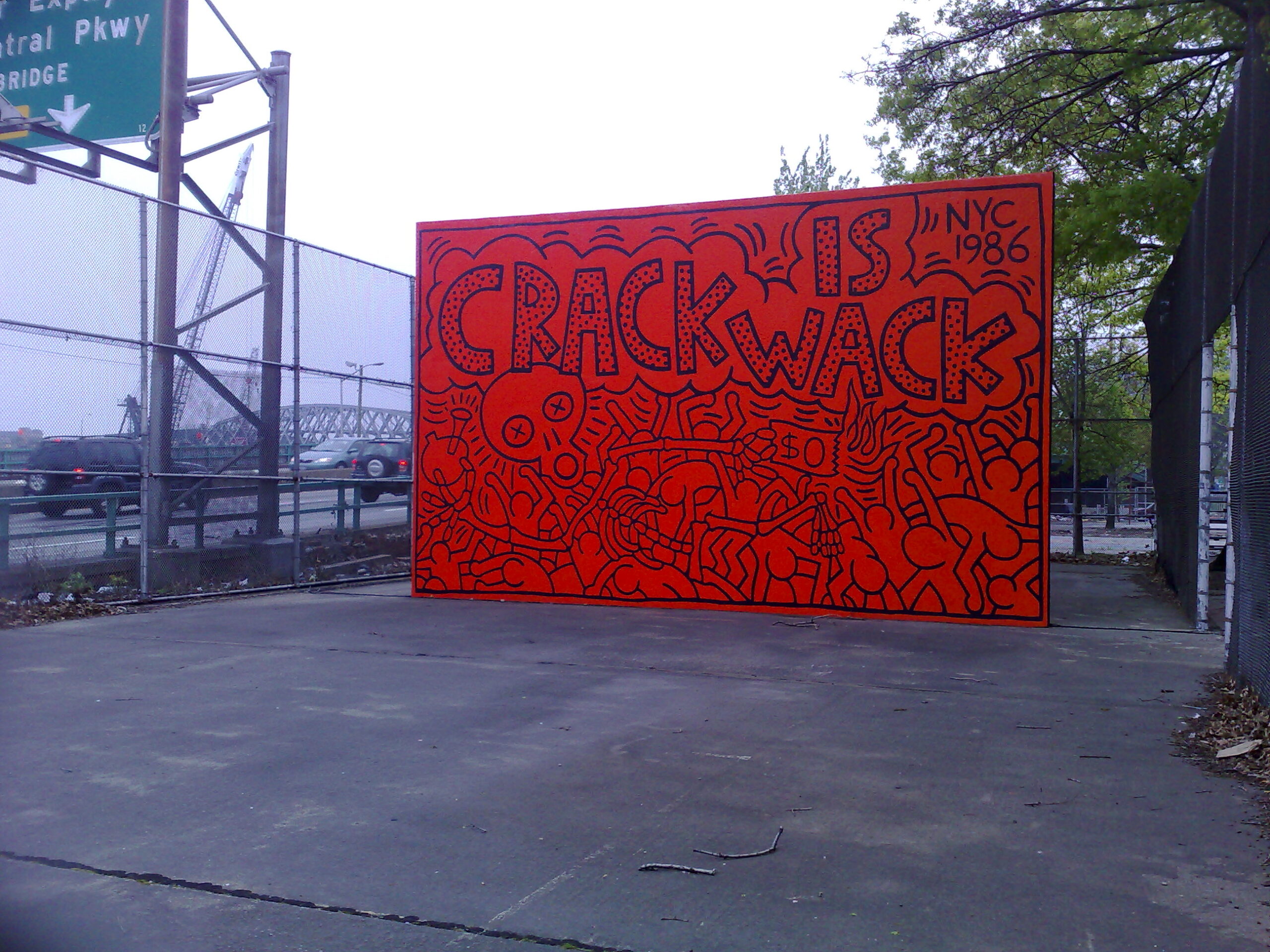
A crucial fact is often lost when photographs from different years circulate online. The mural created in June and the one painted in October 1986 were not identical compositions. Both used the same anti-drug message, but the imagery and arrangement changed. The Keith Haring Foundation’s historical materials explicitly distinguish the two works, and the NYC LGBTQ Historic Sites Project identifies the surviving mural as the second version. That means a photograph of the first painting cannot be casually labeled as the current mural, even though the slogan is the same. Nor should the surviving surface be treated as untouched original paint from 1986. Conservation and repainting have helped preserve the design over time. These distinctions matter to historians, photographers and journalists because the work’s identity involves more than a title. The original act, the revised composition and the restored public object are three related but separate chapters. Confusing them can turn a compelling history into a misleading caption.
October 3: Permission Changes the Story
The turnaround came in the fall. Parks Commissioner Henry Stern invited Haring to repaint the wall with official authorization. The Metropolitan Museum dates the second mural to October 3, 1986. In the Keith Haring Foundation’s account, the commissioner’s invitation followed the removal of the first version. The return was significant precisely because the wall remained the same. A space that had been treated as an unauthorized surface became an approved site for a public message. Haring did not abandon the premise of the first mural to obtain permission. He retained the warning, the urgent lettering and the expressive figures. What changed was the arrangement and the legal relationship between artist and city. The second version is the work that survived, became widely photographed and eventually gave the playground its name. The sequence resists a simplistic distinction between graffiti and public art. The same artist, subject and location could be categorized differently depending on whether the city had granted permission.
Reading the Orange and Black
Crack Is Wack operates at the speed of a street sign. The dominant orange field and heavy black outlines make the composition visible from a distance. The lettering is not a quiet caption beneath a picture; it is part of the image itself. Around it, Haring’s simplified bodies and graphic forms create a sense of agitation and physical consequence. The style is unmistakably his, but the emotional register is sharper than the cheerful dancing figures often reproduced on commercial merchandise. The painting makes a warning feel kinetic. It does not require viewers to study a legend to understand its central message. At the same time, the figures resist a single definitive translation. They suggest fear, vulnerability and conflict without providing a clinical diagram of addiction. The design’s directness was an asset at a roadside location, where attention could be measured in seconds. Its visual economy also helped the image travel through photographs, magazines and later digital archives. A work designed for one wall became recognizable far beyond Harlem.
Why the Handball Court Matters
The site is not incidental scenery. A handball court is a neighborhood space used for recreation, movement and social contact. The mural addressed people who used the court and people traveling past it, rather than a ticketed audience. That dual orientation helps explain why the artwork feels different from a painting made for a museum. It had to share its setting with weather, traffic, ordinary play and the city’s maintenance routines. The concrete surface was exposed to deterioration and repair. The surrounding neighborhood changed while the mural remained. Today, the site is officially called Crack Is Wack Playground, a civic name derived from a work once considered unauthorized. The New York City Parks Department’s historical account places the mural at the center of the playground’s identity. That institutional recognition is striking, but it also creates an obligation to preserve the work accurately. Once a public mural becomes a landmark, conservation is no longer merely a matter of fresh paint. It becomes a question of historical continuity.
The Graffiti Question
Haring’s relationship to graffiti is sometimes flattened into an easy label. He worked in public space, drew in subway stations and moved within a creative world shaped by writers and street culture. Yet the techniques and social histories of aerosol graffiti writing, train painting, muralism and Haring’s chalk drawings are not interchangeable. New York graffiti writers developed elaborate lettering systems, crew traditions and codes of recognition long before major institutions began celebrating street art. Haring’s pictographic language followed a different formal path. What linked the practices was an insistence that public surfaces could carry visual culture outside conventional galleries. The story of Crack Is Wack is therefore relevant to hip-hop history without claiming that it was a rap record translated into paint. It belongs to the broader creative transformation of New York in the late 1970s and 1980s, when the city became a laboratory for new relationships among sound, movement, style and public image. For the larger context, see Raptology’s history of graffiti from subway tags to global art.
The Personal Cost Behind the Public Message
One reason the mural has endured is that its warning cannot be separated from Haring’s wider belief that art should respond to urgent social conditions. His later work confronted AIDS, stigma and the vulnerability of marginalized communities. He was openly gay and would die of AIDS-related complications in 1990 at age 31. The Metropolitan Museum places Crack Is Wack within this broader activist practice. That context should not erase the specific crisis that prompted the 1986 mural. Crack cocaine and HIV/AIDS were distinct public-health emergencies, with different histories and effects. What connects Haring’s responses is his refusal to treat the artist as an observer with no responsibility to the surrounding world. He brought a recognizable visual language to issues that many institutions addressed through slogans or bureaucratic messaging. His work did not replace medical treatment, harm reduction or social services. It made suffering visible in a form that ordinary people could encounter without invitation.
What the Photographs Actually Show
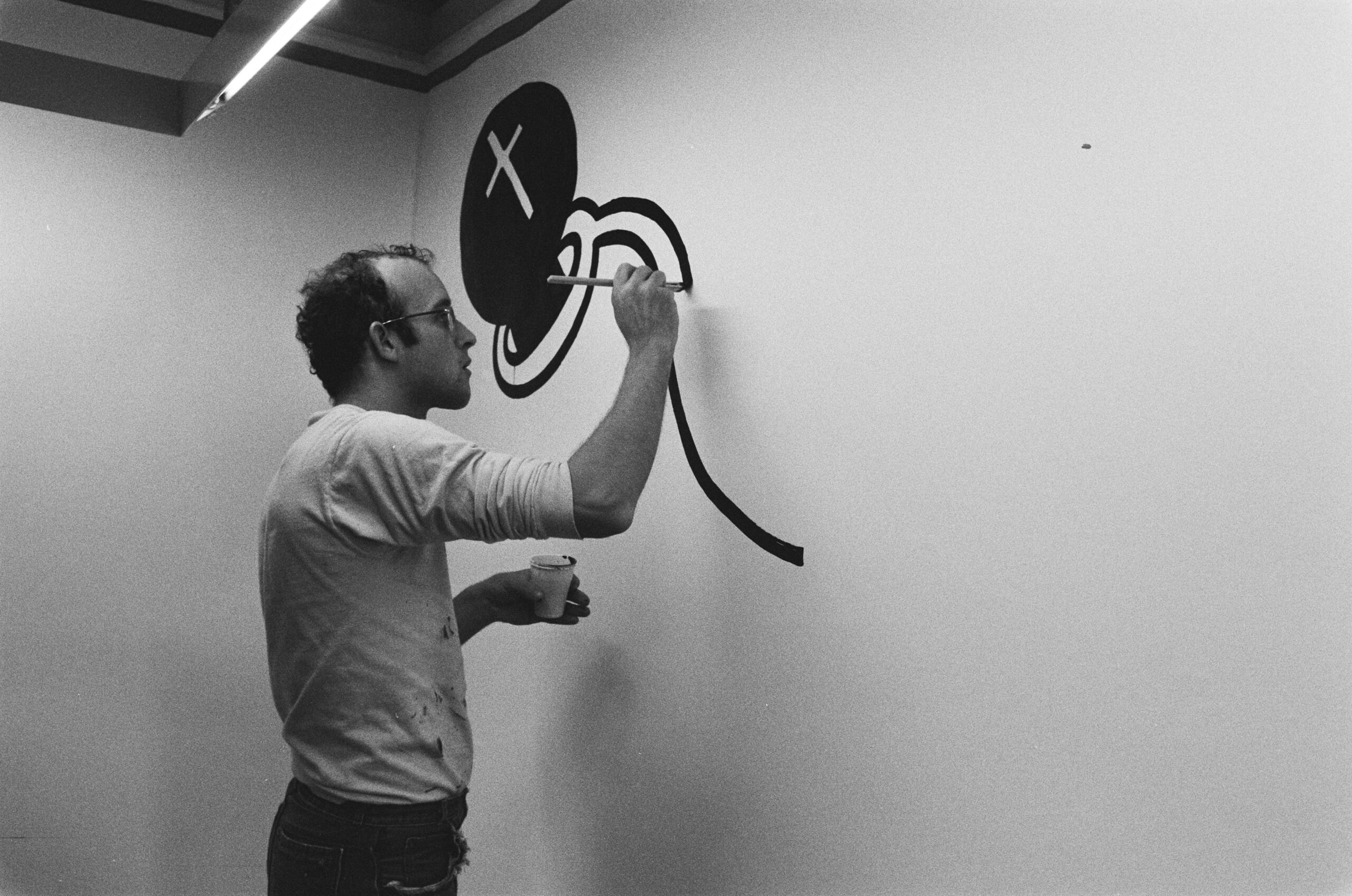
The photographic record is especially important because the mural has undergone changes over time. Archival images of Haring with the work in 1986 capture the artist and the newly completed composition. Later photographs document the mural’s appearance after years of exposure and conservation. The two images accompanying this feature were made in 2008 and 2014, respectively. Neither should be mistaken for a photograph of the June 1986 original. Both document the surviving mural at different points in its later life. The 2008 image is credited to Stan Wiechers and is available under a Creative Commons Attribution-ShareAlike license. The 2014 image is credited to edwardhblake under Creative Commons Attribution. The photographers’ licenses concern their photographs; the underlying Haring artwork retains its own copyright status. Accurate captions therefore identify the photographer, date and licensing while distinguishing the photographic record from ownership of the artwork itself. That care is part of responsible cultural journalism, not a decorative footnote.
Conservation Is Not the Same as Re-creation
A mural outdoors faces weather, pollution, sunlight and the slow deterioration of paint and substrate. Crack Is Wack has required periodic attention, and the Keith Haring Foundation has played a central role in protecting the work. Historic accounts document interventions in the 1990s and 2000s, with further work culminating in a major 2019 restoration. The Foundation’s account of that project emphasizes the continuing importance of the mural’s anti-addiction message. Restoration raises difficult questions: how closely should conservators reproduce a line, how much original material remains, and how should a public work be maintained without turning it into a facsimile? Those questions are especially pointed for an artist who often worked spontaneously on temporary surfaces. The mural’s survival is not evidence that Haring planned every line to remain permanently in place. It is evidence that the city and later custodians decided the work deserved continued public life. The present mural should be understood as a preserved historical design with a conservation history, not a pristine time capsule.
Watch: Restoring the Harlem Mural
amNewYork’s on-site 2019 report shows conservators working on the actual wall, not just finished photographs.
The 2019 Restoration
The most widely documented recent intervention was announced in October 2019. The Keith Haring Foundation and New York City Parks described the renewed mural as a continuing statement about addiction and public responsibility. Architectural Digest reported that artist Louise Hunnicutt participated in the restoration, which addressed a surface damaged by years of exposure. The work had also been affected by infrastructure activity around the Harlem River Drive, making preservation a practical challenge as well as an artistic one. The restored site brought renewed attention to a painting that some New Yorkers had known only through photographs or fleeting views from the highway. Importantly, the restoration did not mean that Haring returned to alter the design. He had died nearly three decades earlier. Conservators worked to preserve a historically significant composition. Describing the mural as restored, rather than newly painted by Haring, is essential to an accurate account of what visitors see today.
A Public Artwork That Outlived Its Moment
The mural’s longevity is unusual for a work that began as an unauthorized intervention. Many important graffiti pieces survive only in photographers’ archives, because trains were cleaned, buildings were demolished or walls were repainted. Crack Is Wack instead acquired official protection and a place name. Its survival has made it easier for new generations to encounter Haring’s message, but it can also obscure the fragility of the original act. The first version disappeared quickly. The second remained because people and institutions repeatedly chose to maintain it. That history complicates the familiar narrative that street art inevitably moves from rebellion to museum acceptance. In this case, the art remained outside, facing a highway and a playground. Its institutional support did not require removing it from the neighborhood. The result is both a public landmark and a reminder that preservation decisions determine which parts of urban cultural history remain visible.
The Hip-Hop Connection Without the Mythology
The story belongs on a hip-hop culture platform because it illuminates the New York environment in which rap, breaking, graffiti and downtown art crossed paths. Haring’s visual language traveled through clubs, public spaces, print and clothing, while hip-hop developed its own networks of DJs, MCs, dancers and writers. These worlds interacted, but they were never a single organization or a uniform artistic movement. A responsible account respects the autonomy of graffiti writing and the distinctive achievements of early hip-hop pioneers. Haring’s mural was not a commissioned album cover, a graffiti crew’s train piece or a direct illustration of a particular rap song. It was an anti-drug intervention made by an artist whose career intersected with the city’s street-culture explosion. That distinction makes the connection more interesting, not less. It shows how New York’s creative communities responded differently to the same urban pressures and public spaces. Raptology’s Hip-Hop Culture hub explores these intersecting disciplines in greater depth.
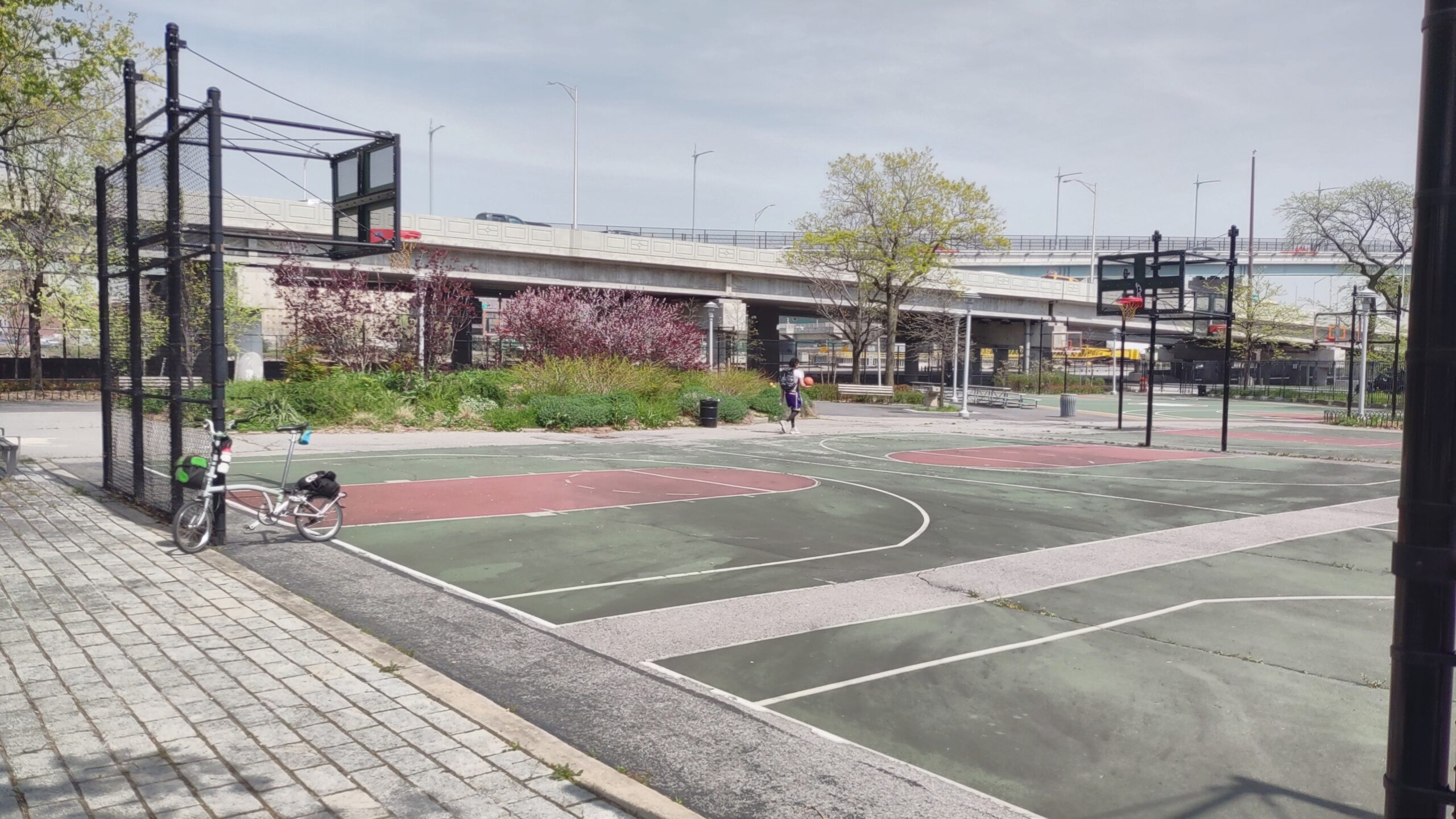
Find the mural: NYC Parks’ official playground location and directions. The wall stands near East 127th–128th Streets, Second Avenue and the Harlem River Drive in East Harlem. The NYC LGBTQ Historic Sites Project also preserves a valuable 1986 photograph of Haring standing in front of the mural, photographed by Tseng Kwong Chi, alongside views of both sides of the artwork.
What Visitors Can See Today
The work remains associated with Crack Is Wack Playground in East Harlem, near East 128th Street, Second Avenue and the Harlem River Drive. The New York City Parks Department maintains an official page for the site, including its history and location. Visitors should remember that the mural occupies both sides of a handball-court wall. A single photograph rarely conveys the full relationship between the artwork, the court and the road. Photographs from different years may also show varying states of conservation. The most reliable way to understand what is being reproduced is to check the image’s date and credit. Public access and site conditions can change, so the Parks Department is the appropriate source for current visitor information. The significance of the location is not merely that it offers a recognizable photograph. The mural remains in the public environment for which its warning was designed, allowing its history to be experienced as part of the city rather than only as a museum reproduction.
The Legacy of Crack Is Wack
Crack Is Wack endures because it carries several histories at once. It is an anti-drug warning born from a personal connection to addiction. It is a major work by an artist who believed images should reach people outside galleries. It is a document of New York’s 1980s public-health crisis. And it is a rare public mural whose original unauthorized version was erased before an officially sanctioned successor became a landmark. Its legacy should not be reduced to the catchy slogan alone. The crucial story is the movement from urgent street intervention to civic preservation, with a change in composition along the way. Haring’s figures still speak in the visual language that made him famous, but the subject remains serious. The wall asks viewers to confront the damage of addiction while reminding them that art can become part of a community’s response. Nearly four decades after the first painting, the work’s strongest quality is still its refusal to be ignored.
Sources and Further Reading
The historical chronology and preservation history were checked against the Keith Haring Foundation artwork record, the Foundation’s 2019 restoration account, the NYC LGBTQ Historic Sites Project, the Metropolitan Museum of Art and NYC Parks. For contemporary restoration reporting, see Architectural Digest.
Raptology Editorial is the official newsroom voice of Raptology, covering breaking hip-hop news, artist developments, industry trends, and in-depth editorial reports from across the global rap landscape.


Leave a Reply