
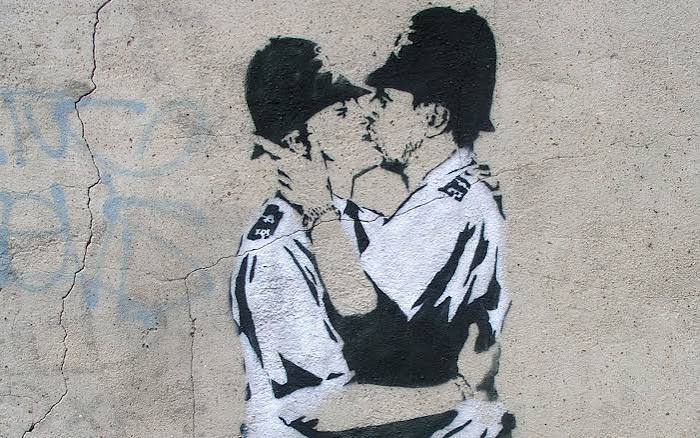
On the side of the Prince Albert pub in Brighton, England, two uniformed police officers appeared to forget the world watching them. They were kissing. Their equipment, badges and unmistakable uniforms remained in place, but the familiar image of police authority had been interrupted by a moment of intimacy. The stencil was simple enough to understand from across the street. Its consequences proved much harder to contain.
Banksy’s Kissing Coppers, widely dated to 2004, became a landmark in the British street-art movement. It also became a case study in what happens when public art is damaged, protected, removed, replicated and finally sold. The original no longer occupies the Brighton wall where the artist placed it. That distinction matters to anyone tracing the work’s actual history.
The wall on Trafalgar Street
The artwork appeared on the exterior of the Prince Albert pub on Trafalgar Street near Brighton’s city center. Multiple contemporary accounts place its creation in 2004. The image shows two male British police officers in an embrace, rendered in Banksy’s recognizable black-and-white stencil language. The officers are not stripped of their official identities: the uniforms and equipment make the contrast between public authority and private affection immediate.
Brighton’s reputation as a city with a prominent LGBTQ+ community helped make the image resonate locally, but a reading limited to sexuality would miss part of the picture. Banksy frequently used police imagery to challenge ideas about power and social control. Here, the supposed agents of order become participants in a tender scene. The image makes its point without a slogan.
The Guardian’s 2011 reporting described the work as a fixture of the city’s tourist trail and documented the controversy over its removal. Pub owner Chris Steward said an intermediary for Banksy had approached the establishment before the work appeared, although the pub did not know exactly what would be painted. That account should not be confused with a general claim that every later reproduction was authorized by Banksy.
How the stencil worked
Unlike a sprawling mural filled with lettering and layered characters, Kissing Coppers concentrates its argument in two figures. Their black silhouettes and white details allow a viewer to recognize both the kiss and the police uniforms immediately. The absence of a background narrative is part of its strength: the public supplies its own assumptions about policing, masculinity and intimacy.
It is also useful to distinguish Banksy’s stencil practice from the lettering-based subway graffiti that helped shape hip-hop’s visual language. Both occupy the contested territory of unauthorized public expression, but they developed different visual strategies and histories. Raptology’s broader history of graffiti and street culture explores that wider movement. This particular piece belongs to the street-art tradition of compact, image-led political commentary rather than a traditional writer’s name-based piece.
Vandalism against an artwork made on a wall
The irony arrived quickly. A work that itself challenged conventions of who controls public space became the target of repeated attacks. The Guardian reported that two men were caught on surveillance footage applying black paint to the image and received fines for criminal damage. Further attacks followed. The original was at risk of being lost not through planned demolition, but through accumulating damage.
Steward eventually chose preservation through removal. The Guardian reported that specialists used chemicals to transfer the work to canvas in 2008. A replacement image, protected behind Perspex, took its place at the pub. That sequence is important because later reports sometimes use the broader language of the work being removed or shipped abroad in 2011. The physical transfer from wall to canvas and the subsequent movement into the international market are different events.
When a public landmark became a private asset
In April 2011, the Guardian reported that the detached original was being offered through a New York gallery. The decision prompted criticism from people who saw the image as part of Brighton’s public identity. Steward argued that a sale could help sustain the pub. The dispute exposed two competing ideas of ownership: a property owner could claim control over a painted wall, while residents and visitors had come to regard the image as shared cultural heritage.
The economic stakes were substantial. Contemporary estimates placed the prospective sale in the hundreds of thousands of pounds. But estimates are not transactions, and the price reported in 2011 should not be presented as an actual sale price.
The Miami auction in 2014
The documented sale came in February 2014. The Guardian reported that Kissing Coppers sold at Fine Art Auctions Miami for $575,000 to an anonymous buyer. ITV News independently reported the same amount, approximately £345,000 at the time. The artwork had traveled a remarkable distance from a Brighton pub wall to an international auction room.
That result does not mean every Banksy work from the same sale found a buyer. Reports noted that two other pieces offered at the auction failed to reach their minimum prices. Nor does the public reporting establish the present owner or present location of the detached original. Those questions require current, independent provenance evidence.
What visitors actually see today
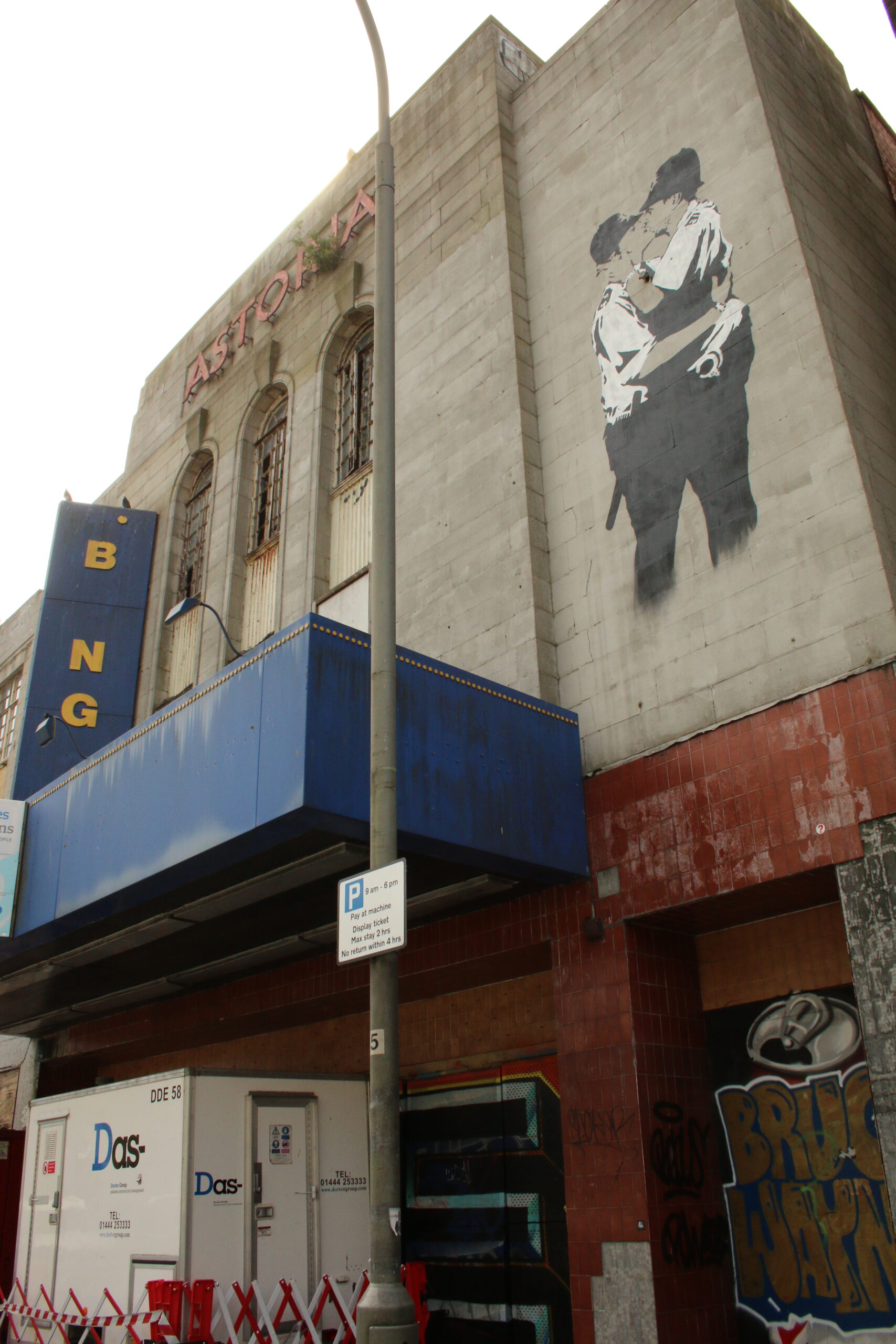
Photographs taken years after the removal document a reproduction at the Brighton site. The photograph accompanying this draft, for example, was taken in 2015 and is explicitly described by its photographer as a copy of the original Banksy image. It would be misleading to label that picture as the untouched 2004 artwork. The distinction between original stencil, detached transferred work and later facsimile is central to the story.
The image’s continued recognition also illustrates why a mural’s meaning cannot always be separated from its original setting. In Brighton, the officers were part of the street’s daily life. At auction, they became a portable object with a price. The image may remain legible in either context, but the relationship between artwork and public changes.
The lasting question
Kissing Coppers survives as a powerful example of Banksy’s ability to turn a familiar symbol against itself. It raises questions about public affection, policing and the social expectations attached to uniforms. Its later history raises equally sharp questions about who has the right to preserve, remove and profit from art placed in public space.
For a fuller view of how graffiti and street art intersect with hip-hop, explore Raptology’s Hip-Hop Culture hub. The story of this particular wall is also a reminder that an artwork’s photograph, its replica and its original physical object are not interchangeable.
Help Raptology preserve and report the stories behind street culture.
Independent artist? Get Featured on Raptology.
Related reading: Featured Stories.

Jose Zamora is a writer and creator from Boston, MA. He has been a music nerd since middle school when he started his record collection. His passion for Hip-hop began when he discovered legends like Nas and Gang Starr and became obsessed with up-and-coming acts like Kendrick Lamar and A$AP Mob.
He is a recently graduated, up-coming journalist, passionate about music and culture. He is always keeping an eye out for the next big thing and is eager to put their talent in the spotlight for others to enjoy. He believes firmly that “Good art deserves to be talked about.”








Leave a Reply