

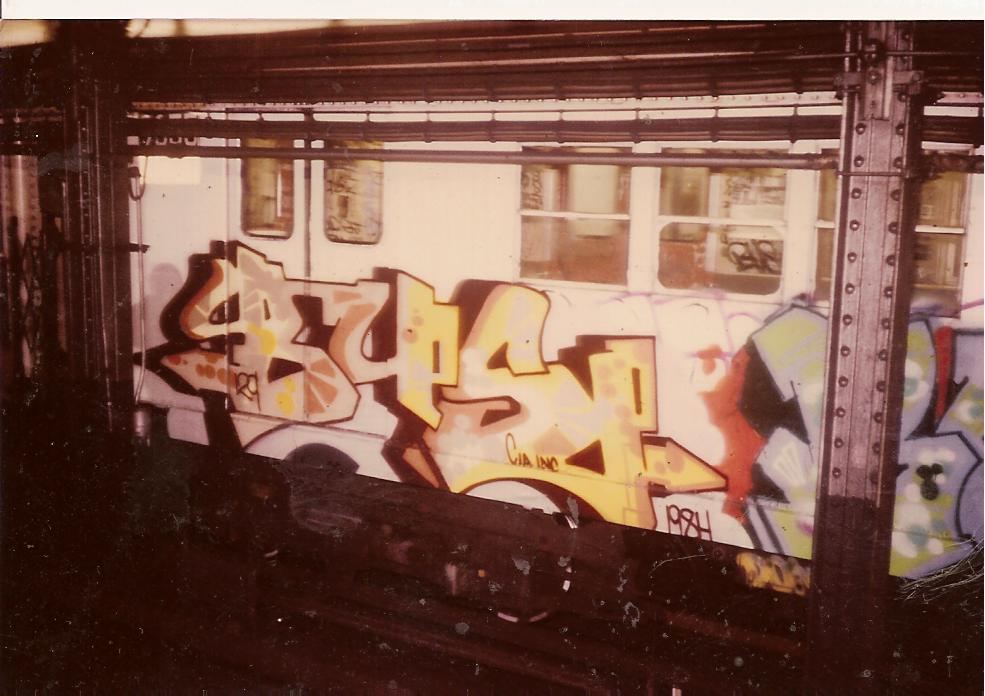
On May 31, 1980, a subway yard in Brooklyn became the setting for one of New York graffiti’s most closely documented nights. Donald “Dondi” White, a writer whose lettering had already made him a force on the trains, painted a full subway car as photographer Martha Cooper recorded the process. The work was Children of the Grave, Part 3. Its painted surface was temporary. The photographs made the moment part of an enduring visual record.
That distinction matters. The original was not a canvas preserved in a gallery, and the photographs are not interchangeable with the physical train. The piece belongs to a three-part series painted between the late 1970s and 1980, and its historical significance lies both in Dondi’s command of whole-car lettering and in the unusual access Cooper had to the creative process.
The writer behind the name
Dondi White emerged from New York’s late-1970s subway-writing culture, where artists competed for recognition through placement, scale, color and letter design. Writing a name on a train was also a way of sending it across borough lines. A whole-car painting pushed that practice toward an elaborate moving composition, visible to commuters and other writers as the train traveled.
In a remembrance published after Dondi’s death, fellow writer Zephyr described his technical discipline and the trust he developed with Cooper. The account places Cooper at New Lots Yard for the May 31 session. It is a valuable firsthand perspective, but it should be read as an artist’s recollection, not as an official transit record. Read Zephyr’s remembrance.
One work in a three-part series
The name Children of the Grave references a Black Sabbath song. It is tempting to collapse the series into one famous train, but that would distort the history. Three distinct whole-car works carried the name. The first was photographed by Francisco Reyes II, while Cooper’s images helped establish the second and third in the wider public record. The images should be identified by part number, photographer and year, not treated as interchangeable.
Cooper later explained that she did not see the photograph of Part 1 until decades after she had photographed the other works. That discovery brought together a more complete visual sequence of the series. Her retrospective account underscores how much early subway-art history depends on photographs surviving in private collections.
May 31, 1980: The New Lots session
Cooper’s presence at the yard was exceptional. Most people saw completed graffiti from a platform or passing train, not the decisions that produced it. Her documentation showed the writer at work and the piece taking shape across the side of the car. The scene became an important bridge between a practice built around fleeting public exposure and an audience encountering graffiti through books, galleries and archives.
Zephyr’s later account and archival discussion of his blackbook suggest Dondi had prepared a sketch before the painting session. An account published by graffiti historian and community site ILOVEGRAFFITI describes the drawing in Zephyr’s book and identifies June 2, 1980, as the date the finished car was photographed in circulation. Those precise dates come from recollections and archival interpretation rather than an independently located transit log. See the archival discussion.
Why the lettering mattered
Dondi’s style was more than a large signature. The relationship among letters, interior patterns, outlines and character illustrations gave the train a unified visual rhythm. The work had to read as a complete composition despite the interruptions of doors, windows and structural divisions. Its scale changed the way a viewer experienced the name: rather than one mark among many, it became the dominant visual event on an entire car.
Different parts of the series explored different solutions. Henry Chalfant’s 1980 photograph of Children of the Grave Return is held by the National Gallery of Art. Its institutional record describes an expansive multicolored composition and a prominent illustrated hand. That photograph is a record of a related work, not a substitute image for Part 3. The gallery explicitly asks users to contact it about image usage. National Gallery of Art collection record.
Cartoon influences and cross-genre imagination
Part 3 incorporated cartoon figures associated with the work of underground cartoonist Vaughn Bodē. The connection is a reminder that early graffiti writers drew from a wide visual world: comic strips, record sleeves, science fiction, commercial lettering and the illustrations circulating among friends. The Black Sabbath-derived title likewise complicates any attempt to draw rigid boundaries around what influenced a hip-hop-era artist.
Those sources did not make the work any less rooted in New York’s subway culture. Dondi combined borrowed visual references with his own highly recognizable lettering language, producing a composition that other writers could study and respond to.
Photography changed the afterlife of subway art
Subway paintings were vulnerable to cleaning, repainting, service changes and eventual scrapping. They were made for motion and exposure rather than permanent display. The images by Cooper, Chalfant and other photographers did not save the painted cars, but they allowed later audiences to see work that otherwise would have disappeared from view.
The Groninger Museum notes that photographs preserve some of the only remaining visual evidence of celebrated subway pieces by Dondi and his contemporaries. Its collection discussion connects the images to the influential 1984 book Subway Art by Martha Cooper and Henry Chalfant. Groninger Museum collection note.
There is an important distinction between preservation and ownership. The photographer holds rights in the photograph, while the underlying painting is the artist’s work. An image appearing on a museum website or in a book does not automatically authorize another publisher to reproduce it. For this article, readers can follow the institutional and archival links while rights-cleared image assets are sought.
From the subway to the art world
By 1980, collectors and cultural institutions were increasingly paying attention to graffiti. Dondi participated in the Esses Studio project, an attempt to preserve the visual energy of train writing on portable surfaces. The shift did not erase the difference between a commissioned canvas and a subway car. It showed that artists who had developed their skills outside galleries could bring that expertise into new spaces.
Later exhibitions and collections made Dondi’s work visible beyond New York. Yet Children of the Grave, Part 3 remains closely tied to the conditions that produced it: a specific yard, a train, a night of work and a photographer’s access. The surrounding cultural economy changed, but the original piece’s context cannot be recreated simply by hanging a photograph on a wall.
What survives, and what does not
The original train painting is not known to survive as an intact public artwork. The photographs and sketches are the primary means through which the series is studied. Claims that a later print, tribute mural or recreated image is the original must therefore be treated carefully. Reproductions can honor Dondi’s influence without becoming the 1980 subway painting.
That is also why image identification matters. A photograph of Part 2, a drawing for Part 3 and a modern tribute are different historical objects. Captions should name the correct work and photographer, with uncertainty stated where the surviving evidence does not settle a detail.
A lasting New York legacy
What made Dondi’s whole-car work influential was not only its visual impact. It demonstrated that graffiti writing could sustain the planning, formal experimentation and technical ambition associated with other recognized art forms while remaining accountable to the rules and rivalries of the subway scene. The work belonged to the streets and to the trains before the museums came calling.
Children of the Grave, Part 3 survives in cultural memory because it was painted with unusual skill and documented at an unusually revealing moment. The photographs offer a rare view of process, but they also remind us of everything the camera could not preserve: the movement of the car, the noise of the yard and the fleeting encounter of a rider seeing it pass.
Share your music and story with Raptology’s editorial team.
Help Raptology document the artists, histories and communities behind the culture.
Related reading
Explore more stories at Raptology’s Hip-Hop Culture hub and Graffiti: From Subway Tags to Global Art.

Shawn Grant is a Chicago-based journalist, multimedia host, and dedicated storyteller with a deep passion for hip-hop culture. His work spans artist interviews, music reporting, entertainment, and cultural commentary. Through conversations with influential figures such as Ice-T, Shawn explores hip-hop’s history, evolving legacy, and the artists shaping its future.






Leave a Reply