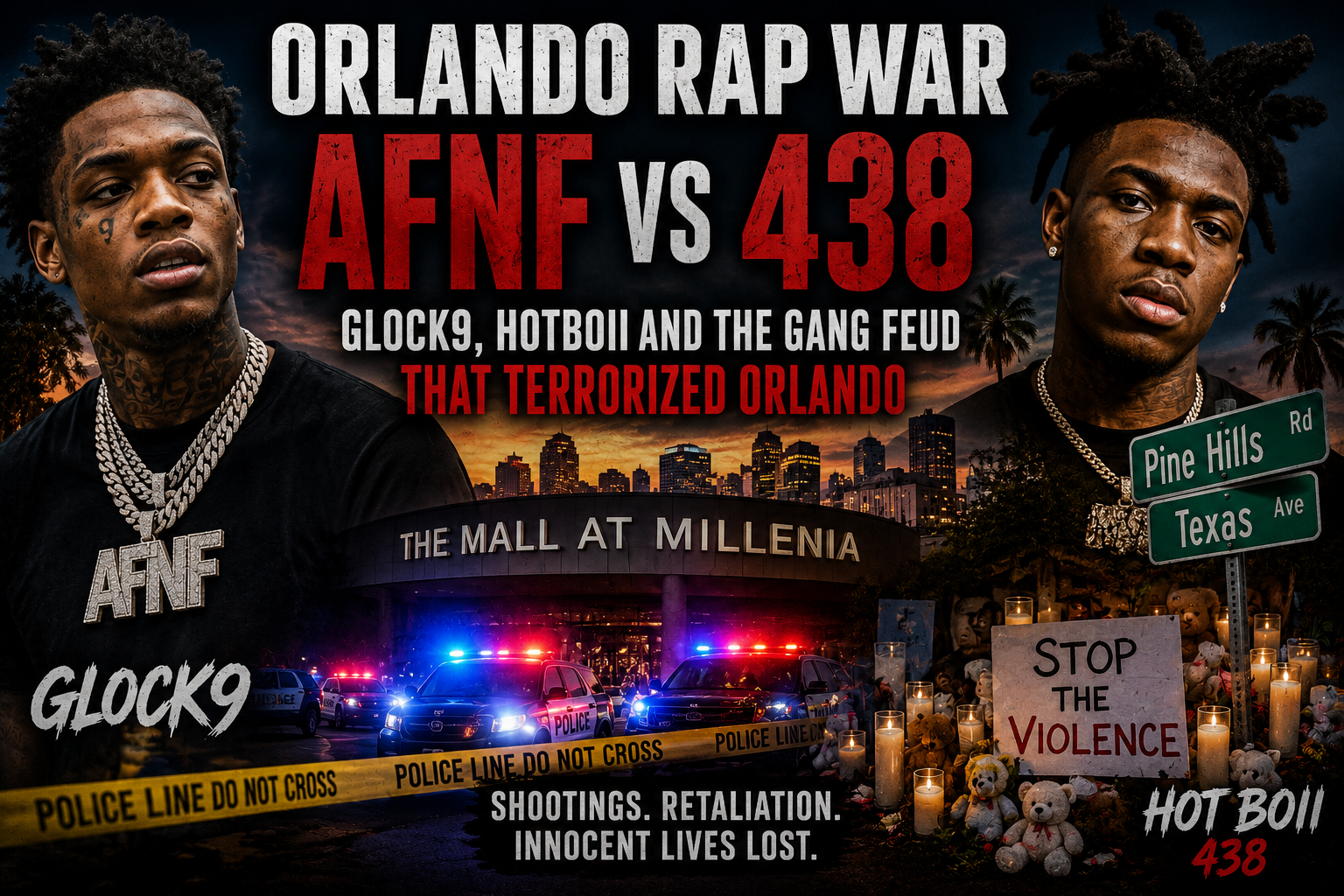
Orlando’s rap scene was supposed to be one of Florida’s next breakout movements. Instead, by 2020, the city’s rising drill wave was being discussed through shootings, federal gang pressure, public ambushes, dead teenagers, social media threats, and a feud that seemed to follow two of its biggest young names: Glock9 and Hotboii.
The conflict was often framed online as AFNF versus 438, or “The Army” versus Hotboii’s side of Orlando. To casual fans, it looked like another rap beef fueled by Instagram Live and diss songs. To law enforcement, it became something much more serious. The FBI, Orange County Sheriff’s Office, and Orlando police publicly identified the 438 gang and the Army gang as major drivers of violence in the area, saying the conflict had already been tied to multiple shootings and deaths.
Case Snapshot
Main artists: Glock9, also known as 9lokkNine, and Hotboii
City: Orlando, Florida
Frequently discussed groups: AFNF, The Army, 438, and connected local circles
Major public incident: October 8, 2020 shooting outside the Mall at Millenia
Law enforcement focus: FBI Safe Streets Task Force attention on Orlando gang violence
Known victims connected to the larger conflict: Wolph Luther King Luma, Dexter Rentz Jr., and other young victims and bystanders discussed in local reporting
Core issue: A rap friendship that turned into a street-linked rivalry with real casualties
The Florida Drill Scene Before The War
Florida has always had its own rap identity. Miami had bass music and street rap. Broward helped shape the SoundCloud era. Jacksonville became known nationally through drill, diss records, and the Yungeen Ace versus Foolio storyline. Orlando’s movement was different because it had several artists building real momentum while the streets around them were heating up at the same time.
Glock9 and Hotboii were both part of that new wave. They were young, raw, and tied to the neighborhoods and circles that shaped their music. The appeal was obvious. Fans heard energy, melody, pain, and authenticity. But the same authenticity that helped sell the music also kept the artists close to dangerous environments where reputation, retaliation, and loyalty were not just lyrics.
Who Is Glock9?
Glock9, born Jacquavius Smith, became one of Orlando’s first breakout drill-era stars. His early records like “10 Percent” and “Crayola” helped him build a regional following before his name traveled nationally. He was young, animated, unpredictable, and connected to the rawest part of Orlando’s street rap energy. That made him magnetic to fans and concerning to police.
His brand was closely tied to AFNF, short for All Family No Friends. In interviews, Glock9 pushed back against the idea that AFNF was a gang, describing it as more like a business or rap label. Law enforcement viewed things differently. As violence escalated in Orange County, officials repeatedly referred to “The Army” and 438 as groups they were watching closely.
Who Is Hotboii?
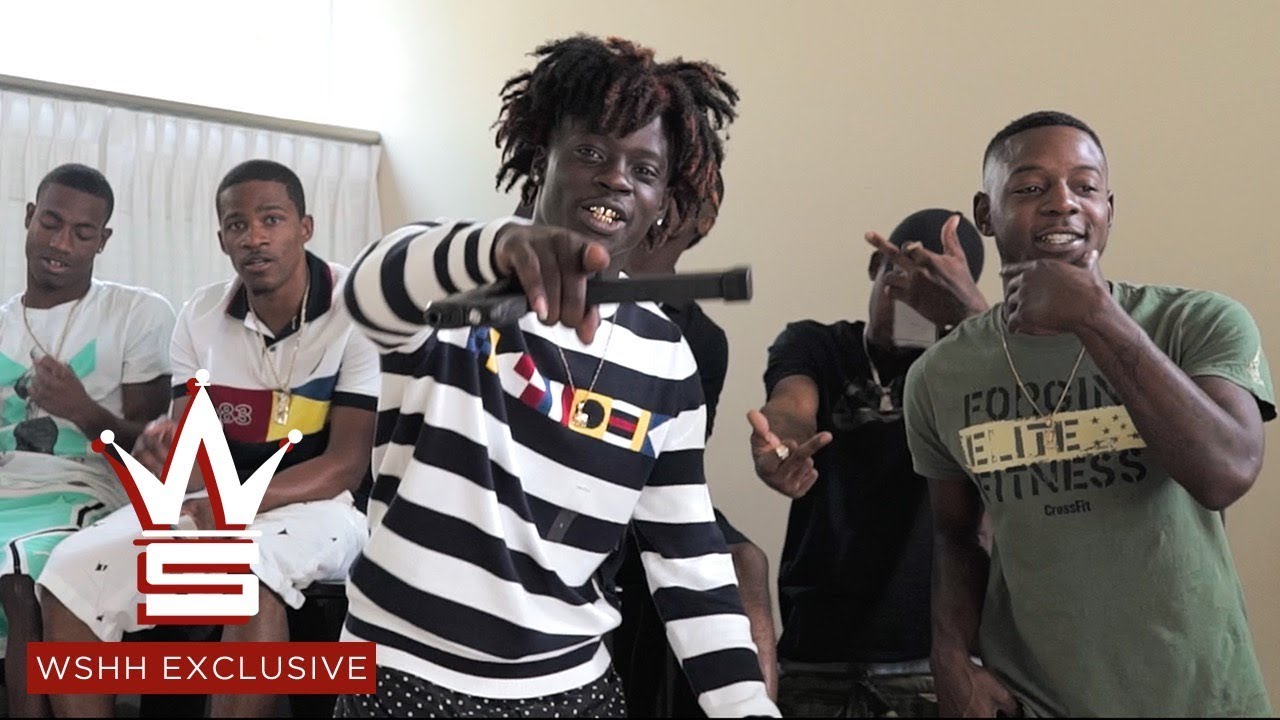
Hotboii, born Javarri Walker, became one of Orlando’s strongest melodic street voices. His breakout record “Don’t Need Time” introduced a different kind of pain music from Central Florida. He had the ability to make street trauma sound emotional without losing the aggression that made his music feel rooted in real conflict.
According to the transcript, Hotboii and Glock9 were once cool, with LPB Poody also connected to the same early circle. That is one of the most important parts of the story. The rivalry did not begin as two strangers chasing clout. It grew from a scene where people knew each other, recorded around each other, and had overlapping relationships before the split became public and violent.
Are You An Independent Artist?
Raptology covers rising artists, regional rap movements, and the stories behind independent music culture. If you are building momentum and want your story seen by hip-hop readers, submit your music for editorial consideration.
Submit Your MusicFriends Make The Best Enemies
The transcript frames the story with one chilling idea: friends make the best enemies. Glock9 and Hotboii were not originally presented as distant rivals from opposite worlds. They came from the same Florida rap ecosystem, and their circles overlapped before the relationship turned sour. When that kind of bond breaks, the conflict can become more personal than an ordinary street dispute.
Hotboii’s return from prison added another layer. The transcript describes him coming home ready to reclaim his spot in Florida rap, while other artists had gained momentum during his absence. That kind of competitive energy can be normal in music. But in an environment already tied to gangs, guns, and reputation, competition can turn into something far more dangerous.
AFNF, 438, And The Labels Behind The Violence
AFNF stood for All Family No Friends. To fans, it looked like a rap brand. To police, the broader “Army” label became part of a gang investigation. On the other side, 438 became publicly associated with Hotboii and his circle. Like many rap-linked street conflicts, the exact borders between music label, friend group, neighborhood identity, and alleged gang activity became blurred.
That blur is one reason these stories become so difficult to cover responsibly. Not every artist around a name is a gang member. Not every person in a music video is involved in violence. But law enforcement believed the conflict between these groups was real enough to bring in federal attention, and local reporting tied the feud to a series of shootings that affected both alleged targets and innocent people.
The FBI Steps Into Orlando’s Gang War
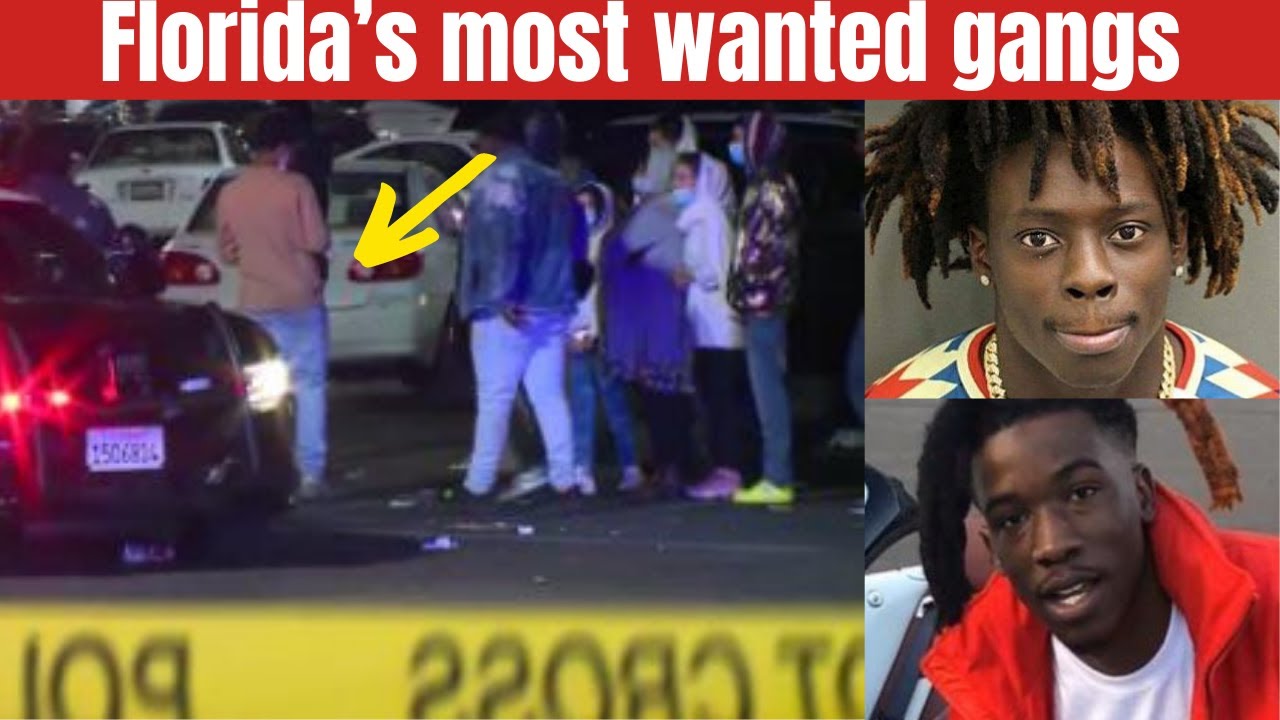
By October 2020, law enforcement publicly acknowledged that the violence in Orange County had reached a level that required more pressure. The FBI’s Safe Streets Task Force was brought into the conversation, and officials said they were focused on violent criminal street gangs, including the 438 gang and the Army gang.
That moment mattered because federal attention changes the stakes. Local cases can lead to arrests and state charges. Federal gang attention can lead to long-term investigations, conspiracy cases, surveillance, informants, and charges that carry serious prison time. Once the FBI starts speaking publicly about a rap-linked feud, the conflict is no longer just street gossip or blog content. It becomes a law enforcement priority.
The Innocent Victims
The most heartbreaking part of the Orlando story is that the violence did not only affect the people allegedly involved. Local reporting connected the broader gang feud to the deaths of young victims, including a 3-year-old boy and a 14-year-old boy. Those deaths became part of why officials pleaded for community help and warned that people knew who was responsible.
That is the reality behind many rap-linked gang stories. Fans often focus on the famous names, the diss records, the arrests, and the social media posts. Families in the city remember the children, students, and bystanders who never asked to be part of the conflict. Their names are the part of the story that cannot be reduced to entertainment.
The Cost Beyond Rap
The AFNF and 438 story is not only about Glock9 and Hotboii. It is also about children, students, families, and regular residents who were pulled into a cycle they did not create.
The Killing Of Wolph Luther King Luma
One of the major events discussed in the transcript is the April 2020 killing of Wolph Luther King Luma, described as a 438 affiliate. According to the transcript, AFNF affiliate Demetrius Cox allegedly found Luma at a house party in Davenport and shot him. Luma was taken to a hospital, where he later died.
That killing became one of the points where the feud grew more visible and more personal. In street conflicts, one death can create a chain reaction. Friends want revenge. Opponents expect retaliation. Social media adds pressure. Music turns pain into public statements. Once a name becomes tied to the scorecard, every later shooting is viewed through that lens.
The Funeral Shooting And The Death Of Dexter Rentz Jr.
Less than two weeks after Luma’s death, shots were fired at a gathering after his funeral. The transcript and local reporting connect the shooting to retaliation for Cox’s arrest. Four people were injured, and Ocoee High School football star Dexter Rentz Jr. was killed. Rentz was only 18 and had been committed to play football at the University of Louisville.
Rentz’s death showed how far the violence could spread. He was not remembered as a rapper trying to build a dangerous reputation. He was remembered as a gifted student-athlete with a future. His death turned a gang feud into a community tragedy and gave Orlando another painful example of how street violence destroys lives outside the intended target list.
The July 2020 Shooting That Killed Jeremiah Robinson
The transcript also describes a July 7, 2020 shooting involving Jeremiah Robinson and Jermaine Monterrio Ingram Jr., who allegedly pulled up on VanShawn Sands, described as connected to the 438 side. According to the transcript, Sands returned fire with a rifle, striking Robinson in the head and Ingram in the hand. Robinson died days later at Orlando Regional Medical Center.
That incident added another layer of retaliation and grief to the story. It also demonstrated how quickly alleged attackers could become victims. In these conflicts, no one stays safe for long. The person hunting today can become the person mourned tomorrow. That cycle is what makes these feuds so hard to stop.
Timeline Of The Orlando AFNF vs 438 Conflict
2018-2019: Glock9 rises as one of Orlando’s breakout street rap names, while Hotboii builds his own momentum.
2019: Glock9 faces high-profile legal trouble, including weapons and drug-related charges.
April 2020: Wolph Luther King Luma is killed, becoming one of the major deaths tied to the conflict.
April 25, 2020: Shots are fired after a funeral gathering for Luma. Ocoee football star Dexter Rentz Jr. is killed.
July 7, 2020: Jeremiah Robinson is shot during an incident involving VanShawn Sands and later dies.
October 8, 2020: Shots are fired outside the Mall at Millenia. Police say Glock9 was the intended target.
October 2020: FBI and local officials publicly identify the 438 gang and Army gang as groups drawing federal attention.
2021 onward: Glock9 faces additional serious criminal cases, while Hotboii continues building national music momentum.
The Mall At Millenia Shooting
On October 8, 2020, gunfire erupted outside Orlando’s Mall at Millenia. Police later said a 19-year-old man, Trey’von Jaheim Graham, was attempting to shoot Glock9 when he opened fire. The incident caused a major police response at one of Orlando’s most visible shopping centers, though no injuries were reported from that shooting.
The setting made the incident impossible to ignore. Street shootings are already dangerous, but a public mall adds the risk of mass panic, bystanders, families, workers, and shoppers being caught in the chaos. Once violence moves into a major commercial space, law enforcement attention intensifies immediately.
Glock9 As Victim And Suspect
The Mall at Millenia incident put Glock9 in a strange position. Police described him as the intended target of the shooting, but he was also taken into custody around the same time in connection with a separate warrant. According to the transcript, that warrant was tied to a July incident involving shots fired into a residential home.
That dual position became part of Glock9’s public story. He could be targeted by enemies and investigated by police at the same time. That is often how these street-linked rap cases unfold. Artists are not only victims or suspects in clean categories. They can be both, depending on the incident, the day, and the investigation.
The July Residential Shooting Allegation
The transcript describes a July 2020 incident on Bliesdale Avenue in Orlando, where a home was allegedly shot up while a mother and children were inside. Witnesses reportedly described multiple men with weapons outside the house, and Glock9’s name was tied to the investigation. He denied being the leader of a gang and maintained that AFNF was a business entity connected to music.
That denial reflects one of the central tensions in the case. Artists often see their crews as labels, businesses, friends, or music collectives. Police may view the same group as a criminal street gang if members are tied to shootings and weapons cases. The difference between those two interpretations can determine whether a rapper is seen as an entrepreneur or a gang leader.
Snitching Allegations And Social Media Fuel
The transcript also discusses Glock9 and Hotboii trading accusations online, including claims about cooperating with authorities. In street culture, few accusations are more explosive than calling someone a rat. Whether true or false, the accusation can damage reputation, raise pressure, and push rivals to respond publicly.
Social media made everything worse. Instagram Live, stories, snippets, and comment sections allowed every insult to travel instantly. A conflict that once might have stayed inside neighborhoods became a public performance. Fans watched, clipped, reacted, and sometimes encouraged the chaos without having to live with the consequences.
Hotboii’s Rise While The Streets Watched
While Glock9’s legal problems mounted, Hotboii’s career continued to grow. “Don’t Need Time” became one of the defining Orlando pain records of the era, and the remix with Lil Baby pushed his visibility further. He showed that Central Florida rap could be emotional, melodic, and commercially strong without losing its street edge.
But Hotboii’s success also existed in the shadow of the conflict. Fans who followed the music also followed the beef. That made his rise bigger, but it also tied his name to a story that included shootings, deaths, and law enforcement pressure. Like many artists from violent scenes, he had to carry both the music and the narrative around it.
Why Orlando’s Rap War Never Became As Famous As Jacksonville’s
Jacksonville’s drill feud became nationally infamous because its diss records, especially “Who I Smoke” and “When I See You,” went viral on a massive scale. Orlando’s conflict did not become quite as culturally visible, but that does not mean it was less serious. In some ways, the lower profile made it even darker. There were real shootings, real deaths, and real federal attention without the same level of national conversation.
That gives this story a different weight. Orlando’s AFNF versus 438 conflict is not remembered by casual rap fans the same way as Jacksonville’s Ace versus Foolio war, but for Central Florida families, the consequences were just as real. The people killed did not become viral memes. Some became local news segments, memorial posts, and case files.
The Role Of Music In The Conflict
Rap did not create the Orlando violence by itself. The conflicts existed in the streets first. But music gave the tension a soundtrack, a brand, and a way to spread beyond the city. Every song, snippet, and online taunt could become evidence of disrespect. Every fan reaction could make the artists feel like they had to keep standing on what they said.
That is the complicated truth of drill culture. The same honesty that makes the music powerful can also make it dangerous when artists are still active in the situations they rap about. A record can be art to one listener and a threat to another. A lyric can be entertainment to fans and a reason for retaliation to rivals.
The Bigger Lesson From AFNF vs 438
The AFNF versus 438 story is not only about Glock9 and Hotboii. It is about what happens when young artists become famous before they are safe, before their circles are stable, and before the conflicts around them have been resolved. It is about a music industry that benefits from danger while rarely providing a real exit strategy for artists coming from dangerous places.
It is also about how quickly a local conflict can become a public crisis. Once a feud reaches malls, funerals, neighborhoods, and federal press conferences, it has already gone far beyond rap. At that point, the music may be part of the story, but the story belongs to the city, the victims, the families, and the communities living with the aftermath.
Was Any Of It Worth It?
Glock9 became famous, but his legal troubles derailed much of his career. Hotboii became one of Orlando’s strongest voices, but his rise was tied to a scene surrounded by violence. AFNF and 438 became names that fans searched, but for families in Central Florida, those names were connected to grief.
That is the final question behind this documentary: what did the war actually produce? Streams, views, headlines, arrests, funerals, and fear. Orlando’s rap movement deserved to be remembered for its talent, not only its body count. But the AFNF and 438 conflict became one of Florida drill’s darkest chapters because too many people learned the hard way that street fame can bring attention before it brings safety.
Reader Poll: What made Orlando’s AFNF vs 438 feud so dangerous?
Raptology Editorial is the official newsroom voice of Raptology, covering breaking hip-hop news, artist developments, industry trends, and in-depth editorial reports from across the global rap landscape.
Leave a Reply