
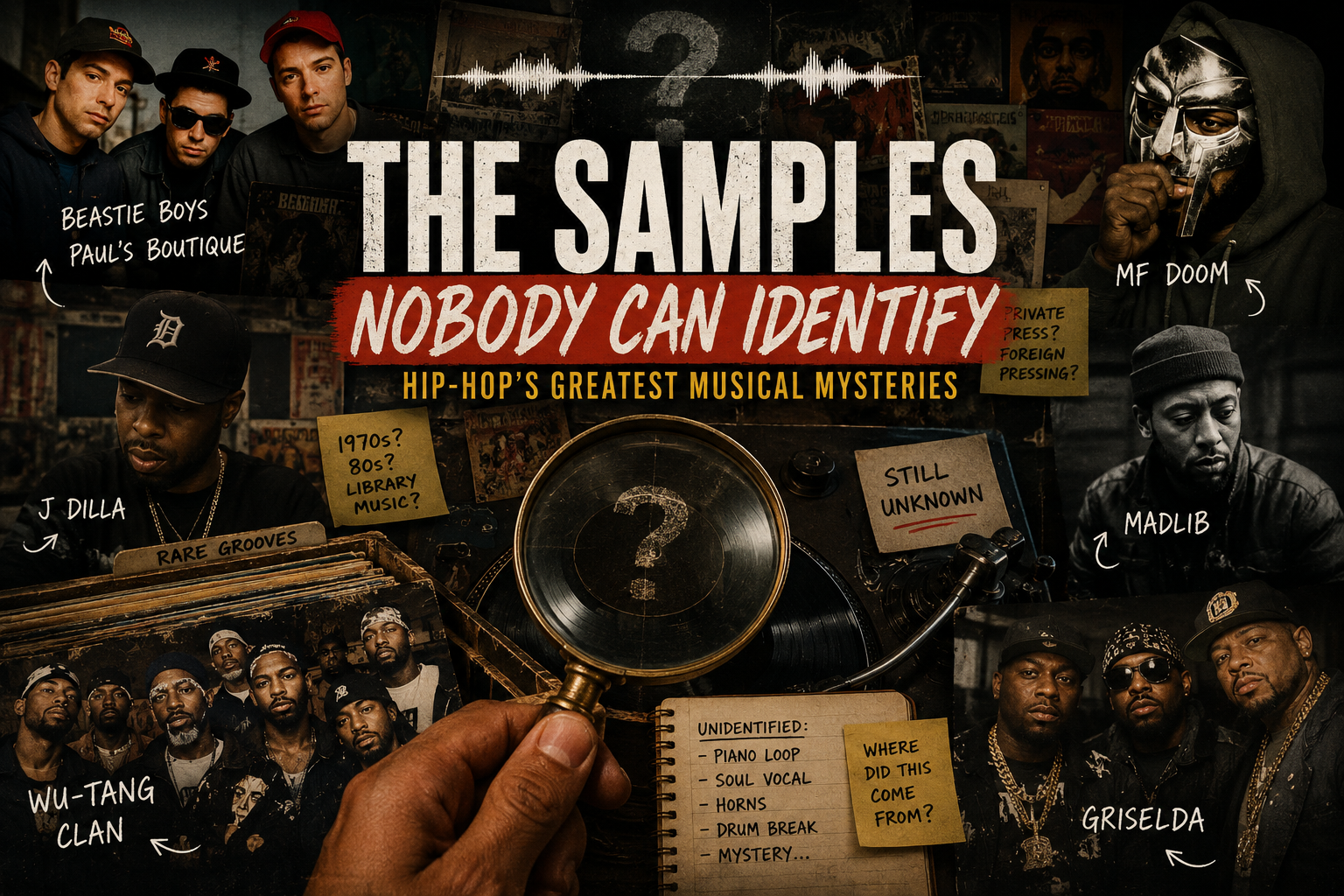
Thousands of rap samples have been tracked down by fans, DJs, record collectors and online databases. But decades after hip-hop turned digging into an art form, some sounds still refuse to reveal where they came from.
Submit Your Music To Raptology
Independent artists can submit music, videos and press materials for editorial consideration.
Submit Your Music Read More DocumentariesHip-hop was built by people who heard possibility inside other people’s records. A drum break became a new rhythm. A horn stab became a warning sign. A soul loop became a whole neighborhood’s memory. A kung-fu movie line became a mythology. For decades, producers have treated the record store, the basement crate, the thrift shop bin and the forgotten soundtrack as raw material.
Today, a lot of that history has been mapped. Sites like WhoSampled have turned sample identification into a public archive, while Discogs, YouTube, Reddit, Facebook groups and private collector circles have made it easier than ever to compare a loop against millions of known recordings. Still, even in the age of searchable audio, some hip-hop samples remain mysteries.
That is what makes the unidentified sample so addictive. It is not just a missing credit. It is an unsolved case. Somewhere, a forgotten gospel 45, library record, private-press jazz LP, regional soul single, television score, foreign film soundtrack or demo tape might hold the answer to a loop that hip-hop fans have been chasing for years.
Why Unidentified Samples Still Exist
On the surface, it seems like every sample should be easy to find now. Fans can slow songs down, pitch them up, isolate frequencies, reverse audio, compare waveforms and search huge online catalogs. But sample hunting is not that simple.
Many hip-hop producers did not sample from famous records. They sampled from dusty singles, local releases, obscure pressings, foreign records, television broadcasts, VHS tapes, movie dialogue, radio recordings and personal collections. Some records were never digitized. Some were pressed in tiny runs. Some were mislabeled. Some were released under aliases. Some were not commercially released at all.
Then there is the producer’s own manipulation. A sample can be chopped into fragments, filtered, compressed, reversed, layered, sped up, slowed down or replayed until it barely resembles the original source. J Dilla, Madlib, RZA, The Dust Brothers, MF DOOM and countless underground producers did not just loop records. They disguised them, recontextualized them and made them feel like new objects.
Paul’s Boutique: The Album That Turned Sampling Into A Maze
The Beastie Boys’ Paul’s Boutique is one of the most famous sample-based albums in rap history. Released in 1989 and produced with the Dust Brothers, the album became a landmark because of its dense collage style. Pitchfork’s 20th anniversary review described the album as a work whose reputation grew after its initially underwhelming commercial performance, eventually becoming recognized as one of hip-hop’s great sample masterpieces.
Part of the fascination is the sheer density. WhoSampled’s page for Paul’s Boutique lists a huge network of known sample connections, from funk and soul records to rock, jazz and spoken-word fragments. The Vinyl Factory has also published a track-by-track look at the records behind the album’s sample-heavy construction.
But Paul’s Boutique also represents a lost era. It arrived before the sample-clearance climate became as strict and expensive as it later became. The album was made when producers could layer dozens of references into a single track in a way that would become much harder in the 1990s and 2000s. That is why fans keep returning to it. It feels like a puzzle box from a different legal and creative universe.
The samples we know are impressive. The ones still debated are part of the legend. With a record that layered so much source material, the mystery is not whether every sound can be traced. The mystery is whether some tiny details were pulled from records so obscure that even the internet has not fully caught up.
The Lawsuits That Changed The Hunt
Sampling did not only evolve because technology changed. It evolved because the law changed. The 1991 case Grand Upright Music Ltd. v. Warner Bros. Records, involving Biz Markie’s use of Gilbert O’Sullivan’s “Alone Again (Naturally),” became one of the key legal moments in sample history. A Tulane Journal of Technology and Intellectual Property article notes that digital sampling litigation began surfacing in the early 1990s and identified Grand Upright as the first decision to address digital sampling.
Another major case, Bridgeport Music v. Dimension Films, became infamous for the phrase “get a license or do not sample.” In that case, the Sixth Circuit addressed the use of a Funkadelic sample connected to N.W.A.’s “100 Miles and Runnin’.” Harvard’s archived case materials summarize the dispute around the sound recording “Get Off” and the short guitar riff at issue, while legal scholarship has treated the decision as a turning point in how producers and labels think about clearance.
The result was not the death of sampling. But it changed the economics. Major-label albums became more cautious. Sample-heavy records became more expensive. Underground producers, mixtape artists and beatmakers continued digging, but the official credit trail often became more complicated.

MF DOOM: The Supervillain Of Hidden Sources
MF DOOM’s music turned sample hunting into a fan obsession. He built entire worlds out of cartoons, jazz loops, soul fragments, library records, 1980s R&B, old television audio, comic-book energy and villain mythology. His production as Metal Fingers and his work with Madlib on Madvillainy made him one of the most studied sample artists in underground rap.
Public databases have identified many DOOM-related sources. WhoSampled’s MF DOOM page documents hundreds of sample, cover and remix connections across his catalog. Yet DOOM fans still debate unidentified snippets, obscure transitions and loops that feel like they came from records nobody can name with certainty.
That mystery fits DOOM’s entire artistic identity. Daniel Dumile built his career around masks, aliases and misdirection. He was not trying to make everything transparent. The sample was part of the disguise. A DOOM beat could sound like a forgotten cartoon playing on a broken television in another room. The source mattered, but the aura mattered more.
This is why unidentified DOOM samples are so valuable to fans. Finding one is not just a credit correction. It feels like catching the villain leaving a clue.
Madlib: The Producer Who Made The World Feel Unsearchable
Madlib’s catalog is a nightmare and a dream for sample hunters. He has sampled jazz, psych, soul, Brazilian music, Indian records, African records, library music, private pressings, comedy records, film dialogue and sounds that often feel impossible to locate. His method is rooted in abundance. He records constantly, works quickly and pulls from a record collection that feels global rather than genre-specific.
With Madlib, the difficulty is not only obscurity. It is transformation. He might take a tiny phrase, bury it under drums, pitch it strangely, add percussion, add dialogue, then leave only a ghost of the original source. On Madvillainy, his partnership with MF DOOM turned that approach into one of the most mythologized albums in underground rap.
The sample hunt around Madlib is also a reminder that some answers may never be public. A producer’s crates are personal. Some records are rare. Some sources may come from radio, film, field recordings or material that never had a clean digital footprint. In those cases, the internet is not a magic key. It is only another crate.
J Dilla: The Human Touch Inside The Machine
J Dilla made samples feel alive. His drums leaned, dragged, snapped and breathed in ways that producers are still trying to understand. Donuts, released in 2006, became one of the most studied instrumental hip-hop albums ever. WhoSampled’s Donuts page documents a long list of known source connections, while the project Sampling Donuts explores the album’s sample data as a form of cultural research.
But identifying Dilla samples does not fully explain Dilla. That is the difference. You can know the source record and still not understand how he made the beat feel that way. His genius was not simply choosing records. It was timing, swing, cut points, silence and emotional compression.
Dilla’s sample history also shows how older records can re-enter legal and cultural debates years later. Pitchfork reported in 2018 that a 10cc sample used on “Workinonit” from Donuts became the subject of a copyright infringement lawsuit. That case underlined how samples can remain legally active long after the music becomes part of hip-hop history.
For sample hunters, Dilla represents the high point of the puzzle. Some sounds are traceable. Some are debated. Some are known but still mysterious because the magic was never only in the source.
Wu-Tang Clan: Kung-Fu, Soul And The Sound Of A Hidden Basement
Wu-Tang Clan’s debut album Enter the Wu-Tang (36 Chambers) created one of hip-hop’s most recognizable sample worlds. RZA pulled from soul records, dusty drums and martial-arts films to create a sound that felt raw, cinematic and underground. Pitchfork’s Sunday Review of Enter the Wu-Tang emphasized the album’s lo-fi, cinematic beats and the way RZA’s production helped redefine New York rap in the 1990s.
Wu-Tang’s sample mystery is not only musical. It is also cinematic. Some of the most famous Wu-Tang moments come from kung-fu dialogue, dubbed film clips and martial-arts mythology. Wired once published a breakdown in which RZA discussed kung-fu samples by film and song, showing how deeply martial-arts cinema shaped the group’s language.
Many Wu-Tang samples have been identified. WhoSampled’s page for Enter the Wu-Tang (36 Chambers) tracks known connections from the album. But the Wu-Tang universe still feels mysterious because RZA’s production was about atmosphere as much as citation. Static, hiss, movie grit, chopped dialogue and basement-level distortion became part of the identity.
Sometimes the mystery is not “what record did he use?” Sometimes the mystery is “how did he make the whole thing feel like it came from a cursed VHS tape?”
Join The Raptology Rap Contest
Think your music deserves a bigger platform? Enter the Raptology Rap Contest and compete for exposure.
Enter The Contest Latest Rap NewsGriselda: The New Era Of Dusty Mystery
Griselda helped bring grimy, sample-based rap back into the mainstream conversation. Westside Gunn, Conway the Machine and Benny the Butcher built a movement around cold loops, minimal drums, luxury-crime imagery and an atmosphere that felt closer to old vinyl smoke than modern radio polish.
Producer Daringer became central to that sound. Ambrosia For Heads described him as a producer who built the sonic foundation for Griselda Records, producing for Westside Gunn, Conway and Benny while helping bring the Buffalo movement into the mainstream.
Griselda’s sample mystery works differently from the older legends. Fans now have more tools than ever, but the production style is intentionally sparse and foggy. A loop might be so short, filtered or textural that it becomes difficult to trace. Sometimes the sample is not an obvious hook or melody. It is a mood: one eerie chord, one vocal sigh, one piano phrase, one dusty piece of atmosphere.
That is why Griselda belongs in this conversation. The group did not just revive old-school production. They revived the feeling that a beat could be a locked room.
Why Sample Hunters Are Hip-Hop Historians
Sample hunting can look like trivia from the outside. But it is really a form of historical work. Every identified sample connects one generation to another. A rap record might lead a teenager to a 1970s soul singer, a Brazilian psych band, a jazz drummer, a gospel choir, a Hong Kong action film, a library composer or a forgotten regional label.
That is why unidentified samples matter. They are missing bridges. Until the source is found, the original musician remains hidden from part of the story. The producer gets studied. The rapper gets streamed. The beat becomes legendary. But the older artist whose sound helped create the moment may remain unnamed.
At its best, sample identification gives credit back to the past. It turns a mystery sound into a human story.
Beastie Boys
Paul’s Boutique remains one of rap’s most famous sample-collage albums, with layers that still invite investigation.
MF DOOM
DOOM’s samples often feel like clues from a masked universe of cartoons, jazz, soul and villain mythology.
Madlib
His global crate-digging style makes some sources feel almost impossible to trace with certainty.
J Dilla
Even when the source is known, Dilla’s timing and swing keep the real method mysterious.
Wu-Tang Clan
RZA turned soul records and kung-fu dialogue into a cinematic language that still feels hidden and raw.
Griselda
The Buffalo movement revived the dusty loop as modern street cinema, often built from foggy, hard-to-trace textures.
The Timeline: How Sampling Became A Mystery Culture
The Internet Solved A Lot. It Did Not Solve Everything.
The modern sample hunter has tools that earlier generations could barely imagine. They can compare international pressings, search record databases, ask collector groups, scan YouTube uploads, check Discogs credits, isolate vocals and crowdsource theories in minutes.
But the internet only contains what has been uploaded, cataloged or remembered. If the source record is sitting in a private collection, never digitized, mislabeled in a warehouse or pressed in a tiny run decades ago, the trail can go cold. If the source was from a television broadcast, unreleased soundtrack, film dub, radio show or private tape, the mystery becomes even harder.
That is why the unidentified sample still has power. It reminds fans that hip-hop history is not fully digitized. Some of it is still physical. Some of it is still regional. Some of it is still locked in crates.
The Moral Question: Should Every Sample Be Found?
There is another side to the hunt. Some producers may not want every source revealed. Digging has always involved secrecy. DJs once covered record labels so rivals could not steal breaks. Producers guarded crates because the source was part of the craft. Finding an unknown sample can honor the original artist, but it can also expose a producer’s private method.
That tension has always existed in hip-hop. The culture celebrates knowledge, but it also celebrates mystery. A producer’s sound is part research, part taste and part magic trick. If every source is revealed, one layer of the illusion disappears. But if no sources are revealed, the older musicians who created the raw material can remain invisible.
The healthiest version of sample hunting respects both sides. It treats sources as history, not as theft of technique. It credits the past without flattening the producer’s artistry.
Raptology Hall Of Fame Context
Sampling is one of the reasons hip-hop deserves museum-level preservation. It connects generations of Black music, global crate-digging, street innovation, legal battles and production genius into one living archive.
Visit The Rap Hall Of Fame Featured StoriesFinal Word
The samples nobody can identify are more than unsolved trivia. They are proof that hip-hop still contains secrets. Even after decades of databases, documentaries, lawsuits, fan theories and digital archives, the culture still has hidden rooms.
Some of those rooms belong to the Beastie Boys and the Dust Brothers. Some belong to MF DOOM and Madlib. Some belong to J Dilla’s impossible timing. Some belong to RZA’s kung-fu imagination. Some belong to Griselda’s modern dust. And some belong to unknown singers, drummers, composers and musicians whose records are still waiting to be found.
That is the beauty of the mystery. Every unidentified sample is a question hip-hop is still asking the past.
Want Your Story Featured On Raptology?
Artists, producers, managers and labels can request editorial features, interviews and promotional coverage through Raptology and FAMED PR.
Request A Feature Contact RaptologyPoll: Which producer’s samples are the most mysterious?
MF DOOM: 0
Madlib: 0
J Dilla: 0
RZA / Wu-Tang Clan: 0
WhoSampled: Sample database and music connection archive
WhoSampled: Beastie Boys — Paul’s Boutique sample connections
Pitchfork: Paul’s Boutique 20th Anniversary Review
The Vinyl Factory: The records behind Beastie Boys’ Paul’s Boutique
WhoSampled: MF DOOM sample connections
WhoSampled: J Dilla — Donuts sample connections
Sampling Donuts: Research project on J Dilla’s Donuts
Pitchfork: J Dilla’s 10cc sample on Donuts lawsuit report
Pitchfork: Enter the Wu-Tang (36 Chambers) review
Wired: RZA breaks down kung-fu samples by film and song
Ambrosia For Heads: Daringer and the Griselda sound
Tulane Journal of Technology and Intellectual Property: Sampling litigation and Grand Upright






Leave a Reply