
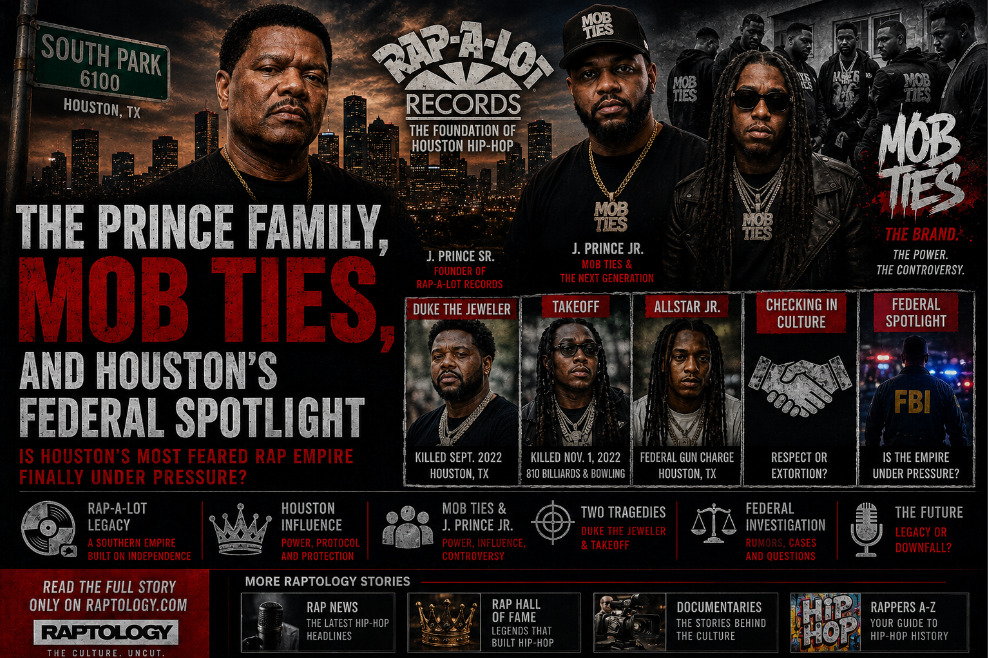
For nearly four decades, J. Prince and the Prince family have stood at the center of Houston hip-hop — respected by some as protectors and power brokers, feared by others as gatekeepers whose influence extends far beyond music.
The story begins with Rap-A-Lot Records, the independent Houston label that helped bring Southern rap into the national conversation. Founded by J. Prince in the 1980s, Rap-A-Lot became home to some of the most important voices in Texas rap history, including the Geto Boys, Scarface, Devin the Dude, Z-Ro, and other artists who helped turn Houston into a permanent force within hip-hop culture.
But the Prince family legacy has never been only about albums, contracts, and record sales. Around the music business came something more complicated: a reputation for street authority, “checking in,” behind-the-scenes pressure, and a level of influence that many rappers, executives, and outsiders treated with unusual caution.
In recent years, that reputation has entered a darker phase. The killings of Duke The Jeweler and Takeoff, the public controversy around Mob Ties, the rise of J. Prince Jr., violent incidents around Houston nightlife, and rumors of federal attention have led many fans to ask a question that once seemed almost unthinkable: is Houston’s most feared rap empire finally under pressure?

Get Featured On Raptology
Independent artists, managers, and labels can submit music for editorial coverage, interviews, and promotional visibility across Raptology.
Submit Your MusicThe Rap-A-Lot Empire
J. Prince built Rap-A-Lot Records at a time when Houston was not treated as a major rap capital by the national industry. New York and Los Angeles dominated the conversation, while Southern artists often had to build their own networks, press their own records, and force the business to recognize their audiences.
Rap-A-Lot became one of the labels that changed that. The Geto Boys gave the South a national shockwave. Scarface became one of hip-hop’s most respected storytellers. The label’s sound was darker, heavier, more regional, and more rooted in the realities of Houston than anything the coastal industry was used to hearing.
The company’s success made J. Prince more than a label owner. He became a symbol of independent Black ownership in rap, a businessman who moved with the confidence of someone who understood both the streets and the boardroom. In Houston, that image became almost larger than the catalog itself.

To supporters, J. Prince represented discipline, loyalty, protection, and business intelligence. To critics, his reputation carried an undercurrent of intimidation. That dual image is the key to understanding the rest of the story.
Rap-A-Lot’s influence is undeniable. The controversy is what kind of influence surrounded it.
Raptology Documentary note: This article discusses public reporting, interviews, online allegations, transcript claims, and ongoing legal matters. Claims that have not been proven in court are described as allegations, theories, or speculation — not established legal facts.
The Meaning Of “Checking In”
Few phrases are more closely tied to the Prince family’s public image than “checking in.” In its cleanest form, checking in can mean respect. A rapper arrives in a city, contacts respected local figures, and makes sure there are no problems. In a dangerous industry where artists travel with jewelry, cash, security, and street affiliations, that kind of local awareness can be practical.
But critics see something else. They argue that “checking in” can become a form of pressure — a system where visiting artists feel they need permission, approval, or protection from powerful local figures. In that darker interpretation, checking in begins to sound less like courtesy and more like control.
Houston became one of the cities most associated with this idea. Stories circulated for years about artists needing to respect the Prince family’s position before moving through the city. Some saw that as protocol. Others saw it as intimidation.

The transcript behind this documentary connects checking in to a larger law-enforcement concern: when street reputation, music industry access, and implied power begin to overlap, prosecutors may interpret the language differently than fans do.
Inside hip-hop, “checking in” can be framed as respect. Inside a courtroom, the same concept can look like something more serious if prosecutors believe it involved threats, coercion, or money. That distinction matters because the federal government has increasingly looked at music-adjacent organizations through the lens of gangs, crews, and alleged criminal enterprises.
Key distinction: Being powerful, respected, feared, or controversial is not the same as being criminally guilty. But in modern federal cases, prosecutors often study patterns, language, associations, and repeated incidents over long periods of time.
Mob Ties And The Next Generation
J. Prince Jr. entered the public story as part of the family’s next generation. While J. Prince Sr. was tied to Rap-A-Lot’s historic rise, Junior became more associated with Mob Ties, Houston nightlife, the city’s younger rap orbit, and the family’s modern street-brand presence.
Mob Ties is difficult to define from the outside. It has been described as a brand, a label, a crew, and a movement. Drake helped push the name into global rap culture with his 2018 song “Mob Ties,” making the phrase familiar to millions of fans who may not have fully understood its Houston roots.
That ambiguity is part of the controversy. Mob Ties does not read like a traditional label in the public imagination. It feels like a network — a name attached to access, protection, relationships, loyalty, and intimidation depending on who is telling the story.

The transcript argues that Junior’s public profile has become one of the biggest vulnerabilities for the family. While J. Prince Sr. built an empire over decades, Junior’s name has repeatedly surfaced around incidents that became viral, controversial, violent, or legally sensitive.
That does not mean Junior has been proven guilty of the allegations made online. It does mean his presence near multiple controversies has changed public perception. In hip-hop, perception can harden quickly. Once people begin to believe there is a pattern, every new incident gets interpreted through that pattern.
The NBA YoungBoy Situation
One of the first major public moments that introduced a younger generation to the Prince family’s influence involved NBA YoungBoy. In 2020, YoungBoy’s Houston home was reportedly burglarized. J. Prince Sr. later appeared online saying that some of the stolen items had been recovered and could be returned.
On the surface, that could be read as help. But YoungBoy did not receive it that way. He publicly pushed back, questioning why the situation had been posted online rather than handled privately. His response cut to the core of the Prince family’s public image: was this protection, or was it a power move?
That moment mattered because NBA YoungBoy is not a quiet artist. He has his own massive fan base, his own street reputation, and his own crew. His refusal to publicly accept the gesture as a favor created a rare moment where a younger superstar challenged the Prince family’s approach in real time.
According to the transcript, the situation was later smoothed over with help from Birdman and others, but the larger point remained. The Prince family’s idea of helping could look different to the person being “helped.” In an era where every move becomes content, that difference can explode online.
Duke The Jeweler And The Houston Nightlife Shadow
In September 2022, Chicago jeweler Duke The Jeweler was killed outside Houston’s Arena Theatre after attending a concert event. Public reporting described him as a 29-year-old victim shot in a parking area after leaving the venue.
The case immediately attracted hip-hop attention because of the company Duke had reportedly been around before his death. The transcript discusses allegations involving a dice game, expensive jewelry, large amounts of money, Boosie, and people within the Mob Ties orbit. Many of those claims remain unproven, but they became central to how fans interpreted the case.

The most important confirmed fact is that Duke was killed. The most important cultural fact is that fans immediately began asking why a jeweler connected to high-profile rap circles ended up dead in Houston.
That is where the Mob Ties conversation grew darker. Whether the online theories were true or not, the death reinforced an image that Houston nightlife could be dangerous when rap money, jewelry, gambling, and street reputations entered the same room.
Takeoff’s Death Changes Everything
Less than two months after Duke The Jeweler’s death, Houston became the scene of another devastating hip-hop tragedy. On November 1, 2022, Takeoff of Migos was shot and killed outside 810 Billiards & Bowling after a private event. He was 28 years old.
Takeoff’s death shocked fans because he was widely viewed as the quietest and least controversial member of Migos. He was not known for reckless public drama. He was not the loudest personality in the group. He was respected for his flow, his calm presence, and his role in helping make Migos one of the most influential rap groups of the 2010s.
That made the circumstances feel even more senseless. Reports described an argument, a gathering outside the venue, gunfire, and chaos. Patrick Xavier Clark was later charged with murder in connection with Takeoff’s death. Clark has maintained his innocence, and the case has moved slowly through the legal system.
The tragedy became tied to the Prince family in the public mind because the event was connected socially to the Mob Ties orbit, and because J. Prince Jr. was seen in footage from the night. A short clip of Junior walking past the scene after the shooting circulated widely and produced intense criticism.
The Prince family later pushed back on the way that clip was interpreted, arguing that it did not show the full situation. But by then, the internet had already made up its mind in many circles. For critics, the image became symbolic: another tragedy, another Houston incident, another moment where people questioned what really happened around Mob Ties.
Confirmed public record: Takeoff was killed outside 810 Billiards & Bowling in Houston on November 1, 2022. Patrick Xavier Clark has been charged with murder and has maintained his innocence while awaiting trial.
The Memorial Backlash And The Million Dollaz Interview
After Takeoff’s death, the Prince family’s public response became another controversy. A memorial outside the bowling alley drew backlash because many fans felt the family name was too visually prominent compared with the tribute to Takeoff himself. Whether intentional or not, the arrangement was criticized as tone-deaf.
Then came the Million Dollaz Worth of Game appearance, where J. Prince Sr., J. Prince Jr., and Mike Prince gave their side of the story. Instead of calming the situation, the interview created even more discussion. J. Prince Sr. defended his family, pushed back against allegations, and made comments involving Offset that triggered a strong response.
Offset publicly criticized the Prince family for speaking on his relationship with Takeoff. His reaction was emotional and direct. To many fans, Offset said what they already felt: that Takeoff’s family and loved ones should not have to watch others repeatedly use the tragedy to defend themselves in public.

That moment changed the Prince family’s public image outside Houston. Before, many fans saw them as legendary power brokers. After Takeoff, a growing number began viewing them through suspicion and resentment.
Legacy can survive controversy. But when a beloved artist dies and the public believes the people around the situation are trying to control the narrative, the backlash becomes much harder to contain.
The Bond, The Lawyers, And The Questions
Another layer of speculation developed around Patrick Xavier Clark’s bond and legal defense. Clark was released on a $1 million bond, and online commentators later pointed to his legal representation and financial support as reasons to question who might be helping behind the scenes.
Speculation is not proof. A defendant hiring strong lawyers does not automatically prove a larger organization is involved. A family friend or supporter helping with bond does not prove conspiracy. Still, in a case already surrounded by dice-game rumors, Mob Ties proximity, Houston nightlife, and the Prince family’s reputation, every detail became part of a larger theory.
That is the power and danger of reputation. Once people believe a group has hidden influence, even normal legal developments can be interpreted as evidence of that influence.
Important legal note: Patrick Xavier Clark is presumed innocent unless proven guilty in court. Online speculation about who may be financing legal fees or influencing the case should not be treated as confirmed fact.
Allstar JR, 4KT, And Another Houston Incident
The most recent incident discussed in the transcript involves Detroit rapper Allstar JR, NBA YoungBoy’s 4KT circle, J. Prince Jr., and a violent confrontation at a Houston venue. According to the transcript, tension exploded inside Confessions Bar and Restaurant during a birthday gathering involving OG 3 and members of YoungBoy’s circle.
The altercation reportedly involved Allstar JR being attacked, jewelry being taken, and then a shooting that left people badly injured. The transcript describes Ben 10 as suffering life-changing injuries, while Deadend Ron was also injured. Allstar JR was later charged federally with being a felon in possession of a firearm.
What made the case especially interesting was the federal angle. The transcript questions why federal authorities became involved in what initially looked like a local shooting. The answer may be jurisdictional — firearm possession by a convicted felon can become federal. But online commentators have suggested that prosecutors may be using the case to pressure cooperation.
That theory remains speculation. But it fits how federal cases sometimes work. Prosecutors can begin with a narrow charge, then build outward if they believe the person charged can provide information about others. Whether that is happening here has not been publicly proven.
What matters culturally is that another violent Houston incident again brought J. Prince Jr. into the conversation. Even if he is not charged, his name continuing to appear around these situations keeps the public narrative alive.
The Wack 100 Factor
A large part of the modern conversation around J. Prince Jr. and Mob Ties has been driven by Wack 100, one of hip-hop media’s loudest and most polarizing voices. The transcript includes multiple claims from Wack involving Duke The Jeweler, alleged dice-game schemes, Takeoff, a bodyguard death, Houston club incidents, and possible federal activity.
Wack 100 is not law enforcement. His claims should not be repeated as proven facts. But they matter because he has helped make these theories part of the mainstream rap conversation. His comments travel through YouTube, Clubhouse, Instagram, podcasts, reaction channels, and blogs. Once repeated enough, they become part of how fans interpret the story.
This creates a difficult problem for hip-hop journalism. Ignoring the claims would ignore the way fans are discussing the Prince family today. Treating the claims as confirmed fact would be irresponsible. The only honest approach is to explain what is alleged, what is confirmed, and where the line between the two sits.
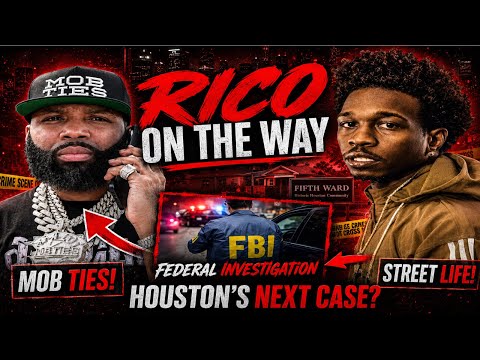
Raptology does not present online allegations as established fact. Claims from commentators are included here because they have shaped public perception, not because they have been proven in court.
Is The Federal Spotlight Getting Brighter?
The transcript argues that federal attention around the Prince family may be growing more serious. It references a broader climate in which federal authorities have increasingly examined rap crews, alleged street networks, and music figures whose public image overlaps with accusations of organized activity.
That does not mean an indictment is guaranteed. Federal investigations can last years and never result in charges. They can also move quietly until the government believes it has enough evidence to make a broad case.
What is clear is that the public story has shifted. The Prince family is no longer being discussed only as the family behind Rap-A-Lot, Houston rap, Scarface, and Southern hip-hop history. They are now being discussed in connection with Mob Ties, Takeoff, Duke The Jeweler, Allstar JR, checking in, and possible federal scrutiny.
That shift alone is significant. Once a legendary family becomes a recurring subject of suspicion, the legacy becomes harder to protect.
What Is Confirmed?
Rap-A-Lot’s historic influence, Takeoff’s death, Duke The Jeweler’s killing, and the public controversies around Mob Ties are part of the public record.
What Is Alleged?
Claims about rigged dice games, hidden protection systems, federal cooperation, and who may have directed certain incidents remain allegations unless proven.
Why It Matters
The Prince family’s reputation has become part of how fans interpret every new Houston incident connected to the rap world.
The Legacy At Risk
J. Prince’s place in hip-hop history is secure. Rap-A-Lot helped build Southern rap’s foundation. Scarface became a legend. Houston became a national force. The Prince family’s influence touched music, boxing, Drake’s career, and the way artists understood power in the South.
But legacies are not frozen in time. They can be strengthened by the next generation, or damaged by it. That is the tension around J. Prince Jr. and Mob Ties. Did Junior inherit a powerful name and modernize it for a new era, or has his generation brought the kind of attention that could threaten what Senior built?
The biggest danger may not be one specific case. It may be accumulation. One controversy can be explained. Two can be debated. Three or four begin to look like a pattern. In hip-hop, patterns become stories. In federal investigations, patterns can become evidence.

Timeline: Rap-A-Lot, Mob Ties And The Federal Spotlight
Enter The Raptology Rap Contest
Think your music deserves a bigger audience? Submit your track and compete for visibility on Raptology.
Join The ContestFrequently Asked Questions
Who is J. Prince?
J. Prince is the Houston music executive who founded Rap-A-Lot Records and helped make Houston a major force in Southern hip-hop.
What is Mob Ties?
Mob Ties is a brand and movement associated with J. Prince Jr., Houston rap culture, Drake’s orbit, nightlife, and the Prince family’s modern influence.
What does checking in mean?
Checking in can mean contacting respected local figures when entering a city. Critics argue it can also resemble pressure or intimidation depending on the situation.
The Final Word
The Prince family story is not simple. It is not only a story about a rap label. It is not only a story about street power. It is not only a story about allegations, tragedy, or federal speculation. It is all of those things at once.
J. Prince helped build Houston hip-hop into something permanent. Rap-A-Lot Records changed the South’s place in the industry. That legacy cannot be erased. But the modern Mob Ties era has made the Prince name more controversial than ever.
Whether the federal spotlight becomes a real legal threat remains to be seen. What is already clear is that the public perception has changed. The Prince family once looked untouchable. Now, every new incident is examined for patterns, every public statement is dissected, and every connection becomes part of a larger question.
In hip-hop, power creates respect. But when too much tragedy begins to gather around that power, respect can turn into suspicion. That is the line the Prince family now appears to be walking.
Rap Hall Of Fame
Explore the legends who shaped hip-hop culture inside the Raptology Rap Hall Of Fame.
Rappers A-Z
Browse artist histories, profiles, and career guides through Rappers A-Z.
Latest Rap News
Follow new developments in hip-hop through Latest Rap News.
Want A Raptology Feature?
Raptology covers rising artists, independent rappers, producers, DJs, and major hip-hop stories. Submit your music today for editorial consideration.
Submit Your MusicReader Poll: What is the biggest part of the Prince family legacy?

Raptology Editorial is the official newsroom voice of Raptology, covering breaking hip-hop news, artist developments, industry trends, and in-depth editorial reports from across the global rap landscape.

Leave a Reply