
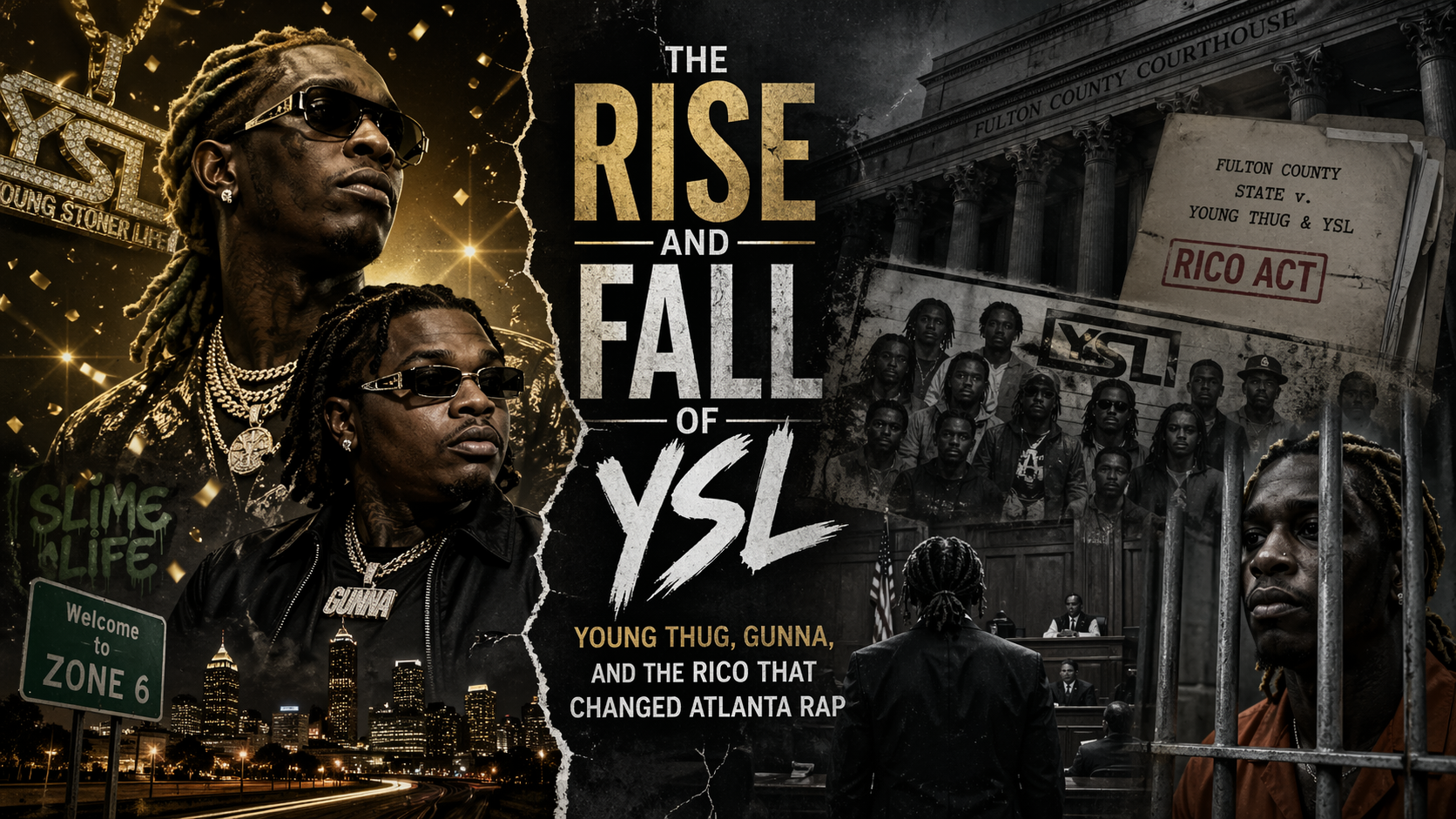
YSL was never just another rap label story. At its peak, it looked like one of Atlanta’s most powerful modern movements: Young Thug at the center, Gunna rising fast beside him, a roster full of momentum, and a sound that felt slippery, melodic, futuristic, and completely local at the same time. For a while, YSL looked less like a crew and more like the next dominant rap institution. Then the RICO case arrived, and the whole mythology changed. What had once looked like a creative empire suddenly became the subject of one of the most closely watched criminal cases in modern rap history, forcing the public to ask whether YSL had been a label, a lifestyle, a brotherhood, a brand, or something the state argued was much darker. That is what makes this such a powerful documentary subject: the rise was real, the music changed Atlanta, and the fall changed the way rap would talk about labels, loyalty, and lyrics in court.


YSL rose because it felt like Atlanta’s next major evolution, not just another label rollout
What made YSL feel so important at the beginning was that it did not arrive like a carefully packaged corporate imprint. It felt looser, stranger, more alive than that. Young Thug had already become one of rap’s most disruptive voices, a stylist whose influence spread through melody, phrasing, fashion, and attitude. He was not simply making popular music. He was altering the shape of what modern Atlanta rap could sound like. Once YSL began to look like a real ecosystem around him, it seemed like the natural next step in that evolution.
The appeal of YSL was that it worked on several levels at once. It was a creative family, a branding vehicle, a pipeline for new talent, and a visual language that fans understood immediately. It signaled Atlanta, but not in a nostalgic way. It signaled new Atlanta, where melody could be more important than rigid bars, where voice itself could be an instrument, and where artists did not have to sound cleanly defined to dominate the conversation. That gave YSL the feeling of a movement rather than a label roster.
Movements like that hold attention because they offer fans more than songs. They offer a world to enter. YSL had a distinct sound, but it also had an internal mythology, a sense of hierarchy, and a visual culture that made every new release feel like part of a bigger unfolding story. At its peak, it looked like the kind of rap institution that could define an era the way earlier Atlanta crews and labels had done before it.
Young Thug and Gunna gave YSL its most commercially magnetic center
No matter how broad the movement became, the emotional and commercial core of YSL was the relationship between Young Thug and Gunna. Thug was the innovator, the once-in-a-generation stylist, the artist who made chaos sound elegant. Gunna was the smoother extension of that world, less explosive but easier for large audiences to settle into. Together, they created one of rap’s most effective mentor-protégé pairings, with Gunna becoming both a beneficiary of the YSL machine and one of the reasons it grew larger.
That pairing mattered because it made YSL look sustainable. Thug already had star power, but Gunna suggested succession, expansion, and scalability. He could translate parts of the YSL sound into massive streaming success without completely flattening its identity. That is one reason the collective’s rise felt so serious. It was not only dependent on one genius. It looked like it could generate multiple stars from the same atmosphere.
The chemistry between them also gave the movement a musical center strong enough to survive criticism. Even people who did not fully understand YSL’s broader mythology could hear the appeal in the records. Songs like “Hot” and “Ski” made the whole thing look effortless, as though Atlanta had simply found another naturally dominant lane. When fans think back to YSL at full strength, they usually remember that feeling first: momentum without visible ceiling.
Explore more documentary-style hip-hop coverage across Raptology’s growing archive.
YSL changed Atlanta rap by pushing melody, looseness, and vocal identity even further
It is hard to overstate how influential Young Thug became on rap’s broader sound, and YSL functioned as one of the clearest delivery systems for that influence. The movement pushed a version of Atlanta rap that felt even more fluid than what had come before it. Melodies bent. Syllables stretched. Hooks sounded improvised but intentional. Voices cracked, floated, and slid in ways that made technical polish less important than feeling. For younger artists, that freedom mattered enormously.
YSL also embodied something important about 2010s and early-2020s rap culture: the audience no longer needed artists to fit one clean category. They could be street-coded and fashion-forward, lyrical and slippery, experimental and mainstream at once. YSL thrived in that ambiguity. The music did not ask listeners to choose between underground energy and commercial ambition. It offered both at the same time, and Atlanta remained the ideal city for making that contradiction feel natural.
That is part of why the later legal collapse hit so hard culturally. The state was not just prosecuting a random crew with regional fame. It was targeting a movement that had helped shape the sound of modern rap. Once the case arrived, the public could no longer discuss YSL only as an artistic force. The conversation had to split in two, and that split changed how the whole era would be remembered.
The RICO case changed everything because it reframed YSL from movement to alleged criminal enterprise
In May 2022, Young Thug, Gunna, and more than two dozen others were indicted under Georgia’s RICO law. From that point on, the YSL story split into two competing versions. One version, defended passionately by artists and fans, saw YSL as a music label and creative collective whose language, image, and street-coded music were being criminalized. The other version, advanced by prosecutors, treated YSL as a criminal street gang whose songs, social media, and public identity helped document and support alleged crimes. Once those two narratives collided in court, the movement could never be read in the same way again.
The trial itself became notorious for reasons beyond celebrity. It grew into Georgia’s longest criminal trial, drew enormous criticism for its management, and reignited major debates about whether rap lyrics should be used as evidence in criminal prosecutions. Even people who had never followed YSL closely now had a stake in what the case meant because it touched broader questions about race, performance, policing, and artistic expression. The courtroom stopped being only about YSL. It became a national stage for the question of how rap is interpreted by the state.
That is why the RICO case changed Atlanta rap in a deeper sense. It put one of the city’s most influential modern movements under a legal microscope and forced artists, lawyers, journalists, and fans to confront what happens when regional mythology becomes prosecutorial narrative. YSL’s rise had been cultural. Its fall became institutional.
The fallout was not only legal. It was emotional, political, and cultural inside rap itself
Gunna’s December 2022 Alford plea created one of the most divisive loyalty debates in recent rap memory. Legally, the plea allowed him to maintain his innocence while acknowledging that prosecutors had enough evidence to convict him on the charge. Culturally, that nuance did not save him from public suspicion. A large part of rap discourse immediately turned the issue into a morality play about cooperation, survival, betrayal, and whether loyalty can survive the machinery of a RICO case. Even after Gunna resumed his career, the argument followed him.
Young Thug’s own case ended differently but no less dramatically. In October 2024, he entered guilty and no-contest pleas to gang, drug, and gun-related charges and was released with a sentence that amounted to time served plus 15 years of probation. That outcome closed his portion of the case, but it did not restore YSL to what it had been. By then, too much had fractured. The movement’s public image had been altered by years of incarceration, trial chaos, plea deals, online accusation, and the sheer psychological weight of seeing a once-unstoppable rap ecosystem reduced to courtroom language.
Even after the final defendants’ trial ended in December 2024, the larger damage remained. YSL did not disappear from memory, but it stopped feeling like an active future-tense institution. It became something else: a case study, a warning, a loyalty test, and a symbol of what can happen when rap mythology meets prosecutorial power. That is a much heavier legacy than the one the music alone seemed destined to leave behind.
5 key records that explain the YSL story
This is peak YSL in one record: energy, chemistry, crossover power, and the sense that Atlanta’s next giant movement had already arrived.
A bright, chaotic anthem that made YSL feel not only popular but culturally dominant.
Not a YSL group record, but essential for understanding how Gunna’s rise expanded the influence and commercial footprint of the whole orbit.
One of the songs that foreshadowed the melodic and stylistic world YSL would later turn into a broader movement.
In retrospect, the title alone became eerie, but the record also captures YSL when it still felt unified, ambitious, and fully self-assured.
A quick FAQ for search readers landing on the story
In music terms, YSL was Young Stoner Life, a label and collective built around Young Thug. In the RICO case, prosecutors argued YSL also functioned as a criminal street gang. That clash sits at the center of the whole story.
Gunna took an Alford plea in December 2022 and was released from jail. The move became one of the biggest loyalty flashpoints in modern rap discussion.
Young Thug entered guilty and no-contest pleas in October 2024 and was released on time served with 15 years of probation, ending his part of the case.
Because it combines Atlanta rap innovation, label politics, courtroom controversy, loyalty fractures, and one of the most culturally significant RICO cases rap has ever seen.
What YSL became is almost more revealing than what it first looked like
The rise of YSL is easy to admire because it represented so much of what people love about modern Atlanta rap: innovation, charisma, community, style, and songs that felt both weird and inevitable. The fall is harder to process because it forces a different set of questions. How much of a movement survives when the center of it is placed on trial? What does loyalty mean when freedom is at stake? And what happens to a generation-defining sound once its biggest collective becomes known as much for a courtroom as for a catalog?
That is why this story works so powerfully in documentary form. It is not only a label history and not only a legal case. It is a story about how music worlds are built, how myth protects them, and how the state can shatter that myth by demanding a different reading of the same symbols. YSL once looked like the future of Atlanta rap. After the RICO case, it became one of the clearest warnings about how fragile rap empires can be when the culture and the courtroom collide.
And still, that is not the entire legacy. The music remains. The influence remains. The sound Young Thug helped popularize is still everywhere in rap, even after the institution around him fractured. That may be the strangest final truth of the YSL story: the movement fell, but the blueprint survived. In hip-hop, that kind of contradiction is often what turns a rise-and-fall narrative into history.

Hulda Hicks was born in Brooklyn, NY in the late ’70s, at the time when Hip-Hop music was just emerging as an art form. Her entire life was influenced by the culture, having grown up in the epicenter of the creative movement.
As a trained musician and vocalist, Hulda got exposed to the industry in her twenties and has worked on projects with iconic figures such as the Chiffons, the Last Poets, and Montell Jordan, to name a few. Her passion for music extended past the stage on to the page when she began to write ad copy and articles as a freelancer for several underground publications.
A written review from “Jubilee Huldafire” is as authentic as it gets, hailing from one creative mind that has a unique voice, on paper and in person.


Leave a Reply