
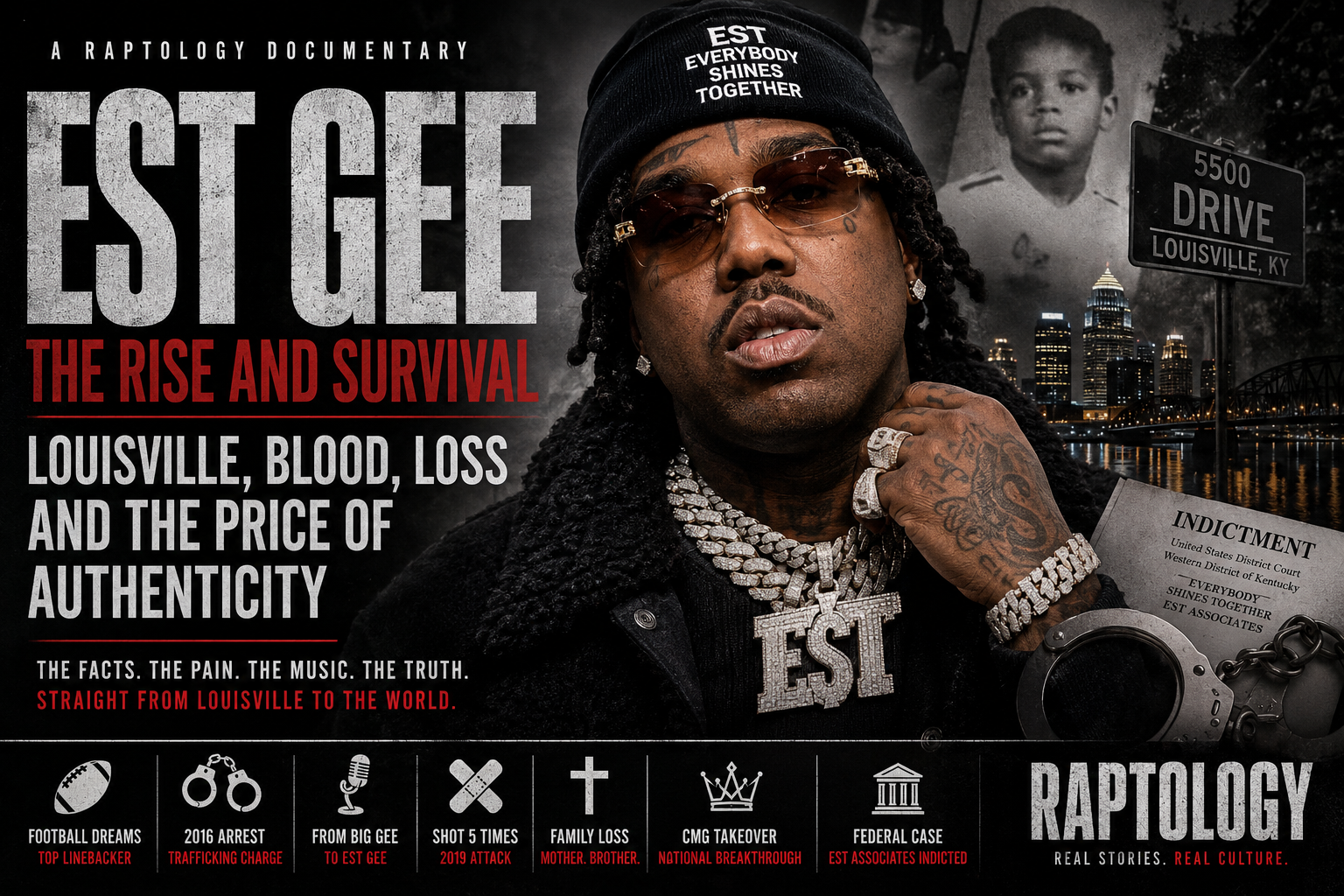
EST Gee did not come out of the traditional hip-hop pipeline. He came out of Louisville, Kentucky, with football dreams, street scars, legal trouble, family loss, a near-fatal shooting, and a voice that made listeners believe every word.
George Albert Stone III, known professionally as EST Gee, became one of the most important street rap voices of the early 2020s by refusing to polish the pain out of his music. His delivery was cold, heavy, and direct. His lyrics did not sound designed for radio, even when the records became big enough to travel through cars, clubs, playlists, gyms, and arenas. He sounded like someone who had already seen too much and was not interested in pretending otherwise.
For years, Louisville was not the first city people named in national hip-hop conversations. Atlanta, New York, Los Angeles, Chicago, Memphis, Detroit, and Houston usually dominated the map. But EST Gee helped force a different conversation. Alongside other Kentucky artists who broke through in different lanes, he showed that Louisville had its own voice, its own trauma, its own street politics, and its own place in modern rap.

Get Featured On Raptology
Independent artists, managers, and labels can submit music for editorial coverage, interviews, and promotional visibility across Raptology.
Submit Your MusicLouisville Before The Spotlight
EST Gee’s story begins in Louisville, Kentucky, far from the traditional rap industry centers. He grew up around street life, family instability, ambition, and violence. In interviews, he has described an environment where survival required attention, toughness, and preparation. The transcript behind this documentary repeatedly frames Louisville as a city where every side has its own reality, from the West End to the East End, downtown, the South, and Newburg.
That context matters because EST Gee’s music is not built around fantasy. It is built around atmosphere. The numbness in his voice, the clipped detail in his verses, and the refusal to over-explain pain all come from the world that shaped him.

Born George Albert Stone III, EST Gee had a path that could have gone in a very different direction. Before rap became the center of his life, football looked like his way out. At Saint Xavier High School, he was an athlete with real promise, eventually earning a football scholarship. Reporting has described him as a standout multi-sport athlete before the streets and legal trouble pulled his life in another direction.
The Football Dream
Football gave EST Gee structure. It gave him a possible future that did not depend on the street economy. He went from Saint Xavier to Indiana State, later spending time at Sacramento City College and Stephen F. Austin. In a different version of the story, George Stone might have become known to people through pads, tackles, and scouting reports instead of rap records.
But life rarely moves in a straight line for artists whose music later becomes this heavy. EST Gee has spoken about trying to fund his dreams and carry weight on his own. The transcript describes him as someone who did not want to burden his family and started doing what he felt he had to do to keep moving forward.
That pressure eventually pulled him closer to the street life he had grown up around. The football dream did not disappear overnight, but it began competing with money, risk, and the reality of survival. In 2016, the situation caught up with him.
The 2016 Arrest That Changed Everything
EST Gee was arrested in 2016 on a trafficking charge. According to biographical reporting, he was later sentenced to four months of house arrest. In the transcript, he is described as facing up to 10 years before the case was reduced. He had a young child on the way, his football future was collapsing, and his freedom was suddenly in question.
For many people, that would have been the end of the dream. For EST Gee, it became the beginning of a different one.
While on house arrest, he started taking music seriously. The transcript describes him buying a $600 studio package from eBay and recording from home. He first used the name Big Gee before becoming EST Gee, with EST standing for Everybody Shines Together. The name was not just a rap alias. It became an identity, a brand, and eventually a point of controversy in federal law enforcement reporting.

From Big Gee To EST Gee
EST Gee’s early music worked because it did not sound like a calculated career pivot. It sounded like a man recording what he knew because everything else had started closing in. His first records carried the hunger of someone who had lost one path and needed another one to work.
He began building local traction through YouTube and mixtape releases. The projects “El Toro” and “Die Bloody” helped establish him in Louisville’s underground scene. His music was not built around shiny hooks or manufactured street imagery. It was heavy, regional, and cold-blooded in tone.
That became the foundation of his appeal. EST Gee did not sound like he was asking the industry to let him in. He sounded like he had already been through enough that approval no longer mattered.
The Shooting That Nearly Ended His Life
In 2019, EST Gee survived the incident that would become one of the defining moments of his story. After filming a music video with Sada Baby, he was shot five times: four times in the stomach and once in the eye. His brother was also shot in the leg. The injuries were severe enough to require surgery and leave lasting vision issues.
EST Gee has spoken about the shooting in interviews. The transcript describes him leaving the video shoot, getting into a car, and being hit when another vehicle opened fire. The injuries became part of his story because they were not abstract. Fans could see the aftermath, hear the change in perspective, and understand why his music carried such a hardened tone.
Surviving the shooting changed how people heard his music. Lines that might have sounded like street rap imagery became attached to visible wounds, hospital recovery, and a real brush with death. EST Gee did not have to tell fans he was authentic. His survival became part of the evidence.
Turning Pain Into Momentum
What made the shooting even more important to his career is what happened afterward. EST Gee did not disappear. He released music while recovering, using songs and visuals already completed before the incident. His 2020 project “Ion Feel Nun” captured the emotional numbness that would become central to his public image.
That title alone explained a lot. EST Gee’s music rarely sounds shocked by tragedy. It sounds like tragedy is expected. That emotional flatness became powerful because it felt honest. He was not performing grief in a dramatic way. He was rapping like someone who had already accepted that pain was part of the schedule.
In 2020, the losses became even more personal. His mother died from leukemia. Soon after, his brother was killed. Those back-to-back tragedies gave his music another layer. The coldness was no longer just street posture. It sounded like grief hardened into survival.
Raptology Documentary note: This article separates verified reporting from street rumors. Shootings, deaths, and federal cases are discussed through public reporting and careful wording. Claims from the transcript are not treated as court-proven facts unless supported by official or reputable sources.
The Industry Finally Catches Up
By 2021, EST Gee had become impossible for the rap industry to ignore. His collaborations with major names like Lil Baby, 42 Dugg, Moneybagg Yo, and Yo Gotti showed that his sound could travel far beyond Louisville without losing its edge.
His feature on Lil Baby’s “Real As It Gets” gave him a major national look. The song introduced more listeners to his cold, direct style. He did not change his voice to fit the moment. He brought Louisville with him.
That same year, he signed with Yo Gotti’s Collective Music Group, in partnership with Interscope and Warlike. It was one of the clearest signs that street rap’s center of gravity had expanded. Louisville now had a rapper who could stand next to the biggest names in the South and Midwest without sounding out of place.
Everybody Shines Together
EST stood for Everybody Shines Together, and at first, that phrase sounded like motivation. It reflected a crew, a movement, and a desire to bring people with him. But as EST Gee’s profile grew, that name also became part of a larger law enforcement story.
In October 2021, local reporting said the FBI arrested 10 people associated with an alleged Louisville street gang called Everybody Shine Together, or EST. Reports noted that the alleged gang shared its name with EST Gee’s business, Everybody Shine Together Entertainment, and that EST Gee was listed in Kentucky business records connected to that company.
EST Gee was not arrested in that 2021 federal bust. That distinction is important. His name and company were discussed publicly in reporting because of business records and associations, but the charges were against other defendants. The DOJ later announced in 2024 that 10 defendants associated with “Everybody Shines Together” had been sentenced in a federal drug and gun conspiracy.

More Documentaries
Explore long-form hip-hop stories in the Raptology Documentary archive.
Featured Stories
Read artist profiles and deep dives in Featured Stories.
Latest Rap News
Follow current updates in Latest Rap News.
The Federal Case Around EST Associates
The federal case added a complicated layer to EST Gee’s rise. Authorities described Everybody Shines Together as a street gang involved in drug and firearms crimes. The 2024 DOJ release said the last of 10 defendants associated with EST had been sentenced in a federal drug and gun conspiracy. That is the official legal framing.
From a music standpoint, the case created a familiar problem. Hip-hop crews, street affiliations, labels, and real-life neighborhoods often overlap in ways that are easy for fans to understand but hard to separate in court or law enforcement language. A name can be a brand, a business, a movement, and an alleged gang label at the same time depending on who is describing it.
For EST Gee, the public challenge was staying focused on music while his name and business identity appeared in headlines connected to a serious federal investigation. He had already survived a shooting, legal trouble, family loss, and the collapse of his football dream. Now he had to protect a rap career that had finally broken through.
The Louisville Street Politics In The Background
The transcript spends significant time describing Louisville street divisions, rivalries, and retaliatory violence. Some of those claims are presented as allegations or street narratives rather than established legal fact. What can be said clearly is that EST Gee’s music emerged from a city with real neighborhood politics and a documented history of violence connected to some of the people discussed in public reporting.
The names Brandon Waddles and Trinity Randolph appear in reporting around a tragic 2020 Louisville double homicide. Kevon Lawless was convicted in 2022, though more recent reporting says his conviction was later overturned by the Kentucky Supreme Court and the case continued through the courts. That legal complexity is exactly why claims around these cases must be handled carefully.
EST Gee’s music lives in the shadow of that environment. It reflects violence without always explaining it. It names pain without turning every detail into a public record. That is part of why fans listen so closely and part of why law enforcement often listens, too.
Why EST Gee’s Music Hit So Hard
EST Gee’s appeal is not built on technical flash. It is built on presence. His voice is steady, low, and heavy, as if the most traumatic details do not surprise him anymore. That emotional restraint became his signature.
When he raps about loss, he does not sound like he is asking for sympathy. When he raps about violence, he does not sound like he is trying to shock the listener. When he raps about money, it does not feel like celebration as much as evidence of escape.
That made him stand out in an era where many artists were either chasing viral melodies or over-polishing street rap for mainstream playlists. EST Gee kept the rough edges. The industry came to him because the rough edges were the point.
CMG And The Bigger Than Life Or Death Moment
Signing with Yo Gotti’s CMG placed EST Gee inside one of the most successful modern rap label systems. CMG understood street rap, regional identity, and the value of letting artists sound like themselves. That mattered for Gee because too much polish could have weakened what made him special.
His 2021 project “Bigger Than Life Or Death” became a breakthrough. It included major collaborations and showed that EST Gee could function as a national artist without losing the core of his sound. The title matched the stakes of his life. For him, the phrase did not sound like marketing. It sounded like a summary.
By then, EST Gee had already survived the kind of events that usually become documentary endings: arrest, lost scholarship, shooting, grief, and federal headlines surrounding associates. Instead, those events became the foundation of the next chapter.
Timeline: EST Gee’s Rise And Survival
Enter The Raptology Rap Contest
Think your music deserves a bigger audience? Submit your track and compete for visibility on Raptology.
Join The ContestThe Legacy EST Gee Is Still Building
EST Gee’s story is still active. Unlike many documentary subjects whose rise and fall already ended, Gee remains a working artist with a career still unfolding. That makes his story less about a final downfall and more about survival under pressure.
He represents a version of rap where authenticity is both blessing and burden. It brought him fans, respect, and industry attention. It also tied his public identity to real violence, real legal headlines, and real grief.
For Louisville, EST Gee helped expand the city’s rap identity. Jack Harlow brought one version of Louisville into the mainstream. Bryson Tiller brought another through R&B. EST Gee brought the trench-level version, the cold and unfiltered side that rarely gets softened for outsiders.
For hip-hop, his rise is a reminder that the most powerful voices often come from places the industry overlooks until the audience forces attention. EST Gee did not need to sound like Atlanta, Detroit, Chicago, or Memphis. He made Louisville sound unavoidable.
The Final Word
EST Gee’s life reads like a sequence of exits that closed one by one until music became the only door left open. Football could have saved him. The streets nearly buried him. A shooting nearly killed him. Family loss nearly broke him. Federal headlines around people connected to his movement could have derailed the momentum.
Instead, he kept moving.
That is why his music resonates. It is not just about violence or money. It is about what happens to a person after the violence, after the loss, after the case, after the hospital, after the funeral, after the dream that did not work out.
EST Gee is not merely a rapper from Louisville. He is one of the clearest examples of modern street rap’s central contradiction: the same reality that gives an artist power can also place him near danger at every turn.
His story is not finished. But it has already earned a place in the documentary history of rap survival.
Rap Hall Of Fame
Explore the legends who shaped hip-hop culture inside the Raptology Rap Hall Of Fame.
Rappers A-Z
Browse artist histories, profiles, and career guides through Rappers A-Z.
Contest Winners
See rising artists gaining attention through the Raptology Rap Contest Winners page.
Reader Poll: What defines EST Gee’s story the most?

Raptology Editorial is the official newsroom voice of Raptology, covering breaking hip-hop news, artist developments, industry trends, and in-depth editorial reports from across the global rap landscape.













Leave a Reply