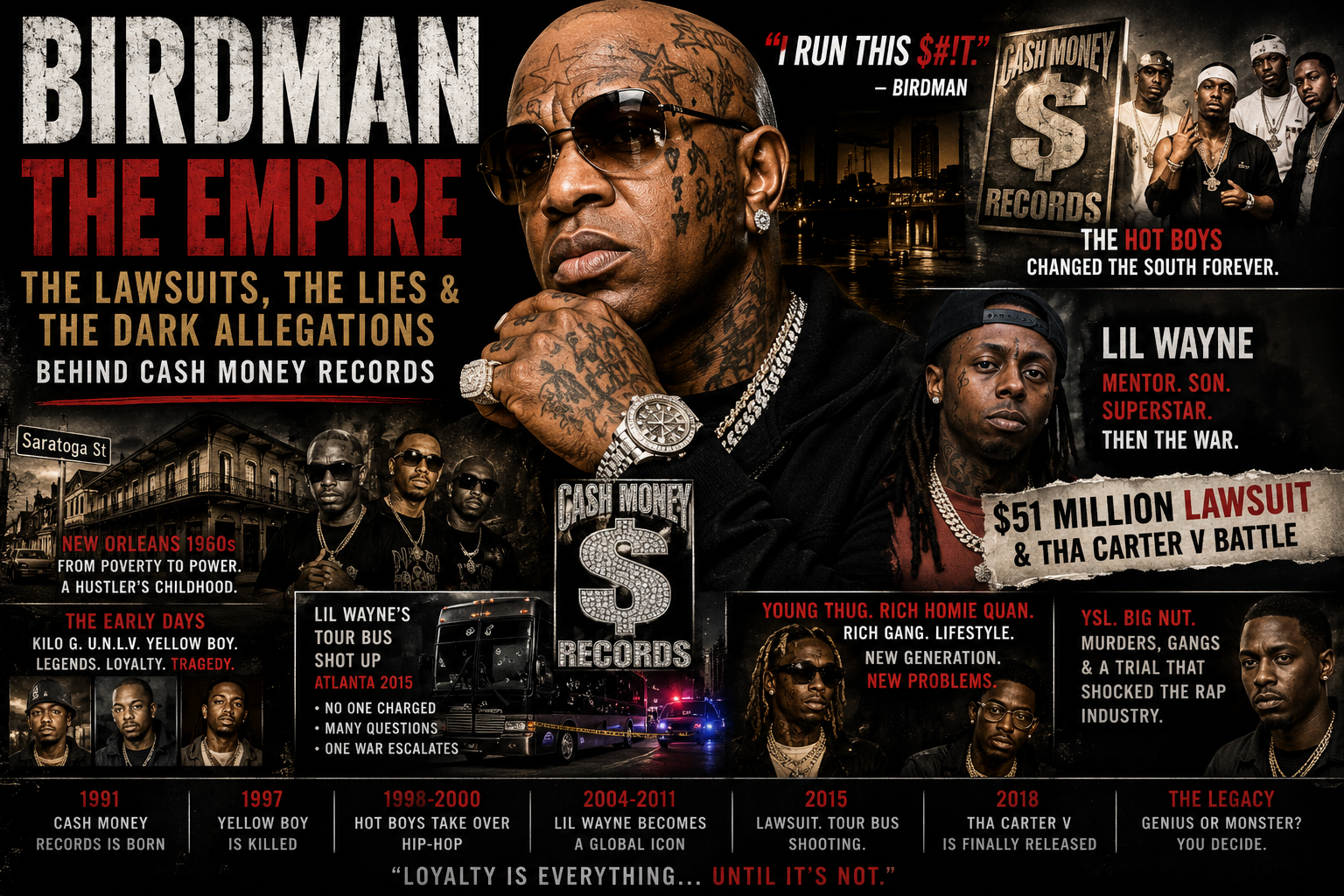
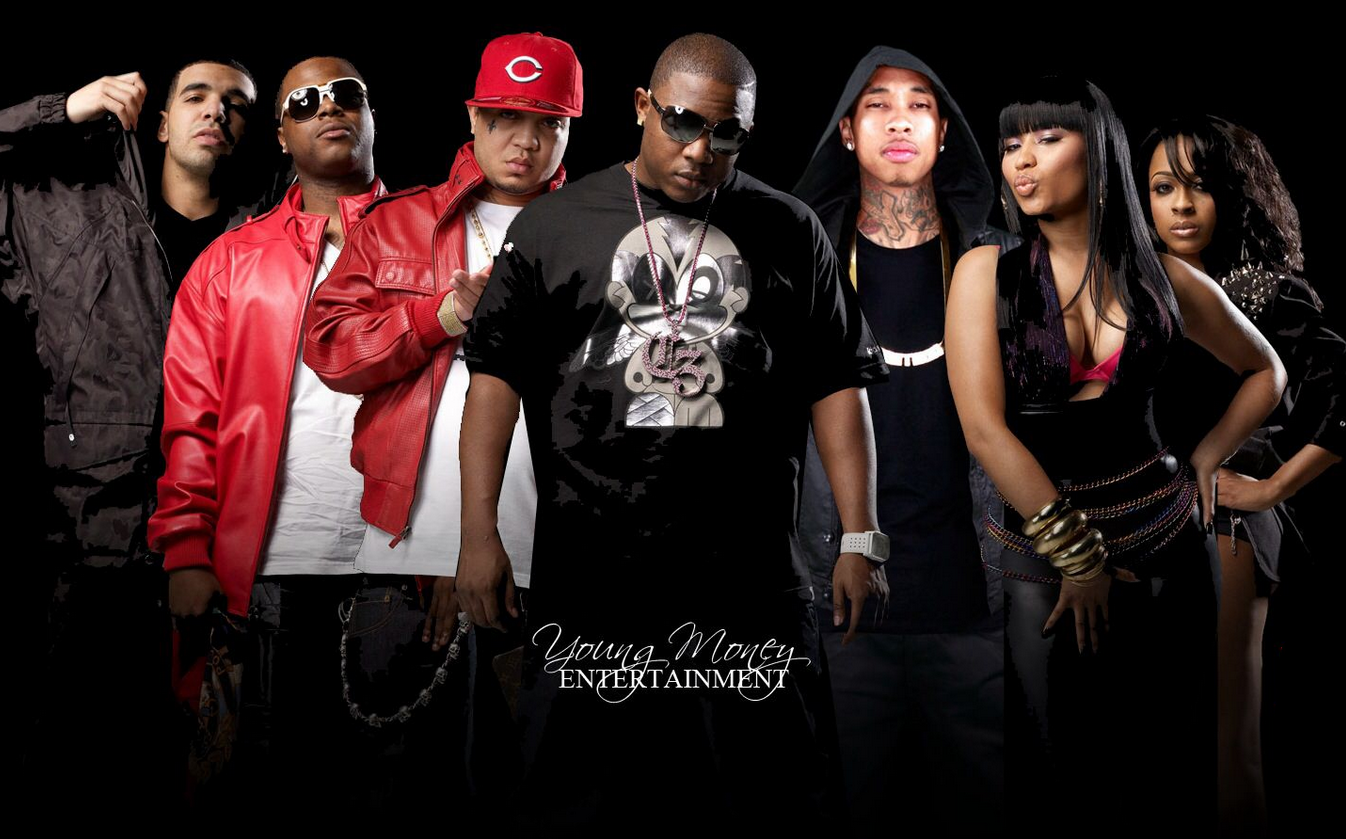
Cash Money Records is one of the greatest success stories in hip-hop history, but the story behind the empire has never been simple. Bryan “Birdman” Williams and his brother Ronald “Slim” Williams built a New Orleans label that changed Southern rap forever, introduced the world to the Hot Boys, helped make Lil Wayne a generational superstar, and later became connected to Young Money, Drake, Nicki Minaj, Rich Gang, Young Thug, and Rich Homie Quan.
But behind the platinum records and luxury image sits a much darker public narrative. Former artists have complained about unpaid money. Lil Wayne sued Cash Money during the long-delayed rollout of Tha Carter V. A 2015 shooting at Wayne’s tour bus pulled Young Thug’s camp and Birdman’s name into headlines, although Birdman was not criminally charged. Earlier Cash Money history also includes unsolved deaths, royalty disputes, alleged intimidation, and stories that fans still debate decades later.
This Raptology documentary is based on the uploaded transcript and public reporting around Cash Money’s history. Because the transcript contains serious allegations about living people, murders, exploitation, and attempted violence, this article does not present disputed claims as proven fact. Instead, it separates documented events from allegations, lawsuits, interviews, street lore, and long-running fan theories.
Case Snapshot
Main figure: Bryan “Birdman” Williams
Label: Cash Money Records
Co-founder: Ronald “Slim” Williams
Founded: 1991 in New Orleans
Key artists: Lil Wayne, Juvenile, B.G., Turk, Hot Boys, Drake, Nicki Minaj, Young Thug, Rich Homie Quan
Major controversy: Long-running accusations of financial disputes, unpaid royalties, delayed albums, and alleged power dynamics
Key legal chapter: Lil Wayne sued Cash Money in 2015 while seeking money and freedom from the label
Major incident: Lil Wayne’s tour bus was shot in Atlanta in 2015; Jimmy Winfrey later pleaded guilty in connection with the shooting, though his conviction was later overturned
Are You An Independent Artist?
Raptology covers rising artists, regional rap movements, music videos, industry disputes, and the stories behind hip-hop culture. If you are building momentum and want your music seen by real rap readers, submit your music for editorial consideration.
Submit Your MusicNew Orleans Before Cash Money
Before Cash Money became a global brand, New Orleans was already one of America’s most important music cities. The city had jazz, bounce, second-line culture, neighborhood pride, and a street economy that shaped the sound and attitude of local rap. But in the early 1990s, New Orleans hip-hop did not have the same national infrastructure as New York, Los Angeles, or Atlanta.
That opened the door for two brothers with local money, ambition, and business instincts. Birdman and Slim did not wait for a major label executive to discover New Orleans. They built their own machine. Cash Money Records was founded in 1991 and began signing local artists at a time when Southern rap was still fighting for national respect.
The transcript frames Birdman’s origin story through poverty, hustle, family instability, street ties, and a desire for control. Some of those details are part of public lore, while others come from interviews, documentaries, and street-media accounts. What is clear is that Birdman and Slim understood something early: New Orleans had its own sound, its own slang, its own artists, and its own market. They did not need to imitate New York or Los Angeles. They needed to sell New Orleans as New Orleans.
The Genius Of Birdman And Slim
Any honest documentary on Birdman has to acknowledge his business genius. Whatever controversies followed him, Cash Money changed rap. The label helped push New Orleans bounce and street rap to a national audience, built a roster that could dominate regionally before breaking nationally, and eventually negotiated one of the most famous distribution structures in hip-hop history.
Slim’s role also matters. While Birdman became the louder public face, Slim was widely viewed as the quieter strategist. That balance helped define Cash Money. Birdman projected charisma, intimidation, and flash. Slim projected patience, structure, and control. Together, they built one of the strongest independent rap machines of the 1990s.
Cash Money’s early story is also a reminder that hip-hop empires rarely come from clean environments. The same pressure that makes people desperate enough to build something historic can also create the kind of business culture where loyalty, fear, money, and control become tangled together.
The First Artists And Early Cash Money Sound
Cash Money’s earliest years included artists such as Kilo G, Lil Slim, and U.N.L.V. These artists helped define the first version of the label before the Hot Boys became national stars. Their music was raw, local, and deeply connected to New Orleans street life.
The transcript spends significant time on U.N.L.V. and Yellow Boy, presenting the group as one of Cash Money’s first real successes. Their records gave the label credibility and proved that local New Orleans street rap could sell. But according to the transcript and long-running accounts from former artists, money disputes eventually created tension between U.N.L.V. and Cash Money.
Those disputes matter because they foreshadowed what would become one of the most persistent criticisms of Birdman’s business career: artists helping build the label, then later claiming they were not properly paid.
Yellow Boy, U.N.L.V., And The First Dark Legend
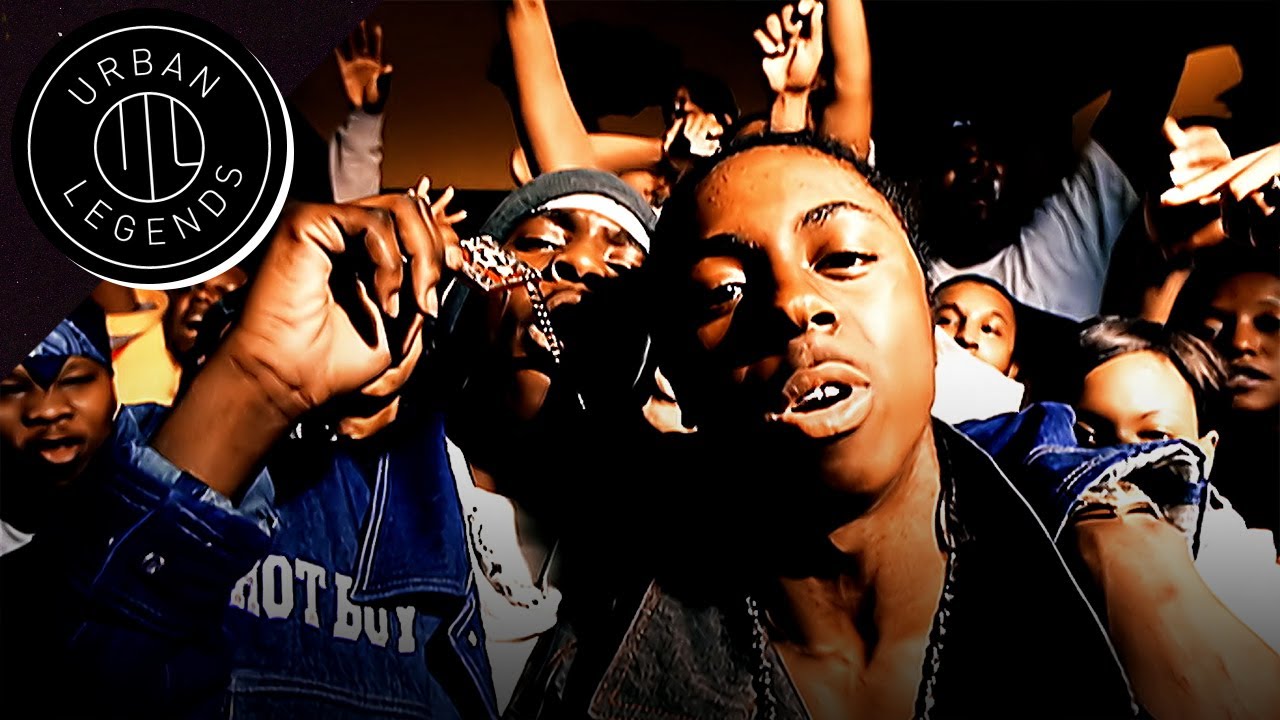
One of the darkest stories attached to early Cash Money history involves Albert “Yellow Boy” Thomas of U.N.L.V. The transcript describes a falling out between Yellow Boy and Birdman tied to money, business frustration, and an alleged physical confrontation. It then connects that tension to Yellow Boy’s 1997 death.
This is where careful reporting matters. Yellow Boy was killed in 1997, and his death remains part of New Orleans rap lore. But no court finding proves that Birdman ordered or caused his death. The transcript presents a theory often repeated in street-media spaces, but a theory is not a conviction. For a responsible documentary, the point is not to declare who killed Yellow Boy. The point is to explain why fans and former insiders still connect his death to the atmosphere around early Cash Money.
The theory survived because of timing, tension, and the way Birdman’s later “What Happened To That Boy” record was interpreted by some fans. But interpretation is not evidence. What can be said safely is that Yellow Boy’s death became one of the first major tragedies attached to Cash Money’s rise, and it helped create a darker mythology around the label’s early years.
Kilo G And The Pattern Fans Still Debate
Kilo G was one of Cash Money’s earliest artists, and his story also ended in tragedy. The transcript describes him as feeling abandoned after the label moved toward other acts. It also notes that he was later killed, while making clear that there was no proven link to Birdman or Cash Money.
That distinction is important. New Orleans during that era was violent, chaotic, and full of unrelated street conflicts. It would be irresponsible to treat every death near the Cash Money orbit as proof of a conspiracy. Still, fans continue to debate the pattern because two early artists connected to Cash Money died after business or personal tension around the label had been discussed.
That is how mythology forms in hip-hop. A fact happens. A rumor attaches to it. A lyric seems to hint at something. Former affiliates tell stories years later. Fans connect dots that may or may not belong together. Over time, the public memory becomes almost impossible to separate from the record itself.
The Early Cash Money Question
Were the early tragedies around Cash Money evidence of something darker, or were they the brutal reality of New Orleans street life during one of the city’s most dangerous eras? The answer depends on what can be proven, not just what fans believe.
Lil Wayne Enters The Story
The most important artist in Cash Money history is Lil Wayne. Born Dwayne Michael Carter Jr., Wayne entered the Cash Money universe as a child prodigy from Hollygrove. His talent was obvious early. His voice, confidence, punchlines, and hunger made him stand out before he was even old enough to understand the full weight of the business around him.
The transcript presents Wayne’s early relationship with Birdman as one built on admiration, mentorship, and later a strange father-son dynamic. Birdman repeatedly called Wayne his son. Wayne publicly referred to Birdman as a father figure. The relationship became one of the most famous and uncomfortable dynamics in rap history, especially after public images and videos of them kissing on the lips became widely discussed.
Birdman defended the behavior as family-style affection. Others inside and outside Cash Money saw it differently. Juvenile and other former artists later criticized or questioned the dynamic. The point here is not to sensationalize it, but to acknowledge why it became such a lasting part of the public conversation: Wayne was introduced to Cash Money as a minor, grew up inside the label, and later became the centerpiece of Birdman’s empire.
The Power Dynamic Around Wayne
The most disturbing part of the transcript involves allegations and public comments about Wayne’s early years around Cash Money. Because those claims involve sensitive subject matter and are not fully adjudicated in court, this article will not repeat graphic claims as fact. What can be said is that Wayne has made public comments that fans have interpreted as troubling, and the larger Cash Money story has long included questions about control, youth, mentorship, and exploitation.
What is beyond dispute is that Wayne became Cash Money’s greatest artist. Tha Block Is Hot, Tha Carter, Tha Carter II, Tha Carter III, and the mixtape run that followed made him one of the greatest rappers alive. For Birdman, Wayne was not just a signed artist. He was the foundation for Cash Money’s second and third lives: first as a Hot Boys member, then as a solo superstar, then as the leader of Young Money.
That made the later fallout even more painful. If Wayne was truly family, why did their relationship end in lawsuits, album delays, accusations of unpaid money, and a public fracture that shocked the industry?
The Hot Boys Become A Movement
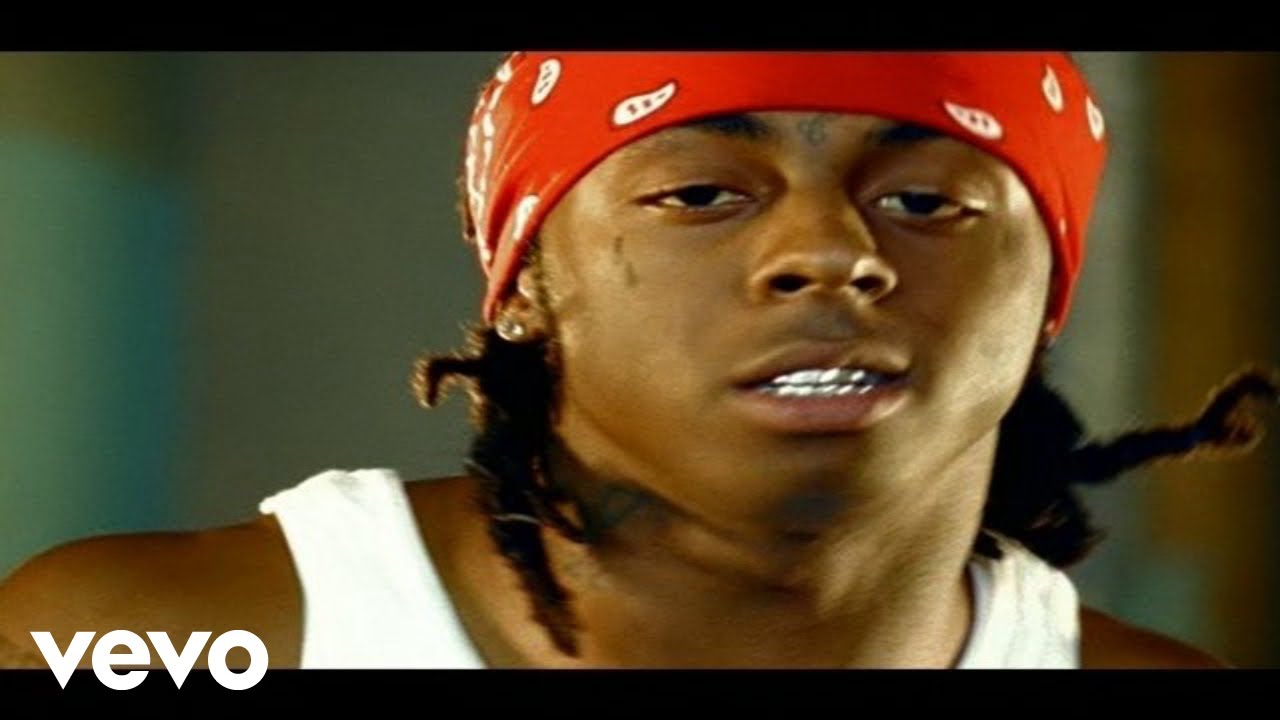
By the late 1990s, Cash Money had its formula. Juvenile, B.G., Turk, and Lil Wayne became the Hot Boys, while Mannie Fresh created the sound that made the label impossible to ignore. Juvenile’s 400 Degreez became a Southern rap landmark, and songs like “Back That Azz Up” turned Cash Money into a national powerhouse.
But even during the label’s biggest rise, money disputes followed. B.G., Juvenile, Turk, and others later spoke publicly about financial issues. Some returned. Some settled. Some stayed bitter. But the pattern remained part of the Cash Money story.
In many ways, Cash Money became the perfect example of hip-hop’s most complicated label model. It gave artists life-changing visibility, but many later questioned whether they received the money, ownership, or respect they deserved.
Birdman’s Business Model And The Royalty Question
The recurring royalty complaints are central to Birdman’s legacy. Former Cash Money artists repeatedly alleged they were owed money, underpaid, or blocked from full financial transparency. Birdman and Cash Money have often denied wrongdoing or resolved disputes privately, but the public perception stuck.
The transcript frames this as a pattern: early artists, Hot Boys members, Tyga, Lil Wayne, and others eventually questioning the business. For readers, the bigger lesson is about power. When one person controls the label, masters, release schedule, advances, branding, and access to national distribution, artists can become dependent on the same machine they helped build.
That dependence becomes dangerous when the relationship turns sour. Suddenly, the artist who made the company millions may discover that the company still controls when music drops, how money is accounted for, and how long the artist stays locked into the system.
The Carter V War
By 2014, Lil Wayne had become frustrated with Cash Money over the delayed release of Tha Carter V. The album was supposed to be a major moment in his career, but Wayne publicly claimed the label would not release it. He later described himself as a prisoner creatively and took legal action.
In January 2015, Wayne sued Cash Money, seeking tens of millions of dollars and release from the label. The lawsuit alleged that Cash Money failed to pay money owed and blocked the release of Tha Carter V. For longtime fans, this was stunning. Wayne had been the face of Cash Money. He had called Birdman family. Now he was fighting him in court.
The lawsuit forced fans to reconsider the entire father-son image. Was it real family loyalty, or had the language of family been used to create control? That question sits at the heart of the Birdman documentary narrative.
Rich Gang, Young Thug, And A New Favorite Son
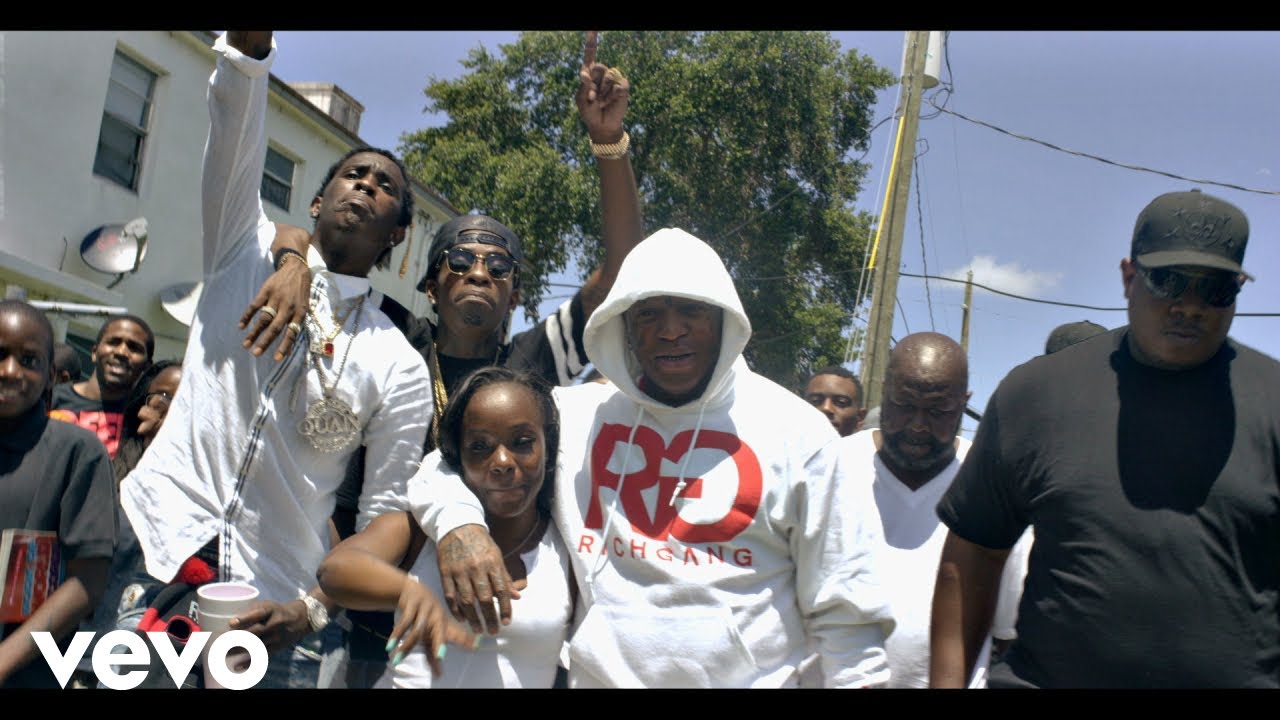
As Wayne fought for freedom, Birdman was building another movement. Rich Gang brought together Young Thug and Rich Homie Quan at a moment when Atlanta’s melodic street rap was changing the sound of hip-hop. “Lifestyle” became a massive record in 2014, and for a brief period, Rich Gang looked like Birdman’s next empire.
The timing made Wayne’s situation feel even colder. The artist who carried Cash Money for years was publicly frustrated, while Birdman appeared focused on a new generation. Young Thug openly admired Wayne, but the relationship quickly became tense. When Thug announced a project titled Carter 6, many fans viewed it as direct disrespect toward Wayne.
Birdman’s role in that tension remains debated. Some saw him as simply backing a new star. Others believed he helped create the environment where Wayne and Thug became public rivals. Either way, Cash Money’s internal power struggle spilled into the broader rap world.
The Lil Wayne Tour Bus Shooting
On April 26, 2015, Lil Wayne’s tour bus was shot in Atlanta after a performance. Jimmy Winfrey, also known as PeeWee Roscoe, was later charged and pleaded guilty to gang-related counts connected to the shooting, although the Georgia Supreme Court later reversed his conviction because of issues with the plea process.
The case became even more explosive because Birdman and Young Thug were named in related civil filings and public reporting, although neither Birdman nor Young Thug was criminally convicted for ordering the shooting. The transcript interprets a jail phone call involving Birdman as suspicious, but suspicion is not the same thing as a court-proven murder-for-hire plot.
Still, the incident changed how fans viewed the Wayne and Birdman fallout. What had been a business dispute now looked, at least publicly, like something that had entered dangerous territory. A tour bus had been shot. Wayne could have been killed. And the people around Birdman’s new Rich Gang world were now being discussed in the same breath as violence against the artist Cash Money had raised.
The Breaking Point
The Lil Wayne tour bus shooting turned a label dispute into something far more frightening. Even without a conviction against Birdman, the public narrative around Cash Money changed permanently.
Rich Homie Quan, Big Nut, And Atlanta Tension
The transcript also connects Birdman’s Rich Gang era to tension involving Rich Homie Quan, Young Thug, YSL, and Donovan “Big Nut” Thomas. Quan became one of Atlanta’s biggest melodic rap stars, and “Lifestyle” should have made Rich Gang a long-term powerhouse. Instead, relationships fractured.
Public reporting confirms that Rich Homie Quan’s father, Corey Lamar, was shot at an Atlanta barbershop in 2014. Public reporting also confirms that Donovan Thomas Jr. was killed in 2015 and that his death became part of the later YSL RICO trial. The transcript suggests Birdman’s business interests may have contributed to tensions around these events, but that claim should be treated as commentary and allegation, not established legal fact.
The larger point is safer and still important: Birdman’s orbit repeatedly intersected with artists, crews, disputes, and violent outcomes. Sometimes that may have been coincidence. Sometimes it may have been the result of the environments these artists came from. But the pattern is part of why the Birdman story remains so heavily debated.
The Donovan Thomas Case And YSL Trial Context
Donovan Thomas Jr., also known as Big Nut, became a major name in the YSL case because prosecutors tied his 2015 killing to alleged gang conflict in Atlanta. The transcript frames him as a figure connected to music business possibilities and Rich Homie Quan’s side of the industry. It also suggests that his death worsened tensions between crews connected to Atlanta rap.
The AP has reported that charges in the YSL case included allegations connected to the 2015 murder of Donovan Thomas Jr. That does not prove every street-media theory around Birdman or Cash Money. But it does show how close the line had become between rap business, street alliances, and criminal prosecutions during that era.
For Birdman, this became another example of how his name could appear near major rap conflicts without him being legally convicted of orchestrating them. For critics, that pattern is exactly why they remain suspicious. For responsible journalism, the answer is to present what is documented and clearly label the rest as allegation.
Terrence “Gangsta” Williams And The Family Question
The transcript ends by returning to Terrence “Gangsta” Williams, Birdman’s half-brother, whose life has become its own major street-media story. Williams served a lengthy federal prison sentence and later became a public speaker and interview figure after his release. The transcript portrays him as someone who claims he was pulled into violence at a young age and later felt abandoned.
Those allegations are serious and deeply personal. They also speak to the larger theme of this documentary: Birdman’s relationships were often built around family language, loyalty language, and street-code language. But former artists and associates have repeatedly questioned what that loyalty meant when money, freedom, or survival was on the line.
That is why the Birdman story is so complicated. He helped create wealth and opportunity for people from New Orleans. He also left behind a long list of former partners, artists, and associates who publicly questioned his loyalty.
Timeline Of Birdman And Cash Money’s Controversial Empire
1991: Birdman and Slim found Cash Money Records in New Orleans.
Early 1990s: Kilo G, Lil Slim, U.N.L.V., and other local acts help define the label’s first sound.
1997: Yellow Boy of U.N.L.V. is killed, becoming one of the darkest early stories connected to Cash Money lore.
1998: Cash Money breaks nationally through its Universal deal and the rise of Juvenile, B.G., Lil Wayne, Turk, and the Hot Boys.
2000s: Lil Wayne becomes Cash Money’s greatest solo superstar and later builds Young Money.
2014: Wayne publicly complains that Tha Carter V is being delayed.
January 2015: Lil Wayne sues Cash Money, seeking money and freedom from the label.
April 2015: Wayne’s tour bus is shot in Atlanta; Jimmy Winfrey is later prosecuted in connection with the shooting.
2014-2015: Rich Gang, Young Thug, Rich Homie Quan, YSL, and Atlanta street tensions become part of the larger Birdman-era story.
2018: Lil Wayne and Cash Money reportedly settle their long-running dispute, clearing the way for Tha Carter V.
The Bigger Lesson Behind Cash Money
Cash Money Records changed hip-hop forever. That cannot be erased. Without Birdman and Slim, New Orleans rap may not have reached the same national height. Without Cash Money, the careers of Lil Wayne, Juvenile, B.G., Turk, Drake, Nicki Minaj, and others would look very different. The label’s influence on Southern rap, independent label structures, slang, production, and artist branding is enormous.
But influence does not erase controversy. Birdman’s legacy includes genius and suspicion, opportunity and alleged exploitation, loyalty language and lawsuits, mentorship and control. He helped build one of rap’s biggest empires, but many of the people who helped build it later questioned whether the empire took more from them than it gave back.
The hardest part of the Birdman story is that both things can be true. He can be one of hip-hop’s greatest executives and one of its most controversial power brokers. Cash Money can be a miracle of Southern entrepreneurship and a cautionary tale about contracts, control, and family language used in business.
Why Birdman Still Fascinates Hip-Hop Fans
Birdman fascinates fans because his story feels almost impossible to categorize. He is not just a rapper. He is not just a label owner. He is not just a mogul. He is a symbol of the era when street money, independent music, regional pride, and major-label ambition crashed into one another and created a new model for rap power.
He built something historic. He also became surrounded by stories that refuse to go away. Some are documented in lawsuits. Some live in interviews. Some remain allegations. Some may never be proven. But together, they explain why Birdman remains one of the most debated figures in hip-hop history.
Cash Money’s music still plays like a victory lap. The business history reads like a warning.
The Final Question
Was Birdman a visionary who gave New Orleans artists a path to the world, or a power broker whose empire left too many people feeling used, unpaid, or abandoned? The answer may be both.
Frequently Asked Questions
Who founded Cash Money Records?
Cash Money Records was founded in 1991 by brothers Bryan “Birdman” Williams and Ronald “Slim” Williams in New Orleans.
Why did Lil Wayne sue Cash Money?
Lil Wayne sued Cash Money in 2015 during the long-delayed release of Tha Carter V. He alleged that the label owed him money and was blocking the album’s release.
Was Birdman charged in the Lil Wayne tour bus shooting?
No. Birdman was discussed in public reporting and civil claims around the 2015 tour bus shooting, but he was not criminally convicted of ordering the shooting.
What was Rich Gang?
Rich Gang was a Birdman-led project and brand involving artists such as Young Thug and Rich Homie Quan. Their song “Lifestyle” became a major hit in 2014.
Why is Birdman controversial?
Birdman is controversial because of repeated artist disputes over money, public fallouts with former Cash Money artists, his complicated relationship with Lil Wayne, and allegations surrounding people and conflicts connected to his orbit.
Raptology Rap Contest
Raptology supports independent artists who want exposure without relying on destructive beef for attention. Enter the Raptology Rap Contest for a chance to build visibility, reach new listeners, and move your music beyond your local circle.
Enter The Rap ContestReader Poll: What defines Birdman’s legacy the most?
Raptology Editorial is the official newsroom voice of Raptology, covering breaking hip-hop news, artist developments, industry trends, and in-depth editorial reports from across the global rap landscape.



Leave a Reply