
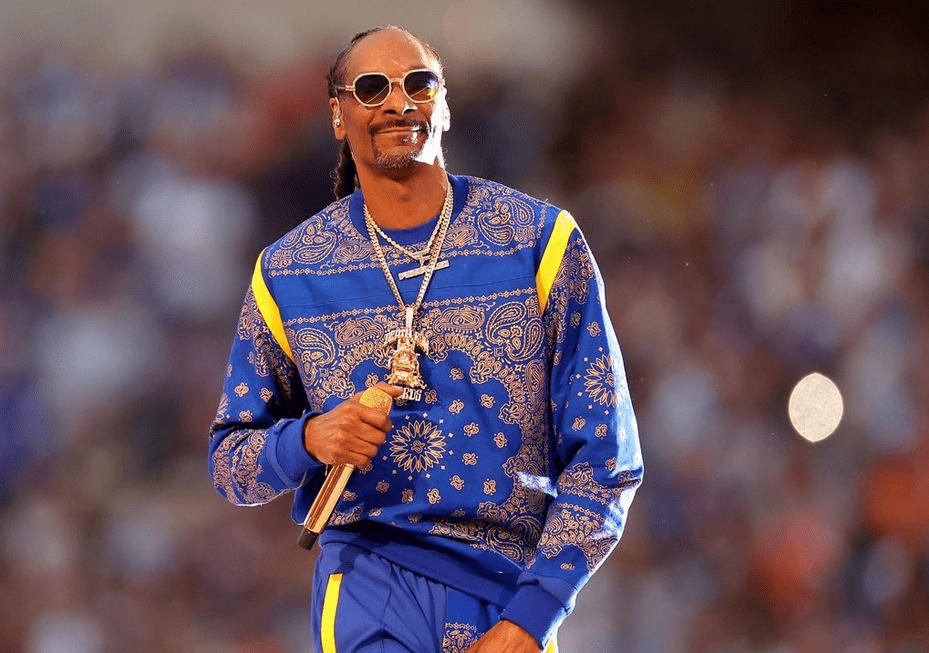
Snoop Dogg has already done what most rappers only get one true shot at: becoming a generational star. But what makes his story especially compelling now is not only what he achieved in the 1990s. It is what he chose to do with that legacy later. By returning to Death Row not merely as one of its most famous former artists but as the owner of the brand itself, Snoop turned nostalgia into something bigger. This chapter is about control, reinvention, and the rare spectacle of a rap icon walking back into his own mythology with the keys in hand.

Before Snoop became a cultural institution, he became a voice nobody could mistake
Before the commercials, the sports coverage, the television appearances, the product lines, and the larger-than-life public image, Snoop Dogg was one of the most distinct voices rap had ever heard. What made him feel immediately special was not just that he sounded cool. It was the way he moved through records. Snoop could slide across a beat without sounding lazy, stretch language without losing structure, and make menace, humor, rhythm, and charm exist in the same verse. Plenty of rappers can rap hard. Very few can make it feel this effortless.
When he emerged through Dr. Dre’s orbit in the early 1990s, the timing could hardly have been better. West Coast rap was ascending into a larger national position, and Snoop sounded like the voice of a new center of gravity. His delivery did not simply complement Dre’s production. It seemed born for it. The sleek G-funk bounce, the low-riding rhythm, the cinematic calm, and the feeling that every song knew exactly where it lived all fit Snoop so naturally that rap’s atmosphere seemed to change around him.
That first impression matters because it explains almost everything that came later. Snoop’s career did not survive for decades only because he was attached to famous collaborators or early classic albums. It survived because his presence itself was durable. Long before people used the language of branding to explain artists, Snoop already had something stronger than a brand. He had a feeling. Listeners knew what it felt like when he entered a song, and that feeling remained portable across eras, trends, and even entirely new industries.
The Death Row era made Snoop a symbol of rap’s West Coast takeover
It is impossible to tell the Snoop Dogg story without understanding what Death Row meant in its prime. It was not just a label. It was an image, a threat, a business force, a regional declaration, and a pop-culture machine at the same time. Dr. Dre crafted the sound, Suge Knight projected the power, and Snoop gave the label one of the most magnetic on-mic identities in rap history. He did not look like a newcomer trying to keep up with the moment. He looked like somebody the moment had been built around.
Then Doggystyle arrived and made the mythology even larger. Snoop was no longer simply the breakout voice from The Chronic. He was a fully formed star with a signature tone, signature movement, signature attitude, and signature lane. The album’s significance goes beyond sales or chart position. It gave Death Row one of its purest artistic symbols and helped cement the idea that the West Coast was not merely competing with the rest of rap. It was dictating the atmosphere.
But the same intensity that made Death Row feel invincible also made it unstable. The label’s early run burned with too much pressure to last cleanly. Internal conflict, legal trouble, violence, ego, and industry warfare gradually turned the institution into something as chaotic as it was powerful. Snoop’s earliest legend was formed inside that storm. And once the storm began collapsing around the label, he had to face the question that defines many artists after a classic debut: who are you when the machine that introduced you stops looking indestructible?
Leaving the original Death Row forced Snoop to become bigger than one chapter
A lot of rap careers are haunted by the first version of the artist that people fell in love with. Once the prime producer is gone, the original label breaks apart, or the cultural moment shifts, the public starts measuring everything new against the old myth. Snoop had to live through that problem in real time. Once the original Death Row chapter ended, he no longer had the same machine around him. What he did have, however, was a personality strong enough to travel.
That portability became one of the defining secrets of his longevity. Snoop could move through different labels, collaborations, sounds, eras, and public roles without becoming unrecognizable. He could be playful, radio-friendly, dramatic, nostalgic, polished, mainstream, or street-adjacent, and the core feeling of Snoop still came through. In some artists, that kind of flexibility reads like drift. In Snoop, it often looked like survival through self-knowledge. He did not need every era to look identical because he understood that the center of the identity was still intact.
That long period of reinvention also gave him a much broader education in what fame, culture, and business actually mean. Snoop was no longer just a rapper. He became a celebrity figure, a businessman, an entertainer, a television presence, a sports personality, and an elder statesman whose face could move between generations without needing translation. That broader experience is what made the eventual Death Row return feel like something more serious than a reunion. By then, he knew exactly what symbols are worth.
Explore more documentary-style hip-hop coverage across Raptology’s growing archive.
Coming back as owner changed the meaning of Snoop’s Death Row return
When Snoop Dogg acquired the Death Row brand, the move landed as something much heavier than a normal business headline. Artists often help build cultural institutions they never truly control. They become the face of a label, a sound, a movement, or an era while somebody else owns the sign on the building. Snoop’s Death Row return disrupted that familiar rap story. He was no longer only one of the most famous alumni of the label’s original run. He had come back with legal and symbolic ownership attached to his name.
That changed the emotional stakes. A reunion would have been nostalgic. Ownership made it strategic. It suggested that a rap veteran could do more than celebrate the past or tour off it. He could take control of the past and attempt to shape its next form. In hip-hop, where artists have spent decades talking about masters, branding, contracts, and self-determination, that gesture carried obvious symbolic weight. Snoop was not simply honoring the mythology. He was repositioning himself as its steward.
Of course, that kind of move also comes with pressure. Death Row is not a neutral brand. It is one of the most mythic, loaded, and controversial names in rap history. If Snoop treated it like a novelty item, the move could have looked hollow. If he tried to cosplay the 1990s, it would have felt trapped in amber. The challenge was to carry the aura of the original without becoming enslaved to it. That challenge is exactly what makes this chapter of his career worth documentary treatment.

The new Death Row is really a test of whether legacy can stay alive without becoming a museum
The most interesting thing about the current Death Row story is that Snoop does not seem interested in turning the label into a static monument. The new era works best when it feels like a living platform rather than a glass case built around old trophies. That matters because legacy brands in rap often survive on symbolism alone. Snoop’s bigger gamble is trying to prove that the symbol can still move.
His recent years support that interpretation. Reconnecting with Dr. Dre on later-era music gave the public a clear legacy event while still framing the collaboration as present-tense art rather than a retro stunt. That is one of Snoop’s strongest instincts at this stage of his career. He understands how to activate memory without simply repeating it. He knows audiences still care about the old chemistry, but he also knows the moment has to feel alive if it is going to matter beyond headlines.
More broadly, Snoop’s stature shows how unusual his arc has become. He is no longer relevant only because of one classic decade. He has spent years proving that a rap figure can age into wider cultural importance without surrendering the original aura that made him matter. That is what makes the Death Row ownership chapter so compelling. It is not an exhausted star clinging to a famous logo. It is one of hip-hop’s most durable icons trying to convert legacy into infrastructure.
5 key songs that explain why Snoop Dogg never really left the center of the conversation
The public introduction to Snoop as a once-in-a-generation voice who could make dominance sound effortless.
A self-introduction so complete it helped define his identity for decades.
The perfect blend of cool, groove, and crossover magnetism from the original Death Row period.
Proof that Snoop’s later acts could still produce huge mainstream moments without losing his core identity.
A reminder that Snoop’s connection to West Coast legacy remains an active force, not merely a piece of history.
A quick FAQ for search readers landing on the story
Yes. He returned in a much more powerful role than before by acquiring the brand most closely tied to his earliest rise.
Because rap history is full of artists who helped build legendary institutions without ever controlling them. Snoop’s move flipped that familiar story.
Its long-term success depends on becoming more than nostalgia. That is exactly what makes this era interesting to watch.
Ownership, longevity, brand stewardship, and the ability to remain culturally visible without depending on only one old moment.
What happens next will decide whether this is a comeback story or a true second institution
The hardest part of the new Death Row story is not the headline. It is the follow-through. Buying a symbol is dramatic. Sustaining it is much harder. If the label under Snoop becomes a real creative platform that can release meaningful music, develop artists, and keep evolving without losing its identity, then this chapter will look historic in hindsight. If it becomes only a badge for memory, the move will still matter, but more as symbolism than transformation.
Still, Snoop is one of the few figures in rap who even seems qualified to attempt that balancing act. He has the history, the charisma, the public familiarity, and the business instincts to move between generations without appearing trapped by any one of them. That is why the story remains compelling. It is not just about whether Snoop can still matter. It is about whether he can turn one of rap’s greatest relics into something alive again.
That is the deeper reason “Death Row’s New Era and Legacy Reinvention” works as a documentary subject. It is not merely a story about a famous rapper aging gracefully. It is a story about one of hip-hop’s most durable icons taking control of one of its most loaded symbols and testing whether ownership can do what nostalgia alone never could: move the story forward.

Hulda Hicks was born in Brooklyn, NY in the late ’70s, at the time when Hip-Hop music was just emerging as an art form. Her entire life was influenced by the culture, having grown up in the epicenter of the creative movement.
As a trained musician and vocalist, Hulda got exposed to the industry in her twenties and has worked on projects with iconic figures such as the Chiffons, the Last Poets, and Montell Jordan, to name a few. Her passion for music extended past the stage on to the page when she began to write ad copy and articles as a freelancer for several underground publications.
A written review from “Jubilee Huldafire” is as authentic as it gets, hailing from one creative mind that has a unique voice, on paper and in person.


Leave a Reply