
How to Count Bars in Rap
Counting bars helps rappers understand beats, write cleaner verses, structure songs, and know exactly where to start and stop over an instrumental.
Learning how to count bars is one of the first technical skills every rapper should understand. It helps artists write verses that fit the beat, communicate with producers, record more professionally, and avoid lyrics that feel rushed, awkward, or unfinished.
At first, counting bars can feel confusing because music moves quickly. But once you understand that most rap beats are built around repeating four-count patterns, the process becomes much easier. You do not need to be a music theory expert to count bars. You only need to train your ear to recognize the rhythm.
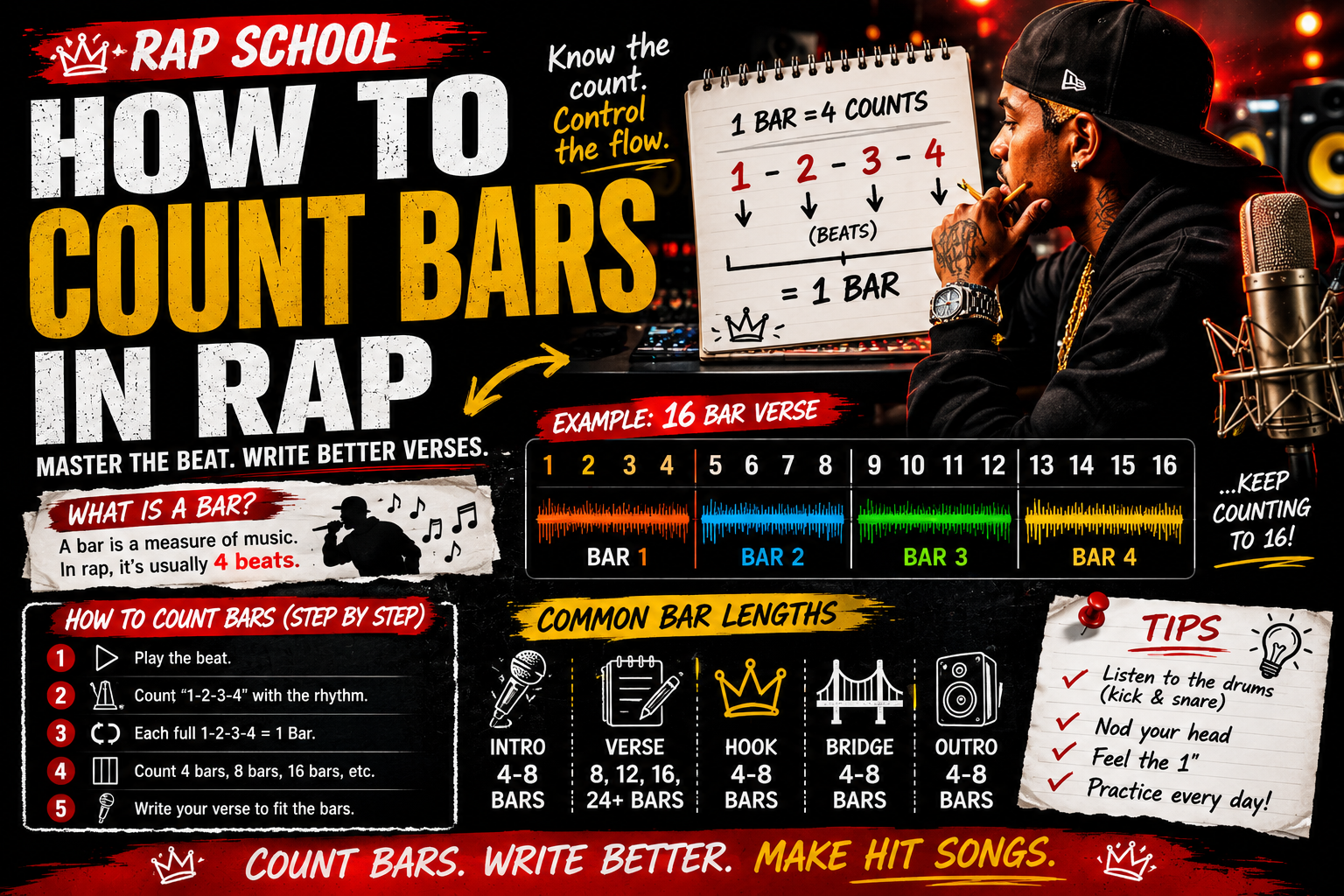
Simple definition: In rap, one bar is usually one measure of music counted as “1, 2, 3, 4.” When you count that four-beat pattern once, you have counted one bar.
What Is a Bar in Rap?
A bar is a measure of music. In most hip-hop songs, one bar can be counted as four beats: 1, 2, 3, 4. When rappers talk about writing 8 bars, 16 bars, or 32 bars, they are talking about how many measures of music their lyrics cover.
The word “bar” can also be used casually to mean a lyrical line or a strong punchline, but when you are learning song structure, the technical meaning matters more. A bar is not always the same as one written line on the page. It is about where the words land inside the beat.
The Basic Four-Count
The easiest way to start counting bars is to count along with the beat in groups of four. Most rap beats have a pulse that lets you count “1, 2, 3, 4” repeatedly. Each full count is one bar.
After you count 1 through 4 once, that equals one bar. Count 1 through 4 again and you have two bars. Keep repeating that pattern until you reach the length of the section you are trying to count.
Rap School Example
Count “1, 2, 3, 4” with the beat. That is bar one. Count “1, 2, 3, 4” again. That is bar two. If you do that 16 times, you have counted a 16-bar verse.
How to Count a 16-Bar Verse
A 16-bar verse is one of the most common verse lengths in rap. To count it, start at the beginning of the verse and count four beats per bar. Every time you complete a full “1, 2, 3, 4,” add one bar to your count.
If you are new to this, do not try to count every instrument at once. Focus on the drums, especially the kick and snare. The snare often helps mark the rhythm clearly and can make it easier to feel the structure.
- Bars 1 to 4: The verse usually introduces the idea, tone, or subject.
- Bars 5 to 8: The rapper develops the idea or adds more detail.
- Bars 9 to 12: The verse often builds energy, switches flow, or adds stronger lines.
- Bars 13 to 16: The rapper finishes the thought and transitions toward the hook.
Does One Bar Equal One Line?
Not always. This is one of the biggest misunderstandings for beginners. One bar does not always equal one written line. Some rappers write one line per bar, which can be helpful when learning. But advanced rappers may stretch one sentence across multiple bars or fit several short phrases inside one bar.
The beat determines the bar, not the page. A lyric sheet can help organize your writing, but the real test is whether the words land correctly when performed over the instrumental.
How Many Bars Are in Common Rap Sections?
| Song Section | Common Bar Length | Purpose |
|---|---|---|
| Intro | 4 to 8 bars | Sets the mood before the main part of the song begins. |
| Verse | 8, 12, 16, or 24 bars | Develops the lyrics, story, message, or performance. |
| Hook / Chorus | 4 to 8 bars | Creates the most memorable repeated section of the song. |
| Bridge | 4 to 8 bars | Adds contrast or a transition before the song changes direction. |
| Outro | 4 to 8 bars | Closes the track or lets the beat fade out naturally. |
How BPM Affects Counting Bars
BPM stands for beats per minute. It measures the speed of the beat. A slow beat gives more space inside each bar, while a fast beat moves more quickly. The number of bars may stay the same, but the amount of time those bars take can change.
This is why a 16-bar verse can feel relaxed on one beat and fast on another. The rapper may need to adjust flow, word choice, and breath control depending on the tempo.
Why Counting Bars Helps Your Flow
Counting bars improves flow because it teaches rappers where their lines should land. When an artist understands the structure, they can place rhymes more intentionally, pause at the right time, and build momentum across the verse.
Rappers who do not count bars may accidentally write verses that are too long or too short. They may also miss the hook, start late, or run out of space before completing the idea. Counting bars solves those problems.
Step-by-Step: How to Practice Counting Bars
- Step 1: Play a simple rap instrumental with a clear drum pattern.
- Step 2: Nod your head or tap your hand to the beat.
- Step 3: Count “1, 2, 3, 4” repeatedly with the rhythm.
- Step 4: Each full four-count equals one bar.
- Step 5: Count 8 bars, then 16 bars, then listen for where the hook begins.
- Step 6: Write lyrics that fit inside the section you counted.
- Step 7: Record yourself and check whether your verse ends at the right spot.
Common Mistakes Beginners Make
One common mistake is counting every word instead of counting the beat. Bars are based on music, not the number of words. Another mistake is starting the count before the verse actually begins. Some beats have intros, drops, or pickups before the main section starts.
Another mistake is writing too many syllables for the available space. If the verse feels rushed, the rapper may need fewer words, better breath placement, or a different flow. Counting bars helps identify where the problem is happening.
How to Know When the Hook Starts
The hook usually begins when the beat changes, the melody shifts, the drums drop differently, or the main repeated phrase enters. If you count 16 bars from the start of a verse, many songs will naturally move into the hook right after that section.
Not every song follows the same structure, but practicing with common rap songs will train your ear. After enough repetition, you will begin to hear section changes before they happen.
Final Thoughts
Counting bars is a basic skill, but it has a major impact on rap songwriting. It helps artists understand beats, write cleaner verses, structure songs properly, and record with more confidence. Once you can count bars, rap music becomes easier to organize and perform.
For beginners, the goal is simple: count the beat in groups of four, understand where sections begin and end, and write lyrics that fit the structure. Over time, counting bars becomes natural, and you will be able to feel the structure without thinking about every number.
Continue Learning in Rap School
Visit the Rap School hub for more lessons on rap lyrics, songwriting, music business, royalties, promotion, and hip-hop history.
Recommended next lessons: What Is a 16-Bar Verse?, How to Structure a Rap Song, and What Is Flow in Rap?.