
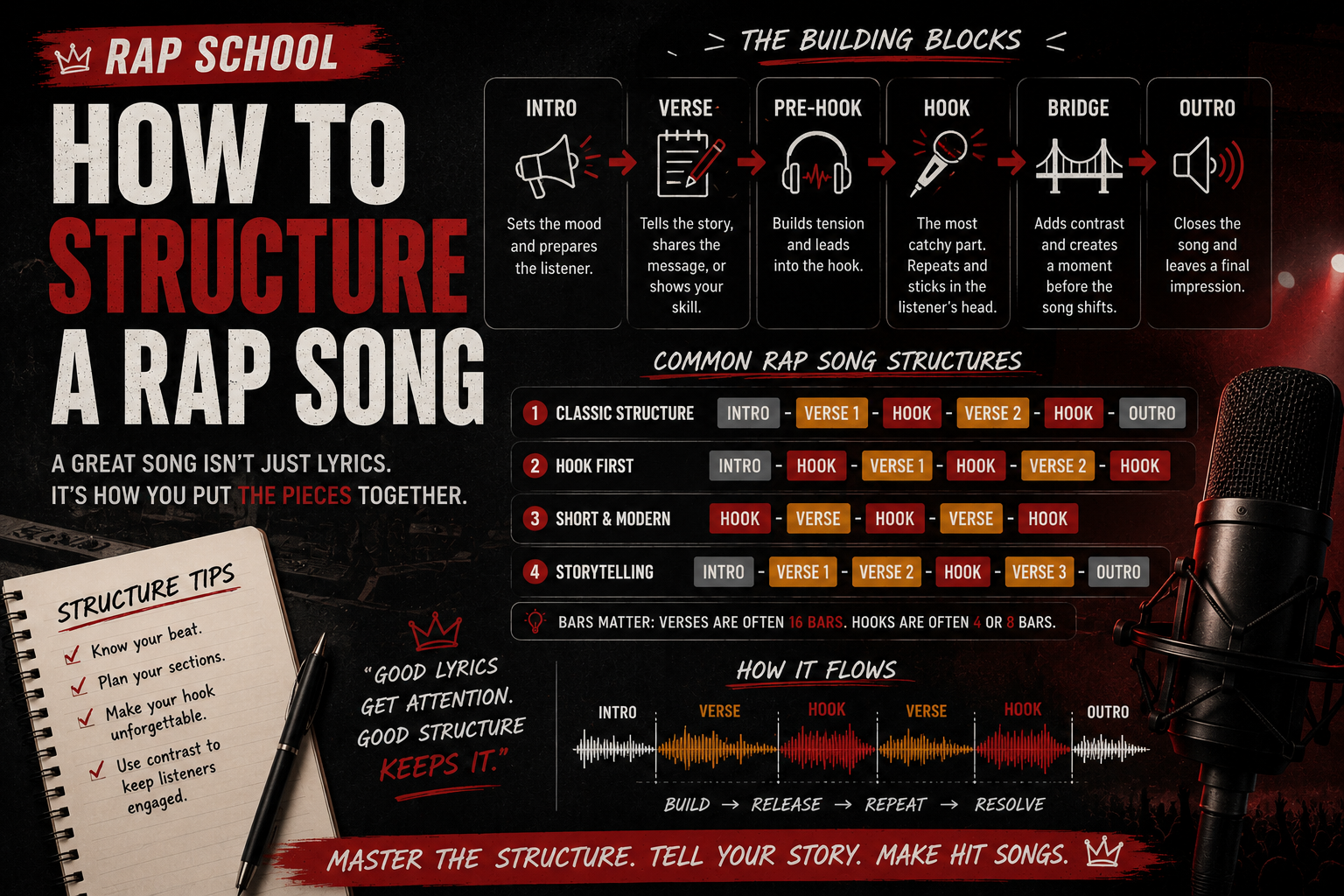
How to Structure a Rap Song
Rap song structure is the way a track is organized from beginning to end. Understanding intros, verses, hooks, bridges, beat drops, and outros helps artists write stronger songs that feel complete and professional.
Learning how to structure a rap song is one of the most important skills for new artists. A good song is not just a collection of lyrics over a beat. It has movement, balance, repetition, contrast, and a clear path that keeps the listener engaged from the first few seconds to the final line.
Rap songs can be simple or complex, but most successful tracks use some combination of an intro, verse, hook, bridge, and outro. Once an artist understands how these parts work together, writing and recording becomes much easier.
Simple definition: Rap song structure is the arrangement of different sections in a song, including the intro, verse, hook, chorus, bridge, and outro.
Why Song Structure Matters in Rap
Song structure gives the listener a reason to keep paying attention. Without structure, even good lyrics can feel scattered or unfinished. A strong structure helps the artist introduce an idea, build momentum, repeat the most memorable section, and finish the song in a way that feels intentional.
Structure also matters in the studio. Producers, engineers, featured artists, and songwriters often communicate using terms like “verse,” “hook,” “8 bars,” “16 bars,” and “bridge.” Knowing what these sections mean helps an artist sound more professional and work faster.
The Main Parts of a Rap Song
Intro
The intro is the beginning of the song. It sets the mood before the main verse or hook begins. Some intros are only a few seconds long, while others include talking, ad-libs, a beat build-up, sound effects, or a short melodic phrase.
Verse
The verse is where the rapper usually delivers the main lyrics, story, message, or performance. Verses often contain the most detailed writing in the song. A verse can be 8 bars, 12 bars, 16 bars, 24 bars, or another length depending on the song.
Hook or Chorus
The hook, also called the chorus, is usually the most memorable part of the song. It often repeats several times and gives the listener something easy to remember. A strong hook can make a song more catchy, more emotional, and more replayable.
Pre-Hook
A pre-hook is a short section that comes before the hook. It builds tension and prepares the listener for the main chorus. Not every rap song needs a pre-hook, but it can be useful when the artist wants a smoother transition.
Bridge
The bridge adds contrast. It usually sounds different from the verse and hook. A bridge can change the melody, energy, rhythm, or mood before the song returns to the hook or final section.
Outro
The outro is the ending of the song. It may include fading vocals, ad-libs, a repeated line, a beat breakdown, or a final statement from the artist.
Common Rap Song Structures
There is no single correct way to structure a rap song, but there are common formats that artists use because they are easy for listeners to follow. These formats also help songs feel balanced and complete.
| Structure | Example Format | Best For |
|---|---|---|
| Classic Rap Structure | Intro – Verse 1 – Hook – Verse 2 – Hook – Outro | Traditional rap songs with clear verses and a memorable hook. |
| Hook-First Structure | Intro – Hook – Verse 1 – Hook – Verse 2 – Hook | Catchy songs where the chorus is the strongest part. |
| Short Streaming Structure | Hook – Verse – Hook – Verse – Hook | Modern songs designed to get to the main idea quickly. |
| Storytelling Structure | Intro – Verse 1 – Verse 2 – Hook – Verse 3 – Outro | Narrative songs that need more room for details and progression. |
| Freestyle Structure | Intro – Long Verse – Outro | Lyric-heavy tracks, freestyles, and performance-focused records. |
How Many Bars Should Each Section Be?
Rap song sections are often measured in bars. A bar is a measure of music, usually counted in groups of four beats. Many rap verses are 16 bars, while hooks are often 4 or 8 bars. Intros and bridges are usually shorter, but this depends on the beat and the style of the song.
- Intro: Usually 4 to 8 bars.
- Verse: Commonly 8, 12, 16, or 24 bars.
- Hook: Commonly 4 or 8 bars.
- Pre-hook: Usually 4 bars.
- Bridge: Usually 4 to 8 bars.
- Outro: Usually 4 to 8 bars or a natural fade-out.
Should the Hook Come First?
Many modern rap songs start with the hook because it gives listeners the catchiest part immediately. This can be effective for streaming platforms, social media clips, and short attention spans. If the hook is strong, opening with it can help the song feel memorable right away.
However, some songs work better when the verse comes first. Storytelling records, emotional songs, and lyrical tracks may need time to build before the hook arrives. The best choice depends on the beat, the message, and the strongest part of the song.
How to Structure a Rap Song Step by Step
- Step 1: Listen to the beat and mark where the energy changes.
- Step 2: Decide whether the song should start with a hook, intro, or verse.
- Step 3: Count the bars for each section so the song feels organized.
- Step 4: Write the hook around the main idea or emotion of the song.
- Step 5: Use the verses to develop the story, attitude, message, or performance.
- Step 6: Add a bridge, pre-hook, or beat drop only if the song needs contrast.
- Step 7: End with a final hook, outro, or strong closing line.
Rap School Example
A simple beginner-friendly structure could be: 4-bar intro, 16-bar verse, 8-bar hook, 16-bar second verse, 8-bar hook, and 4-bar outro. This format is easy to write, easy to record, and easy for listeners to follow.
How Structure Changes the Feeling of a Song
Structure affects emotion. A hook-first song can feel direct and catchy. A long verse before the hook can feel serious, lyrical, or cinematic. A bridge can make the song feel more dramatic because it gives the listener something unexpected before returning to the main section.
Structure also controls energy. If every section sounds the same, the song may feel flat. A strong rap song usually has changes in intensity, flow, delivery, or melody. These changes help the listener feel progression.
Common Mistakes Beginners Make
One common mistake is writing too many lyrics without thinking about the beat. A verse may look good on paper but feel crowded when performed. Another mistake is making the hook too complicated. A hook should usually be easier to remember than the verse.
Beginners also sometimes ignore transitions. The move from verse to hook should feel natural. If the hook comes in suddenly without setup, the song may feel unfinished. Counting bars and listening for beat changes can help fix this problem.
Do All Rap Songs Need a Hook?
No. Some rap songs do not need a traditional hook. Freestyles, underground tracks, lyrical showcases, and storytelling records may use one long verse or repeated phrases instead. However, for artists trying to make songs that are easy to remember, a hook is usually very important.
A hook gives the listener an anchor. It is the part they are most likely to repeat, quote, or remember after the song ends.
Final Thoughts
Rap song structure is the blueprint of a track. It helps organize the artist’s ideas, controls the listener’s attention, and gives the song a professional shape. Once an artist understands intros, verses, hooks, bridges, and outros, writing complete songs becomes much easier.
The best structure is the one that serves the song. Some tracks need a simple verse-hook format, while others need a longer storytelling arrangement. The goal is not to follow a formula blindly. The goal is to use structure as a tool so the message, flow, and emotion hit harder.
Continue Learning in Rap School
Visit the Rap School hub for more lessons on rap lyrics, songwriting, music business, royalties, promotion, and hip-hop history.
Recommended next lessons: What Is a 16-Bar Verse?, How to Count Bars, and What Is Flow in Rap?.