
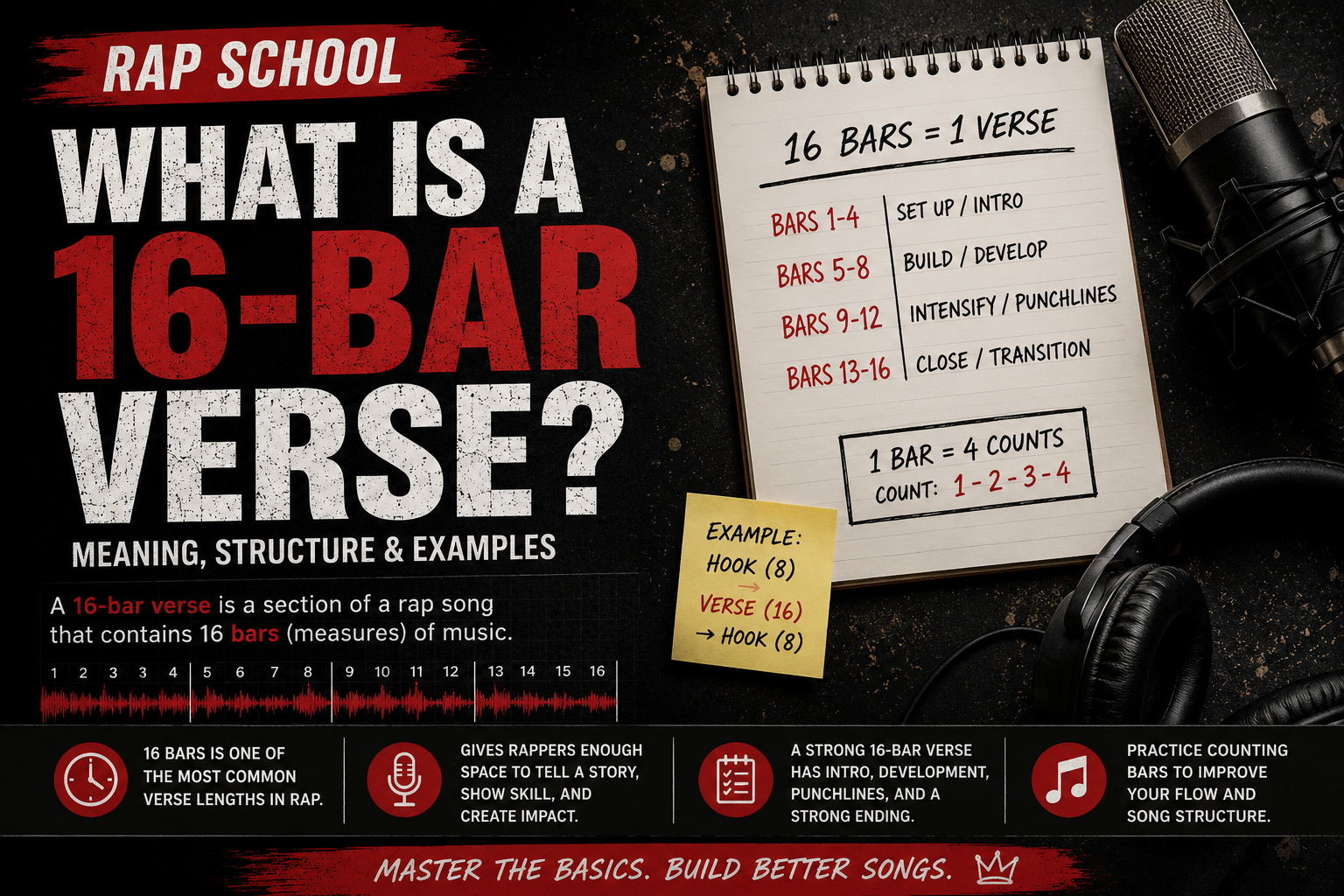
What Is a 16-Bar Verse?
A 16-bar verse is one of the most common verse lengths in rap music. It gives a rapper enough space to develop an idea, show lyrical skill, and build momentum before the hook or chorus returns.
A 16-bar verse is a standard section in rap songwriting made up of 16 musical bars, also called measures. In hip-hop, each bar usually represents one countable unit of the beat, often built around a four-count rhythm. When rappers talk about writing “a 16,” they usually mean writing a full 16-bar verse.
Understanding 16-bar verses is important for anyone learning how to rap, write lyrics, record songs, or work with producers. It helps artists stay organized, structure songs properly, and communicate clearly in studio sessions.
Simple definition: A 16-bar verse is a rap verse that lasts for 16 measures of music, usually performed before or after a hook, chorus, bridge, or another verse.
What Does “Bar” Mean in Rap?
In rap, a bar is a measure of music. Most rap beats are counted in groups of four, often as “1, 2, 3, 4.” One full count of 1 through 4 usually equals one bar. When you hear rappers say they wrote 16 bars, 32 bars, or have “crazy bars,” they may be talking about lyrical lines, but the technical meaning comes from musical measures.
Bars help rappers organize rhythm, lyrics, and song structure. Instead of guessing where a verse should start and end, artists can count bars to know exactly how long a section is.
How Long Is a 16-Bar Verse?
The length of a 16-bar verse depends on the tempo of the beat. On a slower beat, 16 bars will take longer. On a faster beat, 16 bars will move more quickly. In many rap songs, a 16-bar verse lasts around 40 to 60 seconds, but that can change depending on BPM and delivery style.
A rapper using a fast double-time flow may fit many words into 16 bars. Another rapper using a slower, more spacious flow may use fewer words in the same number of bars. The bar count stays the same, but the feel of the verse changes.
| Song Section | Common Length | Purpose |
|---|---|---|
| Intro | 4 to 8 bars | Sets the mood before the main song begins. |
| Verse | 8, 12, 16, or 24 bars | Develops the story, message, style, or lyrical performance. |
| Hook / Chorus | 4 to 8 bars | Creates the most memorable repeated section of the song. |
| Bridge | 4 to 8 bars | Adds contrast or transition before the song changes direction. |
Why Are 16 Bars So Common in Rap?
Sixteen bars became common because it is long enough for a rapper to build a full idea without making the song feel too long. It gives space for setup, development, punchlines, storytelling, rhyme schemes, and flow changes. At the same time, it usually leaves enough room for a hook and additional verses.
In traditional rap song structure, a track might include a hook, a 16-bar verse, another hook, a second 16-bar verse, and a final hook. This format is simple, balanced, and easy for listeners to follow.
How to Count 16 Bars
The easiest way to count bars is to listen to the drum pattern and count in groups of four. Start counting when the verse begins. Each time you count “1, 2, 3, 4,” that is usually one bar. Repeat that 16 times and you have counted a 16-bar verse.
Rap School Counting Example
Count “1, 2, 3, 4” with the beat. That is one bar. Do it again and you have two bars. Keep going until you reach 16. Once you practice this with several songs, you will start hearing where verses and hooks naturally begin and end.
Some beats have intros, breaks, drops, or unusual arrangements, so counting bars may feel confusing at first. The key is practice. Over time, your ear will recognize when a section changes, even before you count it.
Does a 16-Bar Verse Mean 16 Lines?
Not always. Many beginners think 16 bars means exactly 16 written lines, but that is not always true. A rapper might write one long lyric line that stretches across multiple bars, or several short lines inside one bar. The musical timing matters more than the visual number of lines on the page.
Still, for beginners, writing one line per bar can be a useful starting point. It keeps the structure simple while learning how to match lyrics to the beat.
What Should Happen Inside a 16-Bar Verse?
A strong 16-bar verse usually has movement. It should not feel like random lines placed together. The rapper may start with an introduction, build into stronger details, add punchlines or imagery, and end with a line that leads smoothly into the hook.
- Bars 1 to 4: Introduce the subject, energy, setting, or attitude.
- Bars 5 to 8: Develop the idea with details, rhymes, or story movement.
- Bars 9 to 12: Add stronger emotion, punchlines, or a flow switch.
- Bars 13 to 16: Finish with impact and transition into the hook.
This is not a strict rule, but it is a helpful structure for new artists. Once a rapper understands the format, they can bend it, break it, and create more advanced arrangements.
Can Rap Verses Be Shorter or Longer Than 16 Bars?
Yes. A verse does not have to be exactly 16 bars. Some songs use 8-bar verses for a faster, more hook-driven format. Others use 12 bars, 24 bars, or even longer verses when the artist wants to tell a bigger story or create a more traditional lyrical performance.
Modern streaming-era songs often use shorter verses than older rap records because songs are sometimes built for quicker hooks and replay value. Still, the 16-bar verse remains one of the most important structures for artists to understand.
Why 16 Bars Matter for Studio Sessions
Knowing what a 16-bar verse is helps artists work faster in the studio. Producers, engineers, and featured artists often communicate using bar counts. If someone says, “Come in after the hook and give me 16,” they expect the rapper to understand the structure.
This also matters for features. If an artist is paying for a guest verse, they may request a 16-bar verse, an 8-bar verse, or a hook. Knowing the difference helps avoid confusion and keeps the session professional.
Final Thoughts
A 16-bar verse is one of the basic building blocks of rap music. It gives rappers a clear structure for writing, recording, and performing while still leaving plenty of room for creativity. Once an artist understands bars, song structure becomes much easier to control.
Learning how to count and write 16 bars is not just a technical skill. It helps rappers develop better timing, stronger verses, cleaner hooks, and more professional songs. For anyone serious about learning rap, understanding the 16-bar verse is one of the first lessons that truly matters.
Continue Learning in Rap School
Visit the Rap School hub for more lessons on rap lyrics, songwriting, music business, royalties, promotion, and hip-hop history.
Recommended next lessons: How to Count Bars, What Is Flow in Rap?, and How to Write Rap Lyrics.