
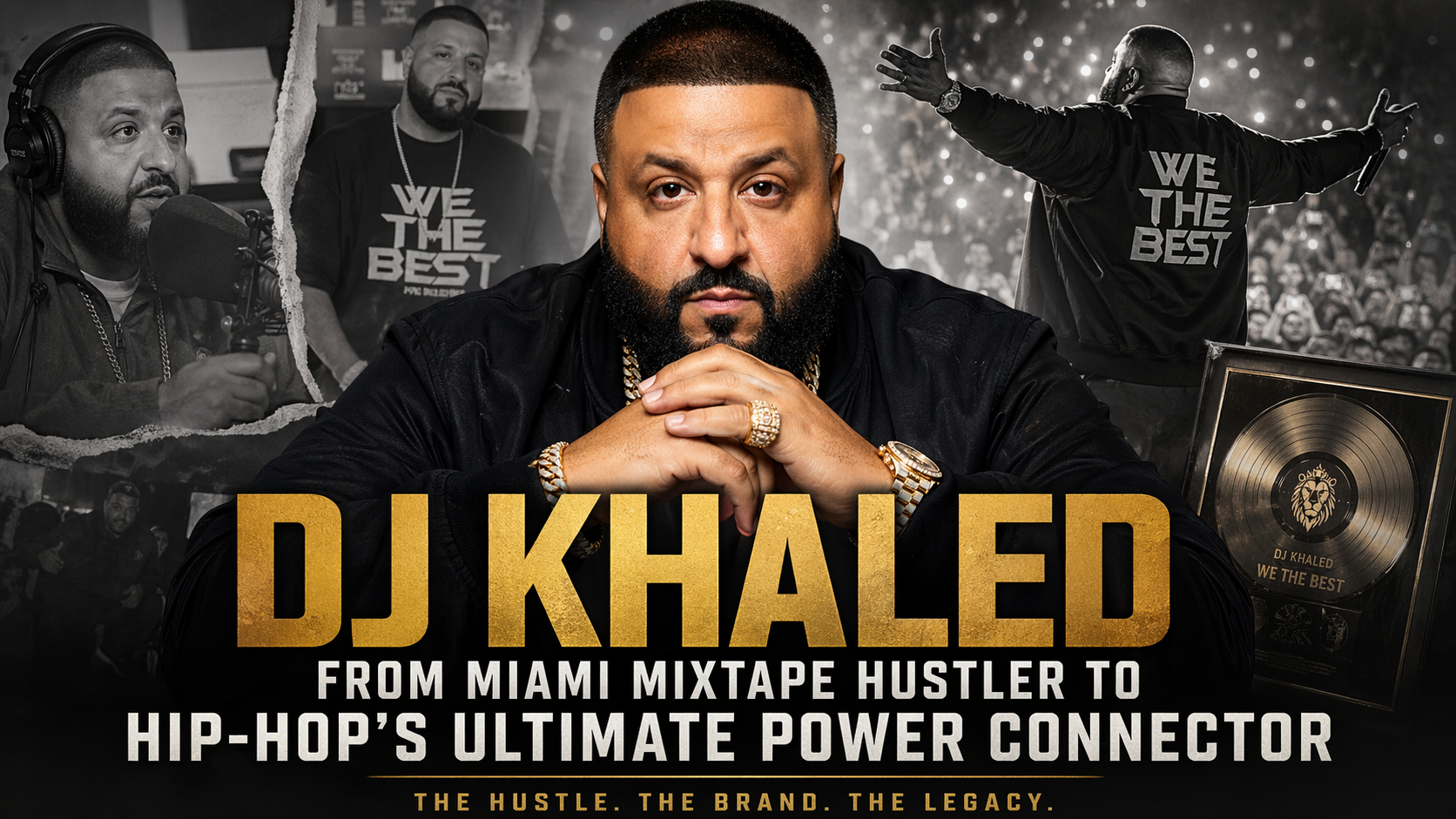
Long before the catchphrases, the mansion tours, the luxury branding, and the larger-than-life internet presence, DJ Khaled was doing something much more fundamental. He was building himself into a central figure in a city that rewarded consistency, personality, and access. His rise was not based on a traditional rap narrative. It came from understanding how hip-hop moves behind the scenes, how relationships become leverage, and how visibility can be turned into power if it is managed with enough force.
That is what makes Khaled such an unusual figure in modern rap history. He is not remembered primarily as a lyricist, and he was never sold as the classic turntablist technician. Instead, he became something more difficult to categorize and, because of that, more durable. Khaled turned curation, promotion, enthusiasm, and strategic self-mythology into a career model of its own. In a genre built on presence, he learned how to stay in front of the conversation without ever needing to fit neatly into one role.
Before “We The Best,” there was radio, Miami, and pure hustle
Khaled’s story starts well before the viral era that made him familiar to people far outside rap audiences. Born in New Orleans and later closely identified with Miami, he came up around music from childhood and eventually built his reputation in the South Florida scene, where radio, clubs, record stores, and artist relationships all overlapped. He became widely recognized through 99 Jamz, where his voice and energy gave him local influence long before the broader internet turned him into a household name.
That radio foundation mattered because it taught him how to be useful. In hip-hop, usefulness often comes before stardom. Khaled was not just present around records and artists. He was helping shape momentum, helping break music, and becoming part of the machinery that turned local energy into regional impact. He learned early that being loud only works if people also believe you can move things. That is the part many later observers missed when they reduced him to a meme or a catchphrase machine.
His ties to Terror Squad and Fat Joe’s orbit gave him added credibility and deeper access. That affiliation positioned him closer to artists, executives, and the kind of real-world movement that does not show up in neat biographies but often determines who lasts in the industry and who does not. Khaled was around enough to understand that hip-hop was never only about music. It was also about alliances, timing, identity, and who could make energy feel unavoidable.
He did not just release records. He learned how to stage events
The mixtape era trained Khaled in one of the most important skills of his career: making records feel bigger than records. Even before the streaming economy fully took over, he understood how to build anticipation around names, create urgency around collaborations, and sell scale as part of the product. The music mattered, but the way it was framed mattered just as much. Khaled was unusually good at making the audience feel that something was already a moment before it had fully arrived.
That instinct defined the early arc of his albums. The second album We the Best helped expand his profile, and later releases pushed him deeper into the mainstream. Songs like “I’m So Hood,” “All I Do Is Win,” and “I’m on One” did not just perform well. They helped establish the Khaled formula: loud energy, major features, and a sense that the track was supposed to land like a public event instead of a private artistic statement. That formula would become both his strength and the center of the criticism around him.
But criticism alone never explains longevity. Khaled kept winning because he understood that many listeners were not looking for quiet subtlety from him. They were looking for volume, confidence, and obvious scale. His records often felt engineered for clubs, sports arenas, radio rotations, and giant rollout moments. He was not trying to disappear into the music. He was trying to become inseparable from the feeling that something big was happening.
Why Khaled mattered
He helped turn the executive-producer persona into a front-facing celebrity role instead of a background function.
The bigger point
Khaled’s real product was not only songs. It was momentum, attention, and the spectacle wrapped around the songs.
The internet did not create him, but it multiplied him
When social media fully reshaped celebrity, many established figures struggled to adapt. Khaled did the opposite. He understood almost instinctively that the internet rewarded repetition, personality, optimism, and absurdly confident self-branding. Instead of treating platforms as simple promo tools, he turned them into a second stage for his persona. His motivational slogans, luxury-heavy lifestyle clips, and relentless self-narration helped him move from respected hip-hop figure to full-scale pop culture presence.
The most interesting part of that transformation is that it could easily have backfired. Plenty of public figures become online jokes and lose whatever authority they once had. Khaled managed to become memeable without fully collapsing into parody. People laughed, quoted him, clipped him, and reposted him, but they also kept watching. That attention fed back into the music, the partnerships, the brand deals, and the broad image of Khaled as someone whose success was always expanding in public.
That is where the “major key” era really mattered. It was more than a slogan. It was a blueprint for how he wanted to be perceived: endlessly rising, endlessly visible, endlessly selling the idea that success itself was a lifestyle. Whether people found it inspiring or excessive almost became secondary. The important thing was that they kept paying attention, and in modern entertainment attention is often the first form of power.
Why the collaboration era was perfect for DJ Khaled
Hip-hop became increasingly collaborative as streaming and playlist culture intensified. Big records were often driven by combinations of stars, crossover appeal, and the promise of event-level visibility. Few people were better positioned for that shift than Khaled. He had already spent years building relationships, learning rollout psychology, and understanding how to package names into anticipation. In that environment, he was not just relevant. He was built for it.
That explains why albums like Major Key and Grateful felt like more than simple releases. They were statements about access. Khaled knew how to turn a tracklist into a headline. He also knew how to make himself the emotional narrator of those releases, even when the biggest stars on the record were doing the rapping and singing. Some artists dominate by disappearing into the material. Khaled dominated by standing in front of the material and telling you how important it was before you even pressed play.
That is an easy thing to mock, but it is much harder to replicate than it looks. Plenty of industry figures have access. Very few can translate access into sustained public relevance. Khaled’s skill was not just in knowing people. It was in making those connections visible, theatrical, and repeatable in ways that strengthened his own brand every time.
The criticism is real, but so is the longevity
A serious discussion of Khaled has to acknowledge the pushback around him. Some listeners have long argued that his music relies too heavily on star power, that his public image sometimes overshadows the records themselves, and that his albums can feel more like branding exercises than cohesive artistic statements. Those critiques did not appear out of nowhere. They have followed him for years, especially during moments when the buildup around a project felt larger than the finished music.
Even so, longevity tells its own story. Khaled has remained present through multiple shifts in rap, multiple platform changes, and multiple cycles of public opinion. Entire eras have come and gone while he kept finding ways to stay culturally central. That does not happen by accident. It happens because he understands reinvention without ever abandoning the core of what made him work in the first place: loud certainty, strategic relationships, and a refusal to become invisible.
It also happens because he occupies a strange and useful place in hip-hop history. He is not easy to slot beside traditional rappers, classic DJs, or pure producers. That ambiguity once looked like a weakness to some critics. In reality, it became his lane. Khaled turned hard-to-define status into a brand advantage, and that may be one of the smartest moves of his entire career.
Five records that explain the DJ Khaled formula
- “I’m So Hood” — the regional energy and cast chemistry that helped solidify his early identity.
- “All I Do Is Win” — an anthem so oversized it escaped its era and became a permanent public soundtrack.
- “I’m on One” — the kind of record that helped push Khaled deeper into top-tier mainstream visibility.
- “I’m the One” — a polished blockbuster that showed how easily he could package a giant crossover moment.
- “Wild Thoughts” — a global hit that turned sleek presentation and star power into another undeniable event.
More than a DJ, less than easy to define
DJ Khaled’s real legacy is not just that he had hit records or memorable slogans. It is that he understood something essential about modern entertainment before many others did. In the current era, attention is not separate from artistry, branding, or business. It blends with all of them. Khaled figured out how to make that fusion work in his favor and then repeated it until it became inseparable from his identity.
That does not mean every project hit equally hard or that every critic was wrong. It means that his larger role in hip-hop became too obvious to deny. He showed that a figure could move from radio to mixtapes, from label politics to blockbuster collaborations, from internet jokes to Grammy-winning relevance, and still remain part of the conversation decades into the run. Very few careers in rap look exactly like his because very few people could have built that model in the first place.
Whether someone sees DJ Khaled as a master connector, a branding genius, a symbol of hip-hop excess, or all three at once, his place in the culture is secure. He built a career out of scale, optimism, repetition, and visibility, then turned those things into an empire. In that sense, the loudest thing Khaled ever sold was not one record or one phrase. It was the idea that being everywhere could become its own kind of authorship.
Reader Poll
How should DJ Khaled be remembered in hip-hop history?
FAQ
Was DJ Khaled originally known as a rapper?
Not primarily. His rise came through radio, DJ work, artist relationships, curation, and executive-style collaboration building rather than through a traditional rapper-first path.
Why did DJ Khaled become so famous beyond core hip-hop audiences?
His visibility expanded through major collaborations, social media branding, repeated catchphrases, and a public persona that made him recognizable even to people who were not following every album release closely.
What made DJ Khaled historically important in hip-hop?
He helped redefine what a front-facing music power broker could look like by merging DJ identity, promotion, executive instincts, artist access, and internet-era branding into one long-running public role.
Featured Stories
Explore more Raptology Featured stories, deep dives, and long-form hip-hop coverage.
Browse Featured Stories
Imo Wimana Chadband, known to the creative world as Wimana, is a music enthusiast, songwriter, poet, author, and screenwriter, with 10+ years’ experience working in the creative world.
His love for hip-hop/rap music and writing was discovered in his years at High School, and the rest is as they say, history. Wimana’s passion for journalism and writing would lead to him releasing several creative projects personally, as well as provide writing services professionally for clients globally.
He has written and curated content for various blogs and websites with his unique writing style, and continues to expand his arsenal to give readers the best experience through his work.








Leave a Reply