
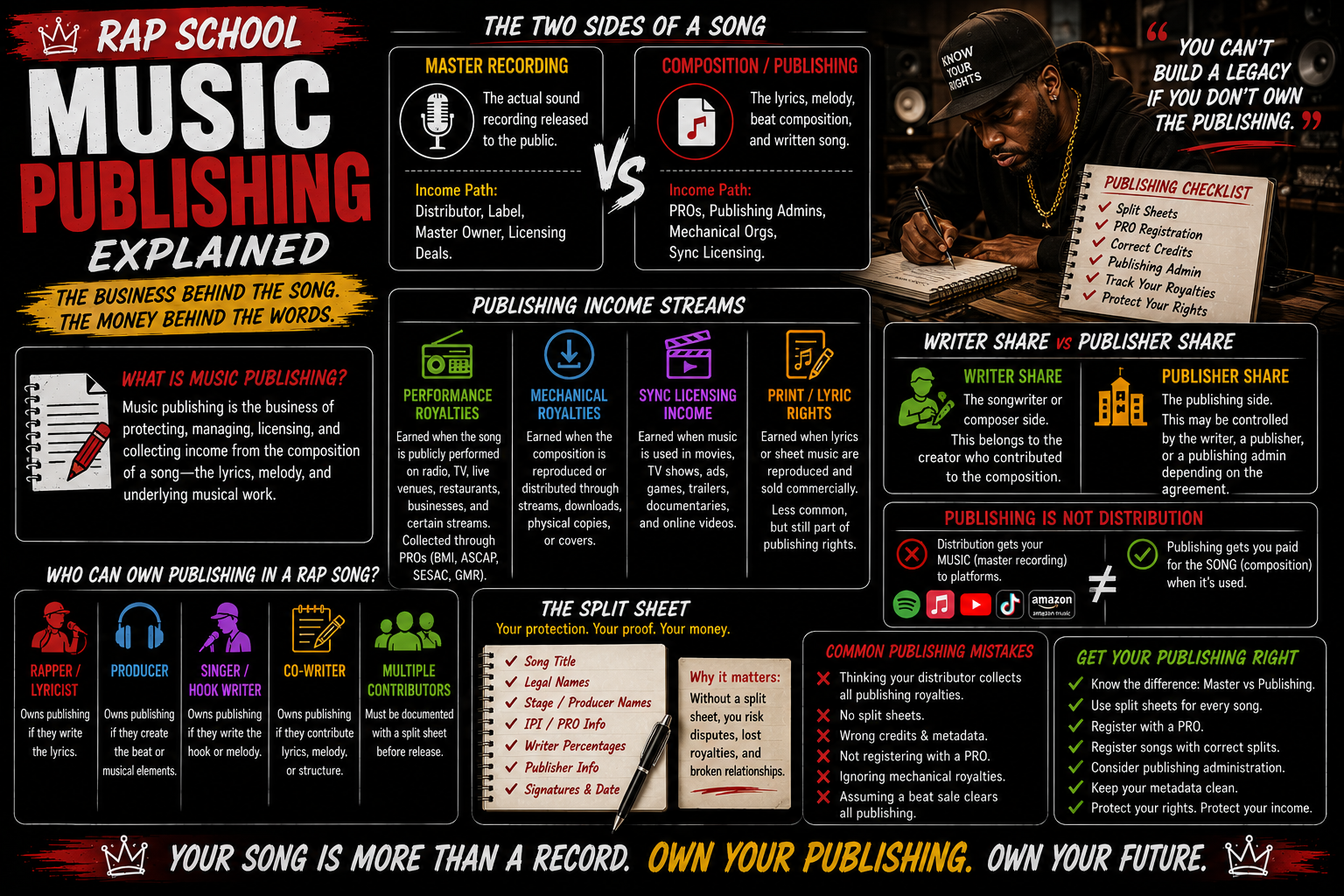
Music Publishing Explained
Music publishing is the business of managing and collecting income from the composition side of a song, including the lyrics, melody, songwriting, and ownership splits.
Music publishing is one of the most important parts of the music business, but it is also one of the most misunderstood. Many rappers and producers know how to upload songs to streaming platforms, but they do not always understand who owns the composition, how songwriter royalties work, or why split sheets matter.
If you write lyrics, create melodies, produce beats, compose music, or contribute to the structure of a song, publishing may affect your income. Understanding publishing helps artists protect their rights, collect the correct royalties, and avoid disputes later.
Simple definition: Music publishing is the business of protecting, managing, licensing, and collecting royalties from the written composition of a song.
What Is Music Publishing?
Music publishing deals with the composition side of a song. The composition includes the lyrics, melody, and underlying musical work. This is separate from the master recording, which is the actual recorded version that listeners hear on streaming platforms, radio, or videos.
For example, if a rapper writes lyrics and a producer creates the beat, both may have contributed to the composition depending on the agreement. The recording of that song is the master. The written song underneath it is the composition. Publishing is connected to that composition.
The Two Main Sides of a Song
| Side of the Song | What It Means | Common Income Path |
|---|---|---|
| Master Recording | The actual sound recording released to the public. | Distributor, label, master owner, licensing deals. |
| Composition / Publishing | The lyrics, melody, beat composition, and written song. | PROs, publishing administrators, mechanical royalty organizations, sync licensing. |
Why Publishing Matters for Rappers and Producers
Publishing matters because a song can keep generating income long after its release date. If the song is streamed, performed, broadcast, licensed, sampled, covered, placed in a film, or used commercially, the composition side may generate royalties.
For rappers, publishing can come from lyrics and songwriting. For producers, publishing can come from musical composition, beat creation, melody, arrangement, or other creative contributions. This is why producers often ask for publishing shares in addition to an upfront fee.
Important: A beat sale, feature payment, or studio fee does not automatically explain publishing ownership unless the agreement clearly says so. Always use written agreements and split sheets.
Writer Share and Publisher Share
Publishing income is often discussed in two parts: the writer share and the publisher share. The writer share belongs to the songwriter or composer. The publisher share belongs to the publisher or publishing administrator, depending on the setup.
If you are an independent artist, you may control both your writer share and your publisher share. But if you sign a publishing deal, administration deal, label-related publishing agreement, or co-publishing deal, the publisher side may be shared or administered by another company.
Writer Share
The songwriter or composer side. This is connected to the creator who contributed to the composition.
Publisher Share
The publishing side. This may be controlled by the writer, a publisher, or a publishing administrator depending on the agreement.
What Royalties Come From Publishing?
Publishing can generate several types of royalties. These royalties are not always collected by the same company, which is why independent artists need a complete royalty setup instead of relying on only one platform.
| Royalty Type | What Triggers It | Why It Matters |
|---|---|---|
| Performance Royalties | Public performance, radio, TV, live venues, businesses, and certain streams. | Collected through PROs such as BMI, ASCAP, SESAC, or GMR. |
| Mechanical Royalties | Reproduction and distribution of the composition through streams, downloads, physical copies, or covers. | Can require separate collection beyond basic distribution. |
| Sync Licensing Income | Music used in film, TV, ads, games, trailers, documentaries, or online videos. | Can create upfront fees and additional backend royalties. |
| Print / Lyric Rights | Lyrics or sheet music reproduced commercially. | Less common for many rappers, but still part of publishing rights. |
Publishing vs. Distribution
Distribution and publishing are not the same thing. A distributor helps deliver your sound recording to platforms such as Spotify, Apple Music, YouTube Music, and other digital services. Publishing deals with the composition underneath that recording.
This is one of the biggest areas where artists lose money. Seeing money in a distributor account does not always mean all publishing royalties have been collected. A distributor may pay master-side income while publishing royalties may require PRO registration, mechanical royalty collection, or publishing administration.
Rap School Example
If your song earns streaming income, your distributor may pay you for the master recording. But the composition may also generate performance and mechanical royalties. Those publishing royalties may not automatically appear in your distributor dashboard unless you have the right publishing setup.
What Is a Publishing Administrator?
A publishing administrator helps songwriters register compositions, collect publishing royalties, and manage licensing across different territories. Unlike a traditional publisher, a publishing administrator usually does not own the song. Instead, the administrator collects and administers royalties for a fee or percentage.
For independent artists, publishing administration can be useful because global publishing royalty collection is complicated. Songs may generate income in different countries, platforms, and royalty systems. An administrator can help track and collect royalties that artists might otherwise miss.
What Is a Music Publisher?
A music publisher is a company that manages song copyrights and may help with licensing, royalty collection, creative opportunities, sync placements, and catalog management. Some publishing deals involve ownership or control of part of the publishing. Others are administration-only agreements.
Before signing any publishing deal, artists should understand whether they are giving away ownership, sharing the publisher share, granting administration rights, or agreeing to a limited-term collection service.
Why Split Sheets Are Essential
A split sheet documents who owns what percentage of a song. It should list every songwriter, producer, composer, and contributor involved in the composition. The split sheet should be completed before the song is released, not after money starts coming in.
Without split sheets, artists may later argue over ownership, credits, and royalties. Split sheets are especially important in rap sessions where beats, hooks, verses, features, and co-writing can happen quickly.
- Song title
- Legal names of contributors
- Stage names or producer names
- IPI or PRO information when available
- Writer percentage for each contributor
- Publisher information when available
- Signatures and date
Who Owns Publishing in a Rap Song?
Publishing ownership depends on who contributed to the composition and what agreements were signed. A rapper who writes lyrics may own part of the publishing. A producer who created the beat may own part of the publishing. A singer who wrote the hook may own part of the publishing. A co-writer who helped shape melodies or lyrics may also own part of the composition.
However, every situation depends on contracts. If someone was paid a flat fee and signed a work-for-hire or buyout agreement, their rights may be different. Without a clear written agreement, assumptions can lead to serious disputes.
Common Publishing Mistakes Artists Make
- Thinking a distributor collects all publishing royalties.
- Releasing songs without split sheets.
- Registering only the artist name and not the correct legal writer information.
- Forgetting to register songs with a PRO.
- Ignoring mechanical royalty collection.
- Not setting up a publisher entity or publishing administration when needed.
- Assuming a beat purchase automatically clears all publishing questions.
- Using incorrect producer, featured artist, or songwriter credits.
Publishing Checklist for Independent Artists
- Know the difference between master rights and publishing rights.
- Complete split sheets for every song with collaborators.
- Register with a PRO such as BMI, ASCAP, SESAC, or GMR.
- Register each song with accurate writer and publisher splits.
- Understand whether you need publishing administration.
- Keep track of ISRCs, ISWCs, IPI numbers, legal names, and stage names.
- Make sure producer and feature agreements are in writing.
- Review any publishing contract before signing away rights.
Final Thoughts
Music publishing is the business side of songwriting. It controls how the composition is registered, licensed, and monetized. For rappers, producers, and songwriters, understanding publishing is essential because it affects long-term royalties and ownership.
The most important lesson is simple: distribution is not publishing. Uploading a song is only one step. To properly protect your music, you need clean splits, correct registrations, royalty collection systems, and a clear understanding of who owns the master and who owns the composition.
Continue Learning in Rap School
Visit the Rap School hub for more lessons on rap lyrics, songwriting, royalties, publishing, promotion, and hip-hop history.
Recommended next lessons: How Music Royalties Work, BMI vs ASCAP, and TuneCore vs DistroKid.