
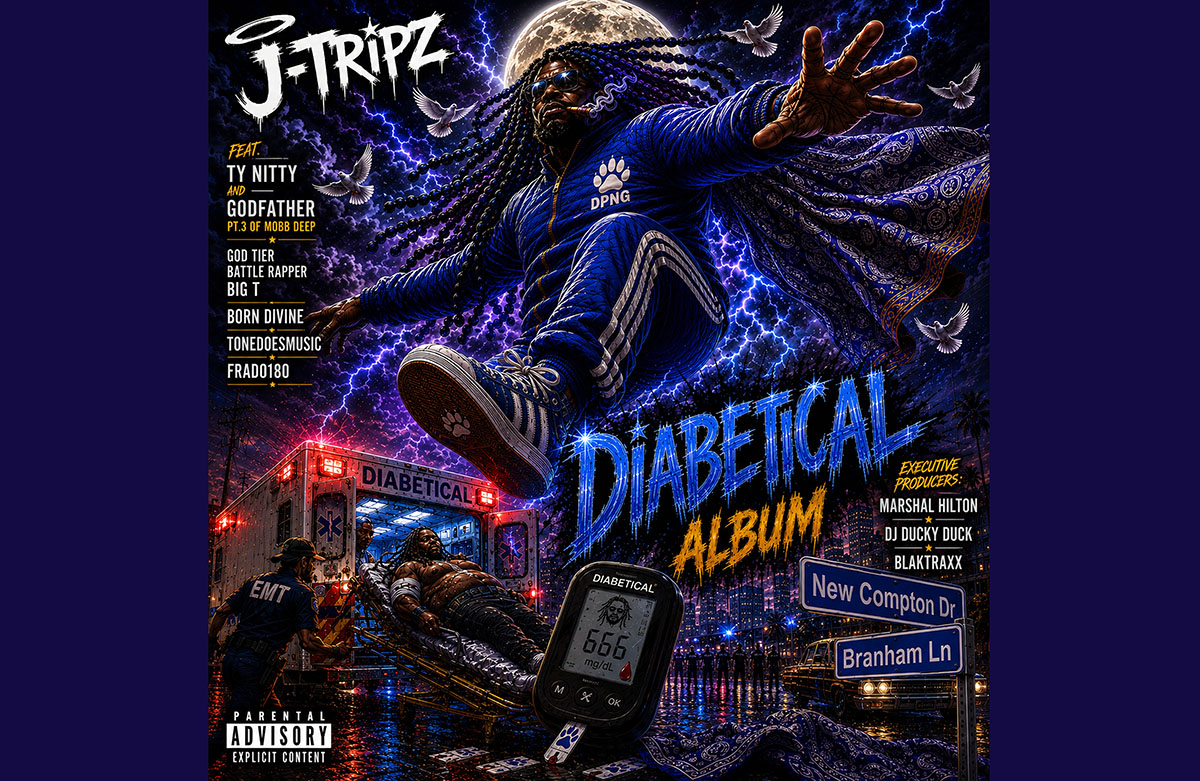
PARADISE, Nev. – John Henry Hudson III has carried several names, cities and chapters through a long and unpredictable life in hip-hop.
Professionally known as J-Tripz, the rapper’s stage name developed from his legal name. John Henry Hudson III became J-Triple, which eventually evolved into J-Tripz. The name reflects both his identity and personality: sharp, self-aware and rooted in a life story that has moved across coasts, countries and different eras of the music business.
Hudson recently turned 40, a milestone he considers deeply meaningful. After surviving a life marked by risk, reinvention and serious health challenges, reaching that age represents more than another birthday. For him, it is evidence that another chapter remains possible.
That sense of survival sits at the center of his latest album, “Diabetical,” a personal project shaped by a frightening health crisis and a renewed sense of purpose. After more than two decades in music, J-Tripz considers it one of the most important records he has created because it allows him to tell his story without hiding behind an exaggerated persona.
The album’s title directly refers to his battle with diabetes, but the project reaches beyond a single diagnosis. “Diabetical” explores mortality, transformation, discipline and the refusal to let setbacks determine the future. What began during one of the darkest periods of his life ultimately became the foundation for music centered on honesty, resilience and legacy.
Rather than presenting survival as a simple victory, J-Tripz examines it as a complicated process. The album moves through altered states, frustration, confidence, reflection and spiritual awakening. Several songs function almost like individual scenes within a larger story, giving the project the shape of a personal film translated into music.
The title track, “Diabetical,” establishes the emotional foundation of the album. It is the song most directly connected to the experience that inspired the project, transforming a serious medical struggle into a declaration of continued life.
Instead of treating diabetes as a background detail, J-Tripz places it at the center of the narrative. The condition becomes a symbol of the moment when his body forced him to reevaluate his habits, priorities and direction. The track reflects the realization that survival requires more than luck. It demands change, accountability and a willingness to confront realities that may have previously been ignored.
The song also introduces one of the album’s central ideas: a breaking point can become the beginning of a new identity. J-Tripz does not present himself as someone who escaped hardship untouched. He presents himself as someone transformed by it.
Another standout, “IIM SO HIGH,” expands the project’s atmosphere through a collaboration connected to Mobb Deep. The feature carries particular significance for J-Tripz, whose influences include the group’s dark production, street realism and uncompromising approach to lyricism.
The song brings a heavier East Coast presence into an album created by an artist whose own history stretches across Delaware, California, the Bahamas and Nevada. That mixture of regional influences reflects J-Tripz’s broader musical identity. He has never belonged entirely to one city or one narrowly defined sound.
“IIM SO HIGH” also represents the type of cross-generational hip-hop connection that has remained important throughout his career. Rather than treating veteran artists and classic groups as distant references, J-Tripz incorporates those relationships and influences into the continuing story of his music.
“Stop Telling Me” shifts the focus toward resistance and frustration. Even through its title, the song suggests an artist pushing back against outside voices, assumptions and expectations.
That theme fits naturally within J-Tripz’s story. After years of moving through the independent music industry, major artist circles, regional scenes and personal setbacks, he has heard numerous opinions about what his career should look like and what kind of artist he should become.
On “Stop Telling Me,” that pressure becomes part of the album’s emotional conflict. The song captures the tension between receiving advice and losing ownership of one’s direction. It reflects the perspective of someone who has accumulated enough experience to recognize that not every outside opinion deserves control over his next move.
While much of “Diabetical” addresses difficult experiences, “Shine” introduces a more immediate and celebratory energy. J-Tripz describes it as a crowd pleaser, and the track provides an important contrast to the album’s heavier subject matter.
“Shine” demonstrates that an album built around survival does not have to remain trapped in darkness. Celebration can also be part of recovery. Confidence, performance and audience connection become reminders of what the artist survived to continue doing.
The song draws on the stage presence J-Tripz began developing during his early years in the Bay Area party scene. Before his career expanded into affiliations, film appearances and international travel, he learned how to perform in front of live audiences and respond to the energy of a room.
That instinct remains present in “Shine.” The track creates space for movement and release while still fitting within the album’s larger narrative. After confronting illness and uncertainty, J-Tripz allows himself a moment to be seen, heard and celebrated.
“The Light” brings the project’s themes of mortality and renewal into their clearest conceptual form. The song concludes with a death-and-awakening sequence, reinforcing the idea that “Diabetical” is not simply a collection of tracks but a journey through collapse and rebirth.
The ending can be understood as the symbolic death of an earlier version of J-Tripz. It creates a dividing line between the life he was living before his health crisis and the person emerging afterward.
Within the album’s larger structure, the awakening is not presented as an easy resolution. It is a recognition that continued life carries responsibility. Surviving means being given another opportunity, but it also means deciding what to do with that opportunity.
“The Light” therefore functions as one of the project’s most important moments. It brings together the album’s health themes, spiritual questions and cinematic ambitions while leaving listeners with the sense that J-Tripz has reached the end of one chapter rather than the end of his story.
Hudson’s path to “Diabetical” began far from his current home in Nevada. He was born in Wilmington, Delaware, before moving to the Bay Area as an infant. He spent part of his childhood on the south side of San Jose and later relocated to Freeport, Grand Bahama Island, at age 8.
He eventually returned to San Jose for his final two years of high school and college, graduating from San Jose City College with an associate degree in radio broadcasting.
Before becoming widely known as J-Tripz, Hudson gained early experience in music and media. While still in high school, he worked at KARA 105.7 in Santa Clara, a soft hits radio station, and remained there for a period afterward.
The experience gave him an inside look at broadcasting, presentation and the process through which music reaches an audience. It also placed him near the professional side of entertainment before his own identity as a recording artist had fully developed.
Hudson later became active in the Bay Area party scene, performing and moving through circles that helped shape his early identity. Those years provided a foundation in live performance, crowd control and regional hip-hop culture before he relocated to Las Vegas around 2006.
Today, he lives in Paradise, Nevada, near Las Vegas. His career, however, has rarely remained fixed in one location. Through music and other business ventures, J-Tripz has traveled widely and built relationships across different corners of hip-hop.
His early solo catalog included “Chicken Wingz, Gritz & Spitz,” released during the mid-2000s. Since then, his music has continued to develop, drawing from West Coast rap, street storytelling, theatrical vocal performances and the perspective of an artist who has experienced the industry from both the inside and its margins.
One of the defining chapters of his career came through his connection to Daz Dillinger and Kurupt of Tha Dogg Pound. Hudson became part of Dogg Pound Next Generation, a group name given by Daz and Kurupt.
The affiliation placed him near one of West Coast hip-hop’s most recognizable legacies and connected his story to the extended family tree surrounding DPG, Snoop Dogg and the broader G-funk tradition.
J-Tripz’s influences and associations span several generations of rap. He identifies DPG, Wu-Tang Clan, Bone Thugs-N-Harmony, Mobb Deep and other foundational artists as significant touchstones.
His path also brought him into contact with artists including G-Dep, Tash of Tha Alkaholiks and Juelz Santana. Rather than pointing to one defining influence, his career reflects the wider impact of the artists, regions and movements he encountered along the way.
His résumé extends beyond recorded music. J-Tripz appeared in “7th and Westlake: The Rerock,” a film featuring Omar Gooding, Layzie Bone and other figures from music and entertainment.
The film was directed by rapper and filmmaker Ric-Hard, whom Hudson credits as an important figure in teaching him the realities of the independent music hustle.
Ric-Hard also played a key role in connecting Hudson to Snoop Dogg in 2003. That meeting became one of the turning points in his career, opening access to a broader network of artists, studios, stages and industry relationships.
For J-Tripz, those years became a firsthand education in hip-hop’s business, culture, opportunities and politics.
“Diabetical,” however, marks a different kind of milestone. Instead of relying primarily on affiliations, memories or recognizable industry names, the album brings Hudson’s own experiences into sharper focus.
His health crisis serves as the entry point, but the project ultimately examines a much larger question: What does someone do after realizing that life could have ended?
Throughout the album, J-Tripz responds by looking inward. The title track confronts the diagnosis. “IIM SO HIGH” connects his current work to one of hip-hop’s influential legacies. “Stop Telling Me” rejects the pressure of outside expectations. “Shine” restores performance and celebration, while “The Light” completes the journey with symbolic death and awakening.
Together, those songs form the emotional backbone of the project.
The album also reflects where J-Tripz stands at 40. He is not attempting to recreate an earlier era or chase every current trend. Instead, he is drawing from his experiences to create music rooted in truth, memory and continued growth.
After years of performing, traveling, building relationships and navigating the independent side of the industry, he appears increasingly focused on legacy rather than image.
That honesty places “Diabetical” within a broader movement in hip-hop, as veteran artists speak more openly about health, aging, trauma, recovery and the consequences of the lives they have lived.
J-Tripz’s story fits naturally within that conversation. He has survived enough to look backward with perspective, but he remains active enough to convert those lessons into new work.
For an artist whose life has moved from Delaware to California, the Bahamas and Nevada, “Diabetical” serves as both a personal statement and a reset.
The album does not erase the past. It organizes it.
It brings together the radio student, Bay Area performer, DPG affiliate, actor, traveler and survivor within one focused chapter. The many different versions of John Henry Hudson III finally become part of the same story.
J-Tripz has spent years around respected figures in rap, but his latest album is less concerned with proving who he knows than revealing who he has become.
“Diabetical” presents an artist who reached a breaking point, confronted his mortality and chose to turn that experience into music.
At its core, the album is about discovering another reason to keep writing, recording, performing and living. For listeners facing difficult seasons of their own, J-Tripz hopes the project can serve as a reminder that the story does not have to end during its hardest chapter.
Sometimes, the darkest moment is where the next version of the story begins.
Natalia is a Rap and Hip Hop enthusiast. After graduating from The New School of New York’s Public Relations Program and taking a course in Journalism at Michigan State University, she decided to dedicate her life to the music publishing business and to the discovery of new talent. She helps new artists gain exposure to the masses via online marketing and publications.






















Leave a Reply