
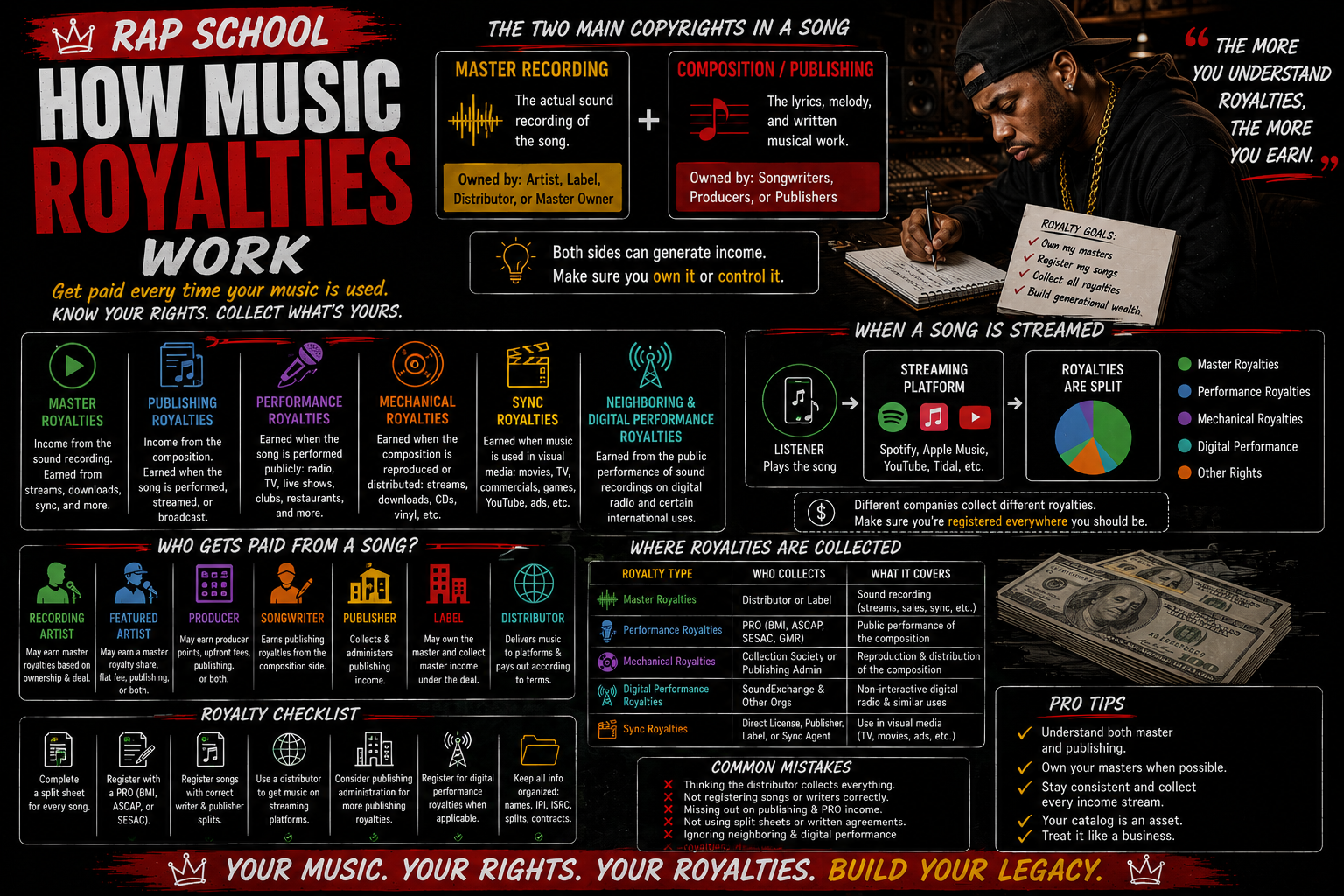
How Music Royalties Work
Music royalties are the payments generated when songs are streamed, sold, performed, broadcast, licensed, or used commercially. For artists, producers, and songwriters, understanding royalties is one of the most important parts of the music business.
Music royalties can feel confusing because one song can generate money in several different ways. A single track may create streaming royalties, publishing royalties, mechanical royalties, performance royalties, master royalties, and sync licensing income. Different companies collect different types of money, and missing one step can mean leaving income unclaimed.
For rappers, producers, songwriters, and independent artists, understanding royalties is not optional. It is the difference between only releasing music and actually building a music business around that music.
Simple definition: Music royalties are payments owed to rights holders when music is used, streamed, sold, performed, broadcast, or licensed.
The Two Main Copyrights in a Song
Every released song usually has two major sides: the master recording and the composition. The master is the actual sound recording that listeners hear. The composition is the underlying song, including the lyrics, melody, and written musical work.
This is important because royalties often split between these two sides. An artist may own the master, the publishing, both, or neither, depending on contracts, collaborators, label deals, producer agreements, and split sheets.
| Copyright Side | What It Means | Who May Own It |
|---|---|---|
| Master Recording | The actual recorded version of the song. | Artist, label, distributor, or master rights owner. |
| Composition / Publishing | The underlying lyrics, melody, and written song. | Songwriters, producers, publishers, or publishing administrators. |
Master Royalties
Master royalties come from the sound recording. When a song is streamed on platforms, sold as a download, used in certain videos, or licensed for commercial use, the master side can generate income. If an artist owns their master, they may receive this income through their distributor or label arrangement.
Independent artists often collect master-side streaming income through services like TuneCore, DistroKid, CD Baby, UnitedMasters, or similar distributors. If the artist is signed to a label, the label may collect the master income first and then pay the artist according to the deal.
Publishing Royalties
Publishing royalties come from the composition side of the song. This includes the lyrics, melody, and songwriting ownership. If multiple people helped write the song, the publishing side should be split according to each contributor’s agreed share.
Publishing is especially important for rappers and producers because a person may not own the master but may still own part of the composition. A featured artist, producer, topline writer, or songwriter may be entitled to publishing if they contributed to the writing or composition and were not properly bought out through a written agreement.
Performance Royalties
Performance royalties are generated when a song is publicly performed or broadcast. This can include radio play, TV play, live venues, restaurants, clubs, concerts, and some types of digital performance. In the United States, these royalties are typically connected to performing rights organizations such as BMI, ASCAP, SESAC, and GMR.
Songwriters and publishers need to be properly registered with a performing rights organization to collect performance royalties. If the song is not registered correctly, money may be delayed, unmatched, or left uncollected.
Mechanical Royalties
Mechanical royalties are generated when a composition is reproduced or distributed. Historically, this included physical copies like CDs and vinyl. In the streaming era, mechanical royalties are also connected to certain streaming and download uses of the composition.
For independent artists, mechanical royalty collection can be one of the easiest areas to miss because it may not all flow through a regular distributor dashboard. Publishing administrators and mechanical royalty organizations can help collect this side depending on the territory and setup.
Streaming Royalties
Streaming royalties are not just one simple payment. A stream can generate income on both the master side and the publishing side. The master-side payment usually goes through the distributor or label. The publishing-side payments may involve performance royalties and mechanical royalties.
When a song is streamed, different royalty paths may be involved:
This is why an artist may see some money in a distributor account but still be missing publishing income. The distributor payment does not always mean every royalty type has been collected.
Sync Royalties
Sync royalties are generated when music is licensed for use with visual media. This can include movies, TV shows, commercials, video games, trailers, YouTube campaigns, documentaries, and online ads. Sync can be valuable because it may involve upfront licensing fees and additional performance royalties if the content is broadcast or publicly performed.
Sync licensing often requires permission from both sides of the song: the master owner and the publishing owner. If there are multiple writers, producers, or rights holders, the paperwork needs to be clean before the song can be licensed easily.
Neighboring Rights and Digital Performance Royalties
Neighboring rights and digital performance royalties are another area artists should understand. These royalties can relate to the public performance of sound recordings, especially on non-interactive digital radio and certain international uses. In the United States, SoundExchange is commonly associated with collecting digital performance royalties for sound recordings from non-interactive digital services.
This area can be confusing because it is separate from regular distributor payments and separate from songwriter performance royalties collected by a PRO. Artists who are building a serious catalog should learn whether they are registered to collect these rights.
Who Gets Paid From a Song?
Many people can be entitled to royalty income from one song. The exact split depends on ownership, contracts, collaboration agreements, split sheets, label deals, producer agreements, and publishing administration.
- Recording artist: May earn master royalties depending on ownership and deal terms.
- Featured artist: May receive a master royalty share, a flat fee, publishing, or a combination depending on the agreement.
- Producer: May receive producer points, upfront fees, publishing, or both.
- Songwriter: Earns from the composition side if properly credited and registered.
- Publisher: Collects or administers publishing income depending on the agreement.
- Label: May control the master and collect master income under a record deal.
- Distributor: Delivers the music to platforms and pays out according to its service terms.
Why Split Sheets Matter
A split sheet is a document that records who owns what percentage of a song. It should be completed before or shortly after the song is created, not months later after the song starts making money. Split sheets help prevent arguments about who wrote what, who produced what, and who is entitled to publishing or master income.
For rappers and producers, split sheets are especially important because studio sessions often move fast. People may assume everyone is on the same page, but later disagreements can happen if there is no written record.
Rap School Example
If a rapper writes the lyrics, a producer creates the beat, and a singer writes the hook, all three may have a claim on the composition depending on the agreement. If there is no split sheet, registering the song correctly later can become difficult.
Where Royalties Are Collected
No single company collects every royalty for every artist in every situation. That is why music professionals often register songs in multiple places. A distributor may handle master-side streaming payouts, while a PRO handles performance royalties, and a publishing administrator may help collect publishing income.
| Royalty Area | Common Collection Path | What It Covers |
|---|---|---|
| Master Streaming Income | Distributor or label | Payments tied to the sound recording. |
| Performance Royalties | PRO such as BMI, ASCAP, SESAC, or GMR | Public performance of the composition. |
| Mechanical Royalties | Mechanical collection society or publishing administrator | Reproduction and distribution of the composition. |
| Digital Performance Royalties | SoundExchange or similar organizations | Certain non-interactive digital performances of sound recordings. |
| Sync Income | Direct license, publisher, label, sync agent, or administrator | Music used in visual media. |
Common Mistakes Artists Make With Royalties
One common mistake is thinking that uploading a song through a distributor automatically collects every royalty. Distribution is important, but it does not always cover every publishing, performance, mechanical, or neighboring rights income stream.
Another mistake is failing to register songs with accurate credits. If writer names, producer names, splits, legal names, and publishing information are incorrect, payments can be delayed or misdirected. Artists should treat registration like part of the release process, not an afterthought.
Basic Royalty Checklist for Independent Artists
- Confirm who owns the master recording.
- Complete a split sheet for every song.
- Register as a songwriter with a PRO.
- Register the song with the correct writer and publisher splits.
- Use a distributor to deliver the song to streaming platforms.
- Consider publishing administration for additional publishing collection.
- Register for digital performance royalties when applicable.
- Keep legal names, stage names, IPI numbers, ISRC codes, and splits organized.
Final Thoughts
Music royalties are the financial system behind songs. Every time music is streamed, performed, broadcast, licensed, sold, or used commercially, there may be income attached to it. The challenge is knowing which royalty is being generated, who is entitled to it, and where it should be collected.
For independent rappers, producers, and songwriters, royalty knowledge is career protection. Releasing music is only the first step. Registering songs properly, documenting splits, understanding the master and publishing sides, and collecting from the right sources are what help turn music into a real long-term asset.
Continue Learning in Rap School
Visit the Rap School hub for more lessons on rap lyrics, songwriting, royalties, publishing, promotion, and hip-hop history.
Recommended next lessons: BMI vs ASCAP, Music Publishing Explained, and TuneCore vs DistroKid.