
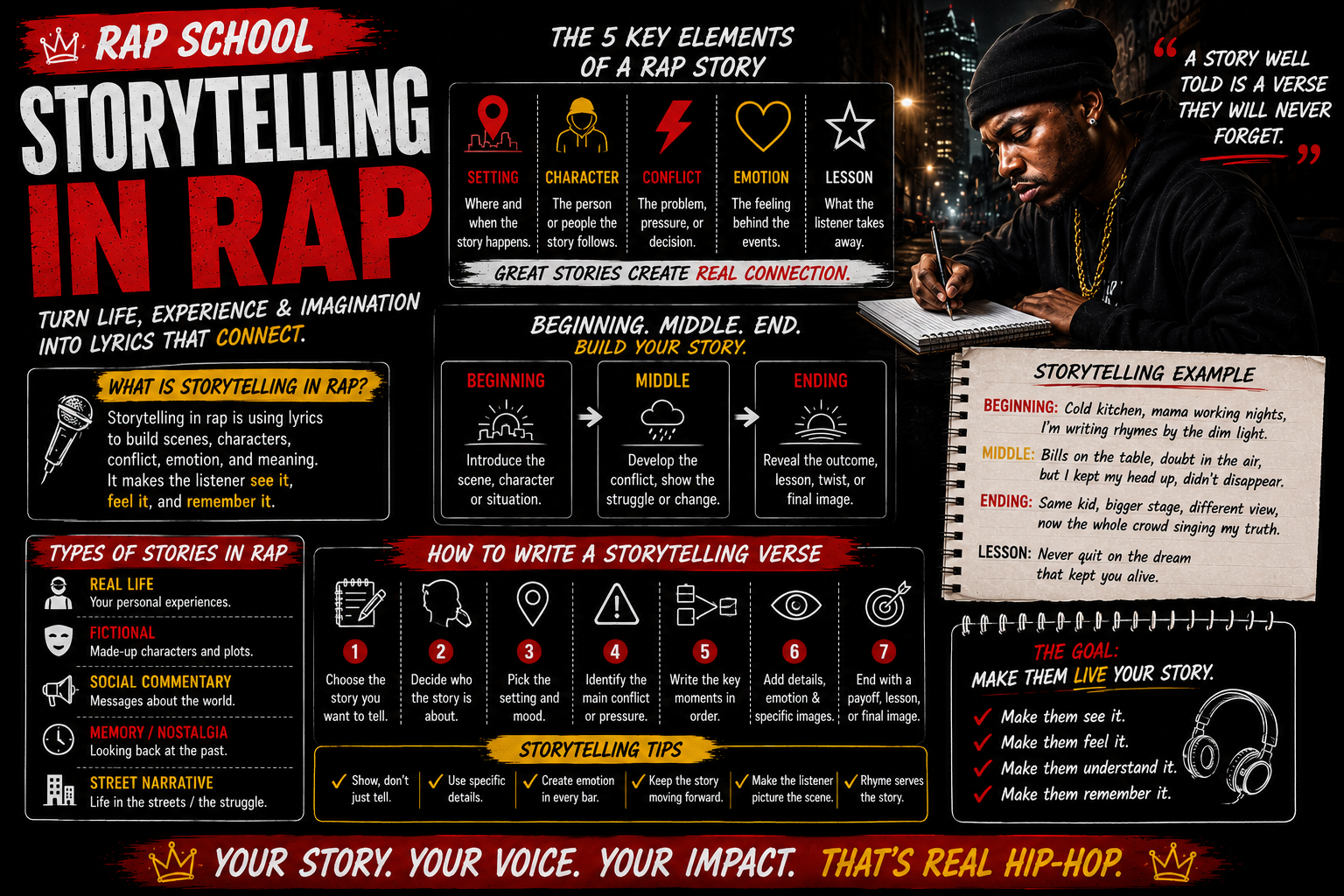
Storytelling in Rap
Storytelling in rap is the art of using lyrics to build scenes, characters, conflict, emotion, and meaning. It turns a verse into something listeners can picture, follow, and remember.
Storytelling has always been one of the strongest skills in hip-hop. A great rap story can feel like a movie, a confession, a warning, a memory, or a street-level documentary told through rhythm and rhyme. While punchlines and flows can impress listeners, storytelling makes them care about what is happening.
Some rappers use storytelling to describe personal experiences. Others create fictional characters, social commentary, crime narratives, family memories, neighborhood scenes, or emotional snapshots from real life. The best storytelling songs are not just about what happened. They show why it mattered.
Simple definition: Storytelling in rap means using lyrics to tell a clear narrative with a setting, characters, events, emotion, and a point.
What Is Storytelling in Rap?
Storytelling in rap is when an artist uses verses to guide the listener through a situation. Instead of writing random bars, the rapper creates a beginning, middle, and ending. The song may follow one character, one day, one memory, one conflict, or one major decision.
A storytelling verse does not have to explain every detail. In fact, strong storytelling often works through specific images. A small detail can make a scene feel real, such as the weather, the room, the car, the phone call, the look on someone’s face, or the sound of silence after something serious happens.
Why Storytelling Matters in Hip-Hop
Storytelling matters because hip-hop grew from real voices describing real environments. Rap has always been a way to document life, speak from experience, and turn personal truth into art. A strong story can make a listener understand a world they have never lived in or recognize emotions they have felt themselves.
Storytelling also gives lyrics replay value. A listener may return to a story song because they want to catch details they missed, understand the message more deeply, or feel the emotion again. This is why many classic rap records are remembered not only for their beats, but for the stories they told.
The Main Elements of a Rap Story
| Story Element | What It Means | Why It Matters |
|---|---|---|
| Setting | Where and when the story happens | Helps the listener picture the world of the song. |
| Character | The person or people the story follows | Gives the listener someone to understand or react to. |
| Conflict | The problem, pressure, danger, or decision | Creates tension and keeps the story moving. |
| Emotion | The feeling behind the events | Makes the story connect beyond the facts. |
| Lesson or Point | What the listener should take away | Gives the story meaning and impact. |
Beginning, Middle, and Ending
A strong rap story usually has a beginning, middle, and ending. The beginning introduces the situation. The middle develops the tension. The ending gives the listener a conclusion, twist, lesson, or emotional release.
- Beginning: Introduce the scene, character, mood, or problem.
- Middle: Show what changes, what goes wrong, or what pressure builds.
- Ending: Reveal the outcome, consequence, lesson, or final image.
Rap School Example
A storytelling verse might begin with a young artist writing alone in a bedroom, move into the pressure of family doubt and financial struggle, then end with the artist performing the same lyrics on stage years later. The story works because it shows change, emotion, and payoff.
Show, Do Not Just Tell
One of the most important storytelling rules is to show instead of only telling. Saying “I was stressed” is clear, but showing the stress through details makes the listener feel it. A rapper might describe unanswered calls, late-night pacing, empty pockets, or a notebook full of unfinished lines.
Details make stories believable. The more specific the image, the more real the verse can feel. General lines may explain the topic, but specific lines bring the listener into the scene.
Basic telling: I was struggling and felt alone.
Stronger storytelling: Three missed calls, cold food on the table, and I still could not tell them what was wrong.
Point of View in Rap Storytelling
Point of view controls how the story is told. A rapper can tell a story from their own perspective, from another character’s perspective, or as an outside narrator watching events unfold. Each choice changes how the listener experiences the song.
- First person: The rapper tells the story as “I.” This feels personal and direct.
- Second person: The rapper speaks to “you.” This can feel confrontational, intimate, or reflective.
- Third person: The rapper tells the story about someone else. This can feel cinematic or documentary-like.
How Hooks Work in Storytelling Songs
The hook in a storytelling rap song should usually support the main theme. It does not have to explain the whole story, but it should reinforce the emotion, question, warning, or lesson of the song. A strong hook gives the listener an anchor while the verses move the story forward.
For example, if the verses tell a story about ambition, the hook might focus on sacrifice. If the verses describe betrayal, the hook might focus on trust. If the verses show survival, the hook might repeat a line that captures resilience.
How to Write a Storytelling Rap Verse
- Step 1: Choose the story you want to tell.
- Step 2: Decide who the story is about.
- Step 3: Pick the setting and mood.
- Step 4: Identify the main conflict or pressure.
- Step 5: Write the key moments in order.
- Step 6: Add sensory details, emotion, and specific images.
- Step 7: End with a payoff, lesson, twist, or final picture.
Common Storytelling Structures in Rap
There are several ways to structure a storytelling rap song. Some stories move in a straight timeline from beginning to end. Others start at the most dramatic moment, then flash back to explain how the character got there. Some songs tell the same event from different points of view.
| Structure | How It Works | Best For |
|---|---|---|
| Linear Story | Events happen in order from beginning to end. | Clear personal stories, memories, and lessons. |
| Flashback | The song starts later, then returns to the past. | Dramatic openings and emotional reveals. |
| Multiple Perspectives | Each verse shows a different character or angle. | Complex social stories or moral conflicts. |
| Twist Ending | The final bars reveal something unexpected. | Suspenseful or cinematic songs. |
Common Mistakes Beginners Make
One common mistake is trying to explain too much. A rap song has limited space, so the artist has to choose the most important details. Too many names, places, and background facts can make the story hard to follow.
Another mistake is writing a story without conflict. If nothing changes, the listener has no reason to stay invested. The story needs pressure, decision, consequence, or emotion. Even a quiet story can have tension if the feeling is strong enough.
Final Thoughts
Storytelling in rap is one of the strongest ways to make lyrics meaningful. It allows artists to turn personal experiences, fictional scenes, neighborhood realities, and emotional memories into songs that listeners can see and feel.
For new rappers, the key is to write with clarity and detail. Choose a story, build a scene, create conflict, and end with a line or image that gives the song purpose. When storytelling is done well, a rap verse becomes more than a performance. It becomes a world the listener can enter.
Continue Learning in Rap School
Visit the Rap School hub for more lessons on rap lyrics, songwriting, music business, royalties, promotion, and hip-hop history.
Recommended next lessons: How to Structure a Rap Song, Punchlines in Rap, and What Is Flow in Rap?.