
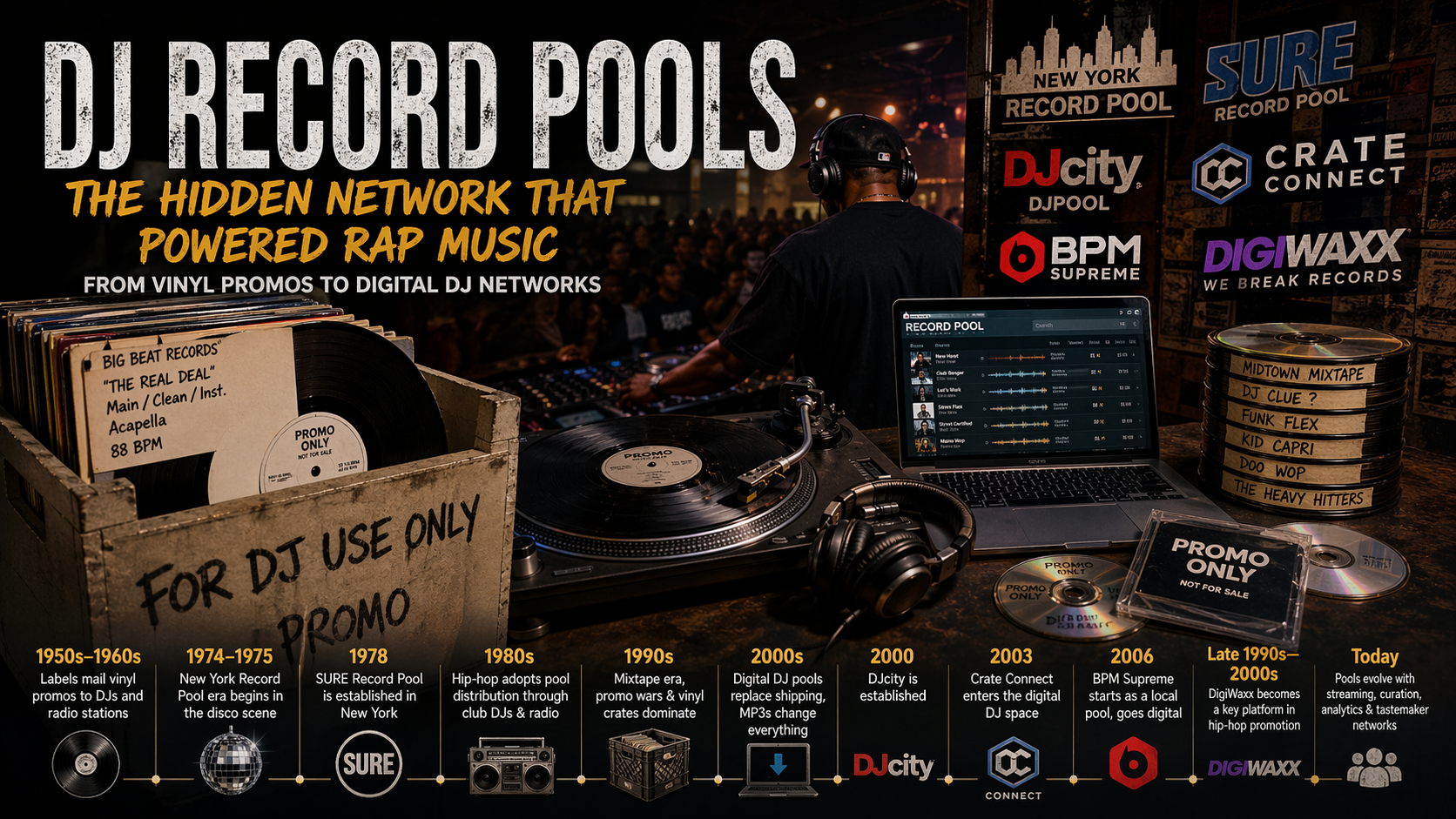
Before streaming playlists, before DSP dashboards, before social media could manufacture the illusion of instant momentum, there was a more physical, more selective, and often more powerful system deciding which records reached the streets first. That system was the DJ record pool. Most casual listeners never saw it. They only felt the result. A song would suddenly be everywhere in clubs, on mixshows, in cars, on mixtapes, and at parties, long before the broader public understood that a deliberate promotional machine had already been working behind the scenes.
Record pools were never just storage hubs for music. At their best, they were trust networks. Labels and promoters used them to get records into the hands of DJs who mattered, and those DJs acted as real-world filters, deciding what moved crowds, what felt dead on arrival, what needed another week, and what was ready to become part of the culture. In rap, that process was especially important because hip-hop did not rise through polite institutional channels. It rose through DJ culture, neighborhood reputation, local reaction, and the authority of people who could make a room erupt or turn cold in a matter of seconds.
The history of rap record pools is really the history of music distribution changing shape while keeping the same core principle intact. From vinyl promos carried by hand to digital servicing platforms that deliver tracks instantly, the technology evolved again and again. What did not change was the importance of the DJ. The right DJ still has the power to turn a file into a movement.
Also read: Explore more Raptology Featured Stories
Before record pools, records moved slowly and expensively
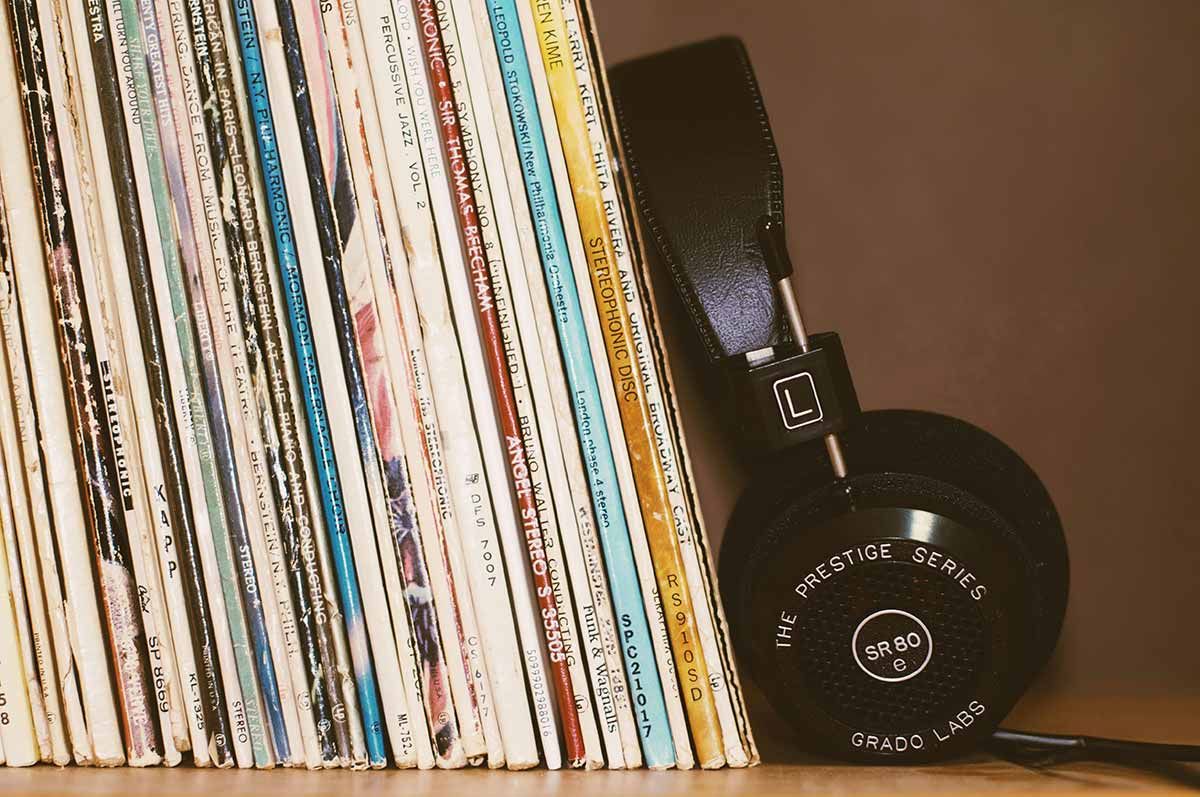
Before formal pools existed, labels had to promote records one copy at a time. In the 1950s and 1960s, promotional strategy was blunt and expensive. Labels pressed physical vinyl records, mailed them to selected radio stations and club DJs, and hoped the right person cared enough to play them. There was no elegant system for organized feedback, no fast way to compare market reaction across cities, and no central structure that could efficiently connect working DJs with the newest music.
This mattered because physical promos were not cheap. Pressing, packaging, and shipping records cost real money, which meant labels had to guess where their resources would matter most. Some DJs received stacks of records they never touched, while others who actually moved the floor were overlooked. Promotion depended heavily on personal relationships, label reps, and luck. If a song reached the wrong DJs first, it could die before it ever had a fair chance.
The industry needed a system that was more organized and more useful. DJs needed reliable access. Labels needed cleaner distribution and better intelligence. That gap is what made record pools inevitable.
1974 and 1975: New York formalizes the idea
The formal history of the modern DJ record pool is generally traced to New York in 1974 and 1975, when disco-era DJs and promoters helped build a structured system for sharing new records and reporting feedback to labels. The New York Record Pool emerged from that environment as a grassroots answer to a practical problem: the people breaking music needed a more efficient pipeline. That early pool model was revolutionary because it made DJs more than end users. It made them participants in the promotional strategy itself.
The concept was simple. Labels sent new releases to the pool. The pool distributed those records to approved DJ members. The DJs then played the music in clubs and returned practical feedback: how the crowd reacted, whether the song built energy, whether it felt too long, too weak, too slow, or right on time. Long before modern analytics dashboards, this was real-world data collection inside nightlife itself.
Disco gave this system its first major proving ground, but the logic was bigger than any one genre. Once the industry realized that organized DJs could influence not just what people heard, but how labels shaped releases, the record pool stopped being a novelty. It became infrastructure.
Key date
1974–1975 is the turning point when the DJ record pool becomes a formal industry mechanism in New York.
Why it mattered
It replaced random promo mailing with targeted distribution and gave labels actual floor feedback from working DJs.
By 1978, pools were already becoming power centers
Once the model proved itself, more pools followed. By the late 1970s, the pool world was already professionalizing, and by 1978 you had organizations like SURE operating in New York as serious DJ networks. By 1984, a New Yorker profile described SURE as a selective Bronx-based record pool serving working DJs with both records and research. That detail matters because it shows how pools had grown beyond simple music handoff. They were now information systems.
That dual role—distribution plus intelligence—helped make pools more powerful than outsiders often realized. They were not just warehouses. They were tastemaker ecosystems. They knew which borough leaned progressive, which club wanted tougher cuts, which records were barking in Manhattan, and which ones were dying elsewhere. That regional knowledge became part of the value.
In other words, record pools were not important only because they got records out. They were important because they turned DJ observation into industry knowledge. In the analog age, that was gold.
Hip-hop enters the structure in the late 1970s and 1980s
Record pools fit naturally into hip-hop because DJs were already central to the culture. Before rap was a giant recording business, it was a live, local, DJ-driven movement. Kool Herc, Grandmaster Flash, Afrika Bambaataa, and countless neighborhood selectors built scenes through parties, systems, breaks, and reputation. Hip-hop was being tested in real time, and that meant the people controlling the sound system were also controlling the first stage of distribution.
As rap entered the recording industry in the late 1970s and early 1980s, labels quickly understood that DJs still had to be reached first. Club DJs, radio mixshow DJs, college DJs, and eventually mixtape DJs became crucial. White-label 12-inches, promo pressings, clean versions, dirty versions, instrumentals, and acapellas all became part of the servicing culture. Pools helped coordinate that flow.
This was especially important in rap because crowd reaction mattered differently. A rap record could feel enormous in one neighborhood and invisible in another. The DJ was the translator. Pools helped labels get closer to that reality without pretending a chart alone could explain the streets.
The 1990s: promo wars, mixtapes, and the crate era
The 1990s were the great physical-promo decade in rap. DJs carried crates, labels fought for first spins, and a hot 12-inch could change the temperature of a market almost immediately. If you were trying to break a rap record in New York, Atlanta, Houston, Miami, Los Angeles, Chicago, or Philadelphia, you needed the right DJs on your side. That meant mixshow support, club testing, and in many cases access to pool networks that already had the necessary reach.
This was also the mixtape era, which gave DJs even more power. Figures like Kid Capri, Funk Flex, DJ Clue, Doo Wop, Kay Slay, and others became authorities in their own right. Getting a record into those ecosystems mattered as much as many traditional ad campaigns. Record pools did not replace hustling and relationships, but they strengthened both by making organized servicing possible.
The format mattered too. DJs needed club-friendly edits, radio-safe cuts, extended intros, instrumentals for blends, and acapellas for routines. Pools became part of the machinery that kept DJs supplied with useful versions instead of just consumer copies. That distinction is easy to overlook now, but it was central to how records spread.
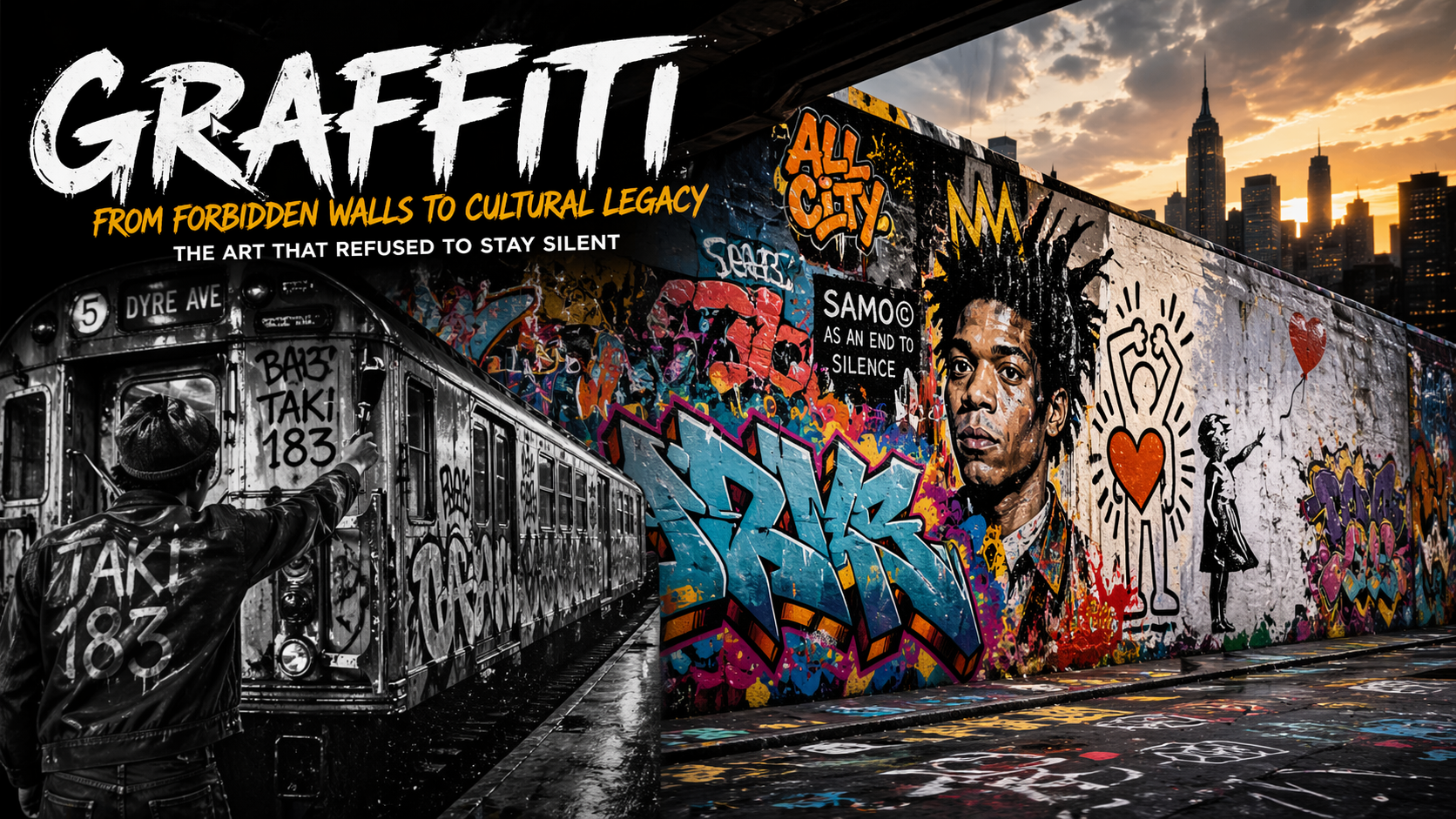
Related story: Graffiti: From Subway Tags to Global Art
The 2000s: digital pools replace the shipping room
The 2000s changed the mechanics completely. MP3 files made physical shipping slower, more expensive, and less necessary. Digital record pools began replacing the mailroom model, giving DJs near-instant access to new music through secure online platforms. This was not just a convenience upgrade. It was a structural change in how promotion happened.
The new system lowered barriers for independent artists and smaller labels. A campaign no longer required pressing huge quantities of vinyl or mailing stacks of CDs. Songs could be delivered nationally—or globally—without waiting on trucks, warehouses, or sales reps. Digital distribution accelerated everything.
But the change also created a new problem: saturation. Once anyone could upload files, the best pools had to prove they offered more than just storage. They needed curation, trust, servicing quality, professional edits, and real DJ communities. The strongest pools survived by preserving the old logic inside the new format.
The major digital-era names: DJcity, BPM Supreme, Crate Connect, DigiWaxx, and more
As the digital era matured, several major names came to define different parts of the modern record-pool world. DJcity, established in 2000, became one of the most recognized long-running digital pools, especially for club and mixshow DJs who needed fast access to relevant music and DJ-ready edits. BPM Supreme, which began in 2006 as a local record pool in San Diego built around physical data discs, evolved into a major digital platform and reflected the transitional moment when pools moved from physical servicing into web-based delivery. Crate Connect, operating since 2003, positioned itself around professional-grade promo access and DJ utility across multiple genres.
Then there is DigiWaxx, which deserves a substantial place in any rap-focused history, though not because it is the whole story. DigiWaxx is important because it represents how hip-hop-specific servicing survived and adapted in the digital era. Founded in the late 1990s and later operating as a digital promotion and DJ platform, DigiWaxx built its identity around urban music culture rather than a purely open-format model. That distinction matters. Rap record pools are not only about delivery speed. They are about credibility inside a genre where DJs, radio personalities, mixtape culture, and tastemakers still influence how a record is perceived. DigiWaxx’s long relevance comes from that overlap between technology and culture. It sits in a lineage where the goal is not merely hosting files, but connecting records to actual people in DJ booths, radio stations, and promotional circuits who can move them in the real world.
None of these platforms replaced the others completely because record-pool culture diversified. Some DJs wanted open-format efficiency. Some wanted radio edits and club packs. Some wanted a deeper hip-hop pipeline. Some needed all of the above. The digital era did not produce one final pool. It produced specialized ecosystems.
Digital-era lesson
Technology changed the delivery method, but pools still lived or died on trust, curation, and who their DJs actually were.
Rap-specific reality
In hip-hop, the right pool is not just a music source. It is access to tastemakers who can give a record legitimacy before the masses catch up.
What record pools still do better than algorithms
Streaming changed public listening habits, but it did not eliminate the need for trusted early adopters. Algorithms are good at reacting to momentum after it forms. DJs are still better at sensing energy before the data fully catches up. That is the difference. A DJ can feel a room hesitate, explode, drift, or lock in. That instinct remains one of the few things the platform era still cannot fully automate.
That is why record pools still matter in rap. They are part of the first-contact layer of promotion. They help decide which records get tested in actual human environments rather than just distributed into an infinite content flood. A stream is evidence that someone clicked. A DJ spin in the right room is evidence that something connected.
Independent artists often miss this because streaming makes exposure look easy. But exposure and impact are not the same thing. A record pool with real DJs can still create local traction, club memory, and cultural legitimacy in a way a passive upload often cannot.
A timeline of the key phases
- 1950s–1960s: labels rely on direct mailing of vinyl promos to selected DJs and radio stations.
- 1974–1975: the New York Record Pool era formalizes the record-pool model in the disco world.
- 1978: SURE emerges in New York, showing how pools are already becoming organized power centers.
- 1980s: rap increasingly uses pool-style promotion through club DJs, radio mixshows, and promotional 12-inches.
- 1990s: mixtape culture, promo wars, and vinyl servicing make DJs central to rap distribution strategy.
- 2000: DJcity is established, becoming one of the defining long-running digital pools.
- 2003: Crate Connect begins operating in the professional DJ music space.
- 2006: BPM Supreme starts as a local physical pool in San Diego and later expands digitally.
- Late 1990s into the 2000s: DigiWaxx becomes one of the notable urban-focused digital servicing and promotion platforms in rap.
- Today: pools coexist with streaming by focusing on curation, edits, feedback, tastemaker access, and early cultural validation.
The hidden architecture of rap promotion
Most listeners never think about record pools, which is partly why their role remains underrated. They are infrastructure. They sit behind the visible campaign, moving records into the right hands before the public sees the full rollout. In that sense, they are not background details. They are part of the architecture of how songs become familiar.
For rap especially, this matters because the culture rarely moved through only one channel. Streets, clubs, mixshows, regional scenes, DJs, and now digital platforms all overlap. Record pools helped coordinate that overlap. They turned distribution into strategy and strategy into repetition. They gave records a path toward becoming real, not just available.
From vinyl promos handed out one box at a time to curated digital platforms serving DJs instantly, the formats changed but the essential truth did not. If you want a record to matter in rap, it still helps to get it to the DJs before everyone else.
Reader Poll
Are DJ record pools still essential in rap promotion?
FAQ
What is a DJ record pool?
A DJ record pool is a professional distribution network that supplies promotional music directly to DJs so they can test, play, and help break records in clubs, radio shows, events, and mixes.
Why were record pools important in rap?
Because DJs were central to hip-hop from the beginning, and getting the right song to the right DJs often determined whether a record gained real street, club, and mixshow traction.
Did digital pools replace physical promo culture?
They replaced much of the shipping and pressing, but they kept the same underlying function: curated delivery of new music to DJs who can influence what breaks first.
Featured Stories
Explore more Raptology Featured stories, deep dives, and long-form cultural coverage.
Browse Featured StoriesKeep reading on Raptology

Raptology Editorial is the official newsroom voice of Raptology, covering breaking hip-hop news, artist developments, industry trends, and in-depth editorial reports from across the global rap landscape.














Leave a Reply