
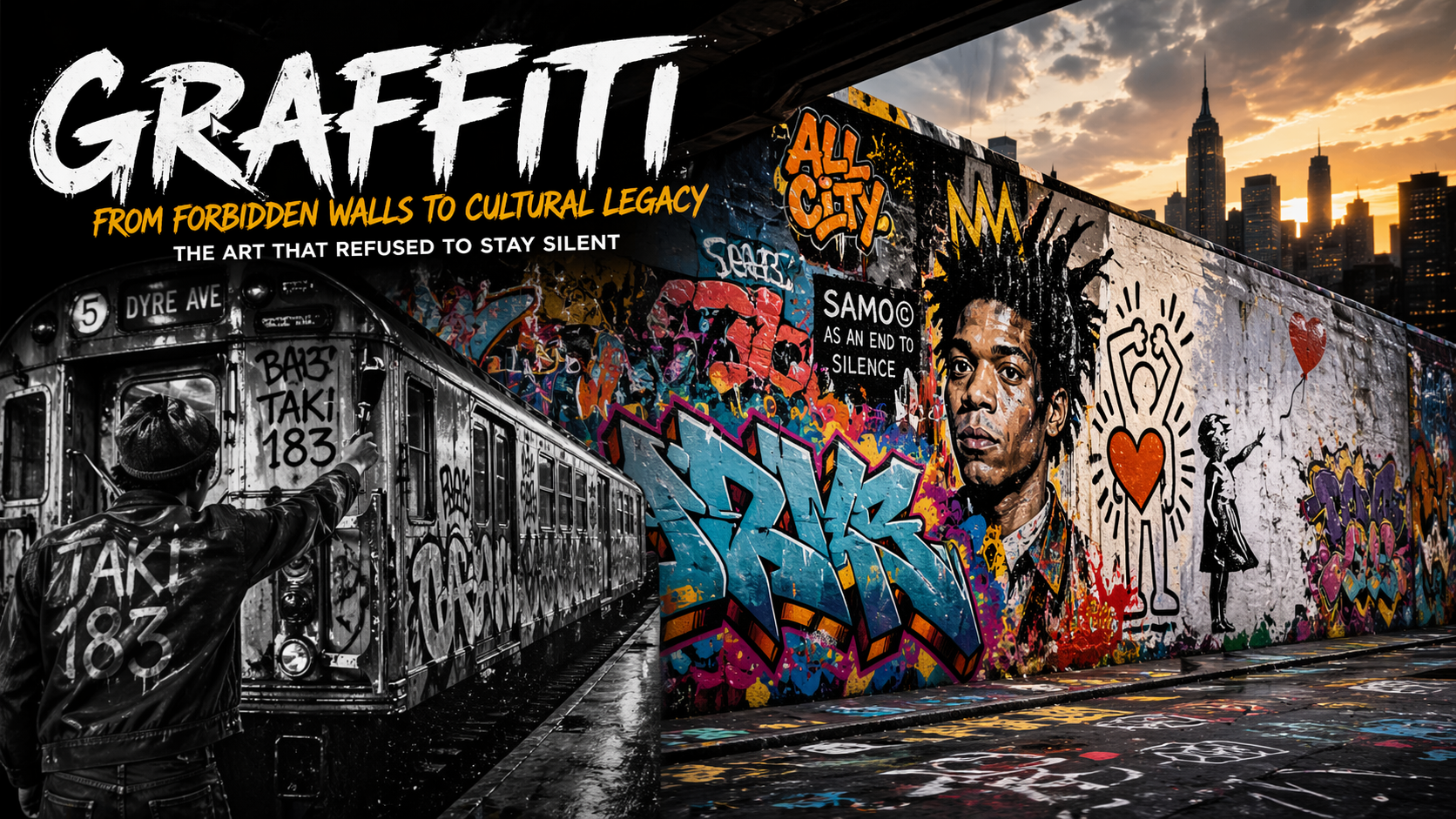
Graffiti has always lived in contradiction. To some people, it is vandalism—damage, trespassing, disorder sprayed across concrete and steel. To others, it is one of the purest forms of public expression ever created: art without permission, voice without invitation, memory written where nobody can ignore it. Few art forms have been judged so harshly while influencing global culture so deeply.
Long before galleries sold street aesthetics for millions, graffiti existed in tunnels, train yards, alley walls, abandoned factories, and city corners where official culture rarely looked. It was born from urgency, identity, competition, rebellion, and the simple human need to say: I was here. In many ways, graffiti is not just paint. It is visibility. It is proof of existence.
Today, the same world that once called it criminal often celebrates it as cultural heritage. Museums preserve it. Fashion brands imitate it. Luxury collectors pay fortunes for artists who once ran from police. But the tension remains: can graffiti still be graffiti once it becomes accepted? Or does its power come from the fact that it was never meant to ask permission in the first place?
Also read: Explore more Raptology Featured Stories


Before spray cans, there were walls and names
Graffiti is older than modern cities. Ancient Rome had political slogans scratched into walls. Pompeii preserved personal messages, insults, advertisements, and declarations of love written directly into public space. Humans have always marked walls because walls are where permanence lives. The impulse is ancient: if a place belongs to power, writing on it becomes a way of challenging power.
Modern graffiti, however, took its most recognizable form in the late 1960s and early 1970s. Philadelphia is often credited as one of the earliest centers, with writers like Cornbread becoming legends for spreading their names across the city. From there, the movement exploded in New York, where subway systems became moving canvases and names became reputations. Writers like TAKI 183 turned tagging into urban mythology, and entire generations followed.
The genius of subway graffiti was simple: if your name was on a train, your name traveled. Visibility became geography. A teenager from the Bronx could be seen across the entire city by morning. Style became status. Bigger letters, better placement, more dangerous locations—these were not random acts. They were a language of competition and identity built in public.


Graffiti and hip-hop were born in the same fire
You cannot properly discuss graffiti without discussing hip-hop. Alongside DJing, MCing, and breakdancing, graffiti became recognized as one of the foundational pillars of hip-hop culture. All four emerged from the same environments—urban neglect, youth creativity, economic pressure, and communities forced to create culture without institutional support.
Rap gave people a voice. Breakdancing gave people movement. DJing gave people rhythm. Graffiti gave people visibility. It was the visual declaration of the same energy. The city ignored you until your name was impossible to ignore. In that sense, graffiti was journalism before journalism cared. It recorded neighborhoods, crews, rivalries, and existence itself.
That relationship is why so many early hip-hop legends understood graffiti not as decoration, but as identity. It was not background. It was part of the architecture of the culture itself. Even today, album covers, music videos, streetwear, and stage design still borrow heavily from graffiti’s visual language because hip-hop never really left it behind.
Core truth
Graffiti was never only about paint. It was about being seen in a system designed to overlook you.
Why it lasted
Because every city produces people who feel invisible, and graffiti gives invisibility an answer.
From vandalism to visual language
By the 1970s and 1980s, graffiti became both famous and feared. New York subway cars were covered so heavily that they became symbols of urban decline to some and symbols of creative rebellion to others. Politicians treated graffiti as evidence of disorder. Artists treated it as a new visual revolution. Both were partly right.
The crackdown was aggressive. Graffiti was seen as a major social problem, and over time the “clean train” era nearly erased the fully painted subway car from daily public transit. But the culture itself did not disappear. It adapted.
Walls replaced trains. International scenes emerged. Europe, Latin America, the Middle East, and Asia developed their own styles. Graffiti moved from tags to murals, from illegal bombing to commissioned walls, from hidden tunnels to museum retrospectives. The argument over whether it was “real art” became harder to maintain because the quality became impossible to ignore.


Banksy and the moment graffiti entered elite art history
No modern graffiti discussion escapes Banksy. Anonymous, political, ironic, and globally recognizable, Banksy became the rare street artist whose work could move between abandoned walls and auction houses without losing cultural force. His success forced mainstream institutions to confront a strange question: what happens when illegal public art becomes more valuable than the buildings it appears on?
Perhaps no image explains this tension better than Girl with Balloon. The image became one of the most recognizable works of modern street art, and its mythology only deepened when a framed auction version partially shredded itself and became Love Is in the Bin. It was not just a stunt. It was a statement about value, ownership, and whether street art should ever be fully tamed by elite commerce.
Banksy’s larger contribution was proving that street art could remain politically sharp while becoming globally legible. He condensed protest into images simple enough to travel and complicated enough to debate.


Keith Haring, Basquiat, and the bridge to fine art
Before Banksy became a global myth, figures like Keith Haring and Jean-Michel Basquiat helped prove that street-born visual language could survive inside galleries without losing intellectual force. Basquiat moved from SAMO writings to becoming one of the most important artists of the twentieth century. Haring transformed public line work into globally recognized symbols.
Their importance was not just commercial success. It was philosophical legitimacy. They forced critics to confront the fact that the streets were producing serious artists long before institutions were ready to admit it. Graffiti was not the opposite of art history. It was part of it.
That bridge changed everything. Once the gallery world opened—even reluctantly—the line between vandal and visionary became much harder to define. Some writers rejected that transition. Others embraced it. The debate still exists today.


Ten images, one argument
- The subway era proved that a name could travel farther than a body.
- The Hall of Fame era proved that style could evolve without losing edge.
- Banksy proved that public art could shake private markets.
- Haring proved that a mural could become both warning and landmark.
- Basquiat proved that street-born language belonged inside serious art history.
Who owns a wall?
This may be graffiti’s deepest question. Not style. Not legality. Ownership. Who has the right to decide what public space looks like? Cities answer with permits, property law, and enforcement. Graffiti answers with action. It assumes that visibility itself can be claimed.
That tension explains why graffiti remains emotionally powerful. Even when the art is beautiful, people argue because the argument is bigger than beauty. It is about control. It is about who gets to shape the city and whose voice counts when concrete becomes conversation.
Some graffiti is careless destruction. Some is extraordinary public art. Most cities contain both realities at once. Pretending otherwise makes the conversation less honest. The power of graffiti comes partly from the fact that it refuses neat moral categories.
Why graffiti still matters now
In an era of polished branding, algorithmic visibility, and carefully managed identity, graffiti still feels dangerous because it is uncontrolled. It interrupts. It appears where it should not. It forces attention without permission. That quality is rare in modern public life.
Even when luxury fashion borrows its aesthetics and galleries sell its language, the original force remains the same. Somebody looked at a blank surface and decided silence was unacceptable. That impulse will always return because cities always produce silence, exclusion, and invisibility.
Graffiti survives because people still need walls to answer back to power. It began as a mark. It became a movement. It remains one of the loudest conversations ever written without asking permission.
Reader Poll
How do you see graffiti today?
FAQ
Is graffiti considered one of the pillars of hip-hop?
Yes. Alongside DJing, MCing, and breakdancing, graffiti is widely recognized as one of the foundational elements of hip-hop culture.
Why did subway graffiti become so important?
Because trains moved names across the entire city, turning tagging into visibility, reputation, and competition on a massive scale.
Why is Banksy so important to graffiti history?
Banksy helped push street art into global mainstream culture while keeping its political edge, forcing the art world to take graffiti seriously as both public expression and collectible fine art.
Featured Stories
Explore more Raptology Featured stories, deep dives, and long-form cultural coverage.
Browse Featured Stories
Raptology Editorial is the official newsroom voice of Raptology, covering breaking hip-hop news, artist developments, industry trends, and in-depth editorial reports from across the global rap landscape.

























Leave a Reply