
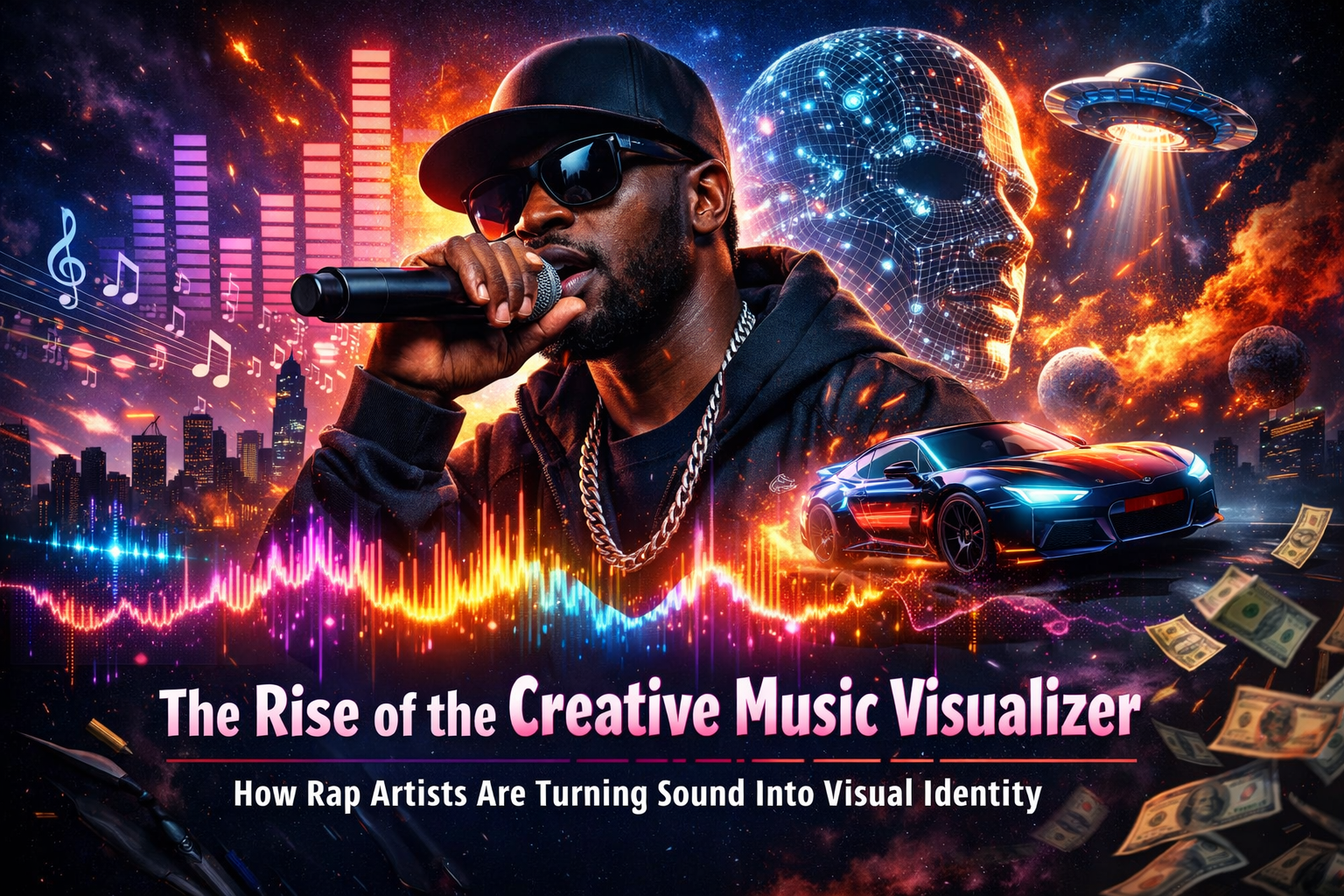
There was a time when visuals in hip-hop were optional. You dropped a track, maybe a cover, and if the budget allowed, a full video followed later. Today, that gap has closed fast.
Many artists now rely on tools like an ai music video generator to quickly turn tracks into dynamic visuals that move with the beat. Not necessarily a cinematic music video, but something that moves with the beat, carries the energy, and gives the audience something to look at while they listen. That is where the creative music visualizer comes in.
A strong creative music visualizer is not just decoration. It is part of how a song is experienced. It shapes first impressions, reinforces identity, and keeps listeners engaged across platforms where visuals matter as much as sound.
For artists and fans alike, the shift is clear. Music is no longer just heard. It is watched.
Why the Creative Music Visualizer Matters in Hip-Hop Right Now
Hip-hop has always been visual. From street aesthetics to high-budget storytelling, the genre has always understood the importance of image.
But the current wave is different.
A creative music visualizer is no longer just a backup plan. It is often the first visual layer a song gets. It fills the gap between release and full video, and in many cases, it becomes the primary way a track lives online.
Here is why that matters:
- Consistency Artists can release visuals with every track, not just singles
- Speed Visuals can drop at the same time as the audio
- Engagement Fans are more likely to watch and share something dynamic
- Identity building Visual styles reinforce an artist’s brand over time
The difference between a basic visual and a strong creative music visualizer is how well it captures the rhythm, flow, and emotion of the track.
What Defines a Strong Creative Music Visualizer
Not all tools deliver the same experience. A real creative music visualizer needs to handle more than just movement.
This content is only supported in a Feishu Docs
Most tools hit one or two of these. Few hit all of them consistently.
Comparing Today’s Creative Music Visualizer Tools
This content is only supported in a Feishu Docs
- Freebeat: Where Music Structure Meets Visual Control
Freebeat sits in a different category from most tools because it treats visuals as part of the music, not something layered on top.
A typical creative music visualizer reacts to beats. Freebeat goes further by following the structure of a track. That includes how verses build, how hooks hit, and how drops shift the energy.
Where it stands out
- Visuals follow BPM, beats, and full song progression
- Scene-level edits allow precise control over output
- Multiple visual styles adapt to different rap subgenres
- Built-in lyric visuals support storytelling and captions, especially when artists develop lines using tools like an ai lyrics generator before turning them into visual sequences.
Why it matters for rap artists
Rap is built on flow and timing. If visuals do not match that, the disconnect is obvious.
Freebeat’s approach creates:
- smoother transitions between sections
- stronger emphasis on hooks and drops
- visuals that feel intentional rather than repetitive
It behaves like a true audio visualizer because visuals respond directly to rhythm and structure.
This is where the idea of a creative music visualizer evolves into something closer to a full creative tool.
- Specterr: The Classic Visualizer Approach
Specterr represents the traditional side of the creative music visualizer space.
It focuses on waveform visuals, the kind you see across YouTube channels and streaming uploads.
What it does well
- Clean waveform animations
- Easy setup
- Reliable output
Where it falls short
The limitation is depth.
Waveforms react to audio, but they do not interpret structure. A hook looks similar to a verse visually, which flattens the experience over time.
For basic use, Specterr works. But as a creative music visualizer, it stays closer to function than expression.
- Renderforest: Template-Driven Visual Content
Renderforest is widely used for lyric videos and promotional content. It offers structured templates that simplify the process.
What it does well
- Strong lyric video formats
- Easy to use interface
- Fast turnaround
Where it falls short
Templates create consistency, but they also limit flexibility.
Visuals do not adapt deeply to the track. Instead, they follow pre-built structures. This makes it less dynamic as a creative music visualizer, especially for tracks with complex flows.
- Videobolt: Clean, Polished, Predictable
Videobolt sits somewhere between creative and corporate. It offers polished templates that work well for branding and presentation.
What it does well
- Professional visual quality
- Strong branding potential
- Clean design outputs
Where it falls short
Like Renderforest, it relies heavily on templates. That means less responsiveness to music.
As a creative music visualizer, it prioritises design over rhythm, which can make visuals feel disconnected from the track.
- Musicvid: The Entry-Level Visualizer
Musicvid is a free tool that covers the basics.
What it does well
- Accessible and free
- Simple to use
- Good for beginners
Where it falls short
It offers limited features and minimal control. Visuals are basic, and there is little room for refinement.
As a creative music visualizer, it works as a starting point but not as a long-term solution.
Where Creative Music Visualizers Are Headed
The gap between basic visualizers and advanced tools is getting wider.
A modern creative music visualizer is no longer just about:
- reacting to beats
It is about:
- understanding song structure
- supporting lyric storytelling
- giving creators control
We are seeing a shift from:
- static visuals → dynamic systems
- templates → adaptive visuals
- automation → creative direction
The next wave of tools will likely focus even more on:
- real-time adaptation
- deeper lyric integration
- stronger identity building
Choosing the Right Creative Music Visualizer
Different tools serve different needs. The right choice depends on how you create and release music.
This content is only supported in a Feishu Docs
Final Verdict
There are plenty of tools available, but they do not all operate at the same level.
A basic tool reacts to sound. A strong creative music visualizer understands how a track moves.
That difference becomes obvious over time.
Among the options, Freebeat stands out because it connects:
- rhythm
- structure
- lyrics
- visual control
into a single system.
It is not just generating visuals. It is shaping how a track is experienced visually.
For artists looking to build a consistent visual identity without slowing down their release cycle, that makes a difference.
And in a space where visuals are becoming as important as sound, the role of the creative music visualizer is only going to grow.

Guest Account for Paid And Sponsored Content on Raptology.com. Posts by Guest Authors are independent of our regular editorial content.
























Leave a Reply