
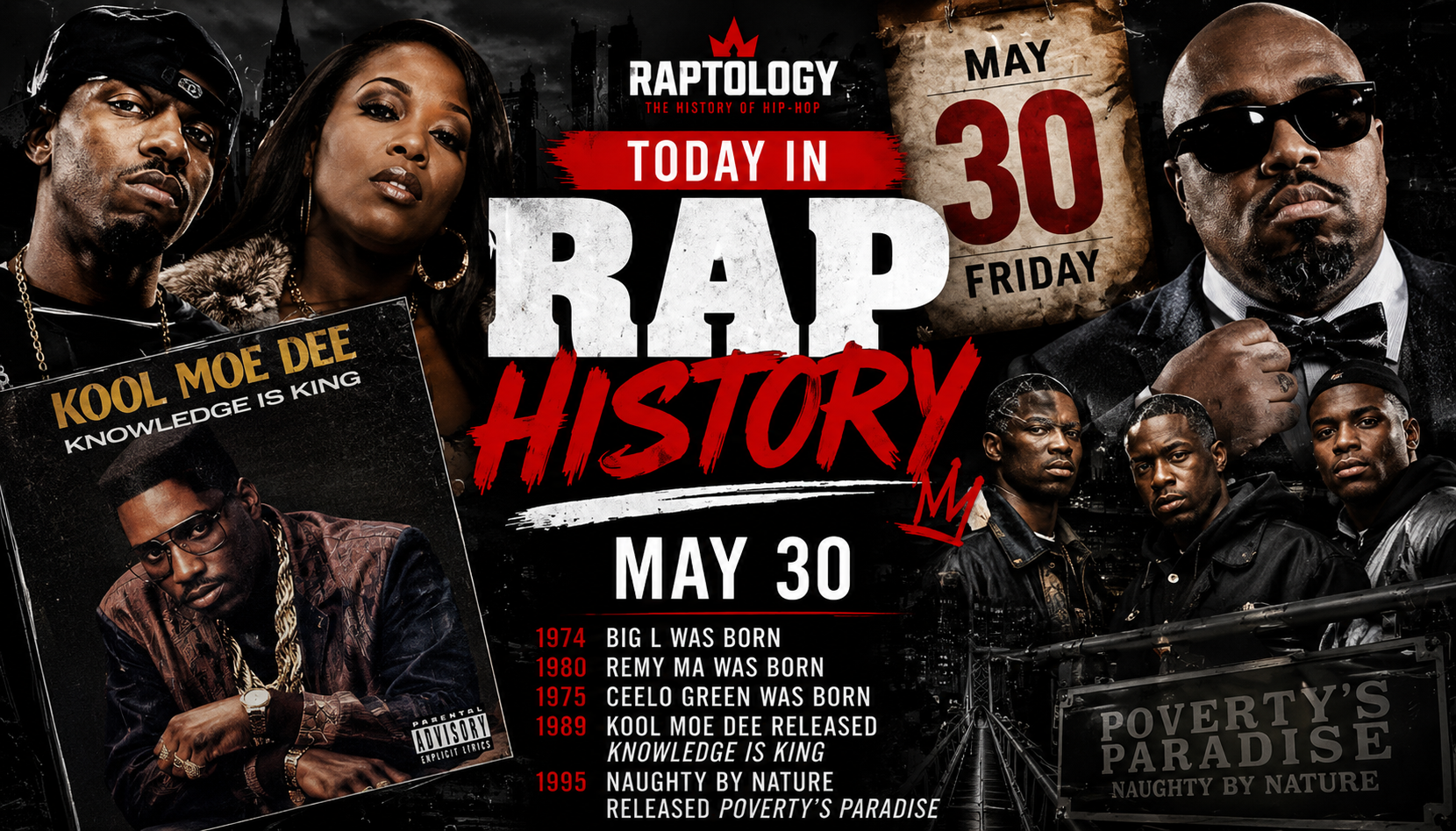
Some dates in hip-hop carry more than one story. May 30 is one of those days, connecting Harlem lyricism, Bronx battle rap, Atlanta soul, golden-era authority, and a Grammy-winning New Jersey rap album into one timeline.
May 30 in Rap History
May 30 belongs to several different chapters of hip-hop history. It is the birthday of Big L, one of Harlem’s most respected lyricists. It is also the birthday of Remy Ma, one of the Bronx’s sharpest battle-tested voices, and CeeLo Green, whose work with Goodie Mob helped shape the sound and emotional depth of Southern rap.
The date also marks two major album moments. Kool Moe Dee released Knowledge Is King on May 30, 1989, while Naughty by Nature released Poverty’s Paradise on May 30, 1995. Together, those moments show how one calendar date can connect lyrical skill, street storytelling, mainstream success, and regional identity across generations.

Big L Was Born – May 30, 1974
Lamont Coleman, known to the world as Big L, was born on May 30, 1974, in Harlem, New York. His career was tragically short, but his influence became enormous. For many rap fans, Big L represents the pure lyricist: sharp punchlines, cold delivery, street detail, and the kind of technical control that made other rappers listen closely.
His 1995 debut album, Lifestylez ov da Poor & Dangerous, helped cement him as one of New York’s elite underground voices. Records like “Put It On” and “MVP” showed his ability to balance charisma with skill, while his freestyle appearances became part of hip-hop mythology. Even decades later, Big L is still brought up in debates about the greatest lyricists of all time.
Big L’s legacy is especially powerful because it never had the chance to fully expand. He was killed in 1999 at only 24 years old, just as broader recognition seemed within reach. That unfinished story is part of why his name still carries so much weight in Harlem, in New York rap, and across the wider hip-hop community.
Remy Ma Was Born – May 30, 1980

Remy Ma was born on May 30, 1980, in the Bronx. Discovered by Big Pun and later known for her work with Fat Joe’s Terror Squad, Remy brought a direct, aggressive, and highly competitive style into the mainstream. Her voice cut through records with confidence, and her presence helped prove that female MCs could dominate street rap spaces without softening their edge.
Her role on Terror Squad’s “Lean Back” put her in front of a massive audience, but Remy’s identity was never only about one hit. She built her reputation through bars, battle energy, and survival. Songs like “Conceited” and her later return with Fat Joe on “All the Way Up” showed how long her presence could last in a genre that constantly moves forward.
May 30 is important because it links Big L and Remy Ma through New York’s lyric-first tradition. One came from Harlem, the other from the Bronx, but both represent the same larger idea: in New York rap, your words have to stand up under pressure.
CeeLo Green Was Born – May 30, 1975

CeeLo Green was born on May 30, 1975, in Atlanta, Georgia. Before his massive success as a solo artist and member of Gnarls Barkley, he helped define Southern hip-hop as part of Goodie Mob and the Dungeon Family. His voice was different from the start: soulful, strange, emotional, and impossible to confuse with anyone else.
With Goodie Mob, CeeLo helped give Atlanta rap a spiritual and political dimension. Their work was not only about regional pride. It was about family, poverty, morality, race, pressure, faith, and survival. That made Goodie Mob one of the most important groups in the rise of Southern rap as a serious artistic force.
CeeLo’s later crossover success did not erase his rap roots. It expanded them. His career shows how hip-hop can move through soul, funk, pop, and gospel without losing its origin story.
Kool Moe Dee Released Knowledge Is King – May 30, 1989
On May 30, 1989, Kool Moe Dee released Knowledge Is King, his third solo studio album. By that point, Moe Dee was already a respected pioneer from the Treacherous Three era, but this album showed how early hip-hop veterans were trying to remain sharp during rap’s fast-changing late-1980s landscape.
The album arrived at a time when hip-hop was becoming more competitive, more visual, and more commercially ambitious. Moe Dee’s image, delivery, and lyrical confidence helped position him as one of rap’s early intellectual warriors. His style was precise, forceful, and built around the idea that MCing was a discipline.
Knowledge Is King also matters because it sits inside a key transition period. Rap was moving from old-school foundations into golden-era complexity. Artists had to adapt quickly, and Kool Moe Dee’s work helped bridge the generation that built the culture with the one that would take it into the 1990s.
Naughty by Nature Released Poverty’s Paradise – May 30, 1995

On May 30, 1995, Naughty by Nature released Poverty’s Paradise, their fourth album. The project followed years of crossover success, but it still carried the group’s streetwise New Jersey identity. Treach, Vin Rock, and Kay Gee had already proven they could make hits without sounding disconnected from the block, and this album continued that balance.
The album included records such as “Feel Me Flow,” “Craziest,” and “Clap Yo Hands,” expanding the group’s catalog while keeping their energy intact. Naughty by Nature’s strength was always their ability to make songs that felt both radio-ready and rooted in real neighborhood language.
Poverty’s Paradise later became historically important for another reason: it won the first Grammy Award for Best Rap Album in 1996. That recognition helped mark rap’s continued movement into major institutional spaces, even as hip-hop was still fighting to be understood on its own terms.
Why May 30 Still Matters
May 30 is not remembered for only one artist, one album, or one region. It connects Harlem, the Bronx, Atlanta, New Jersey, and golden-era New York into one day. That is what makes it such a strong entry in rap history.
Big L represents the lyricist who became larger after death. Remy Ma represents Bronx toughness and female MC survival. CeeLo Green represents the emotional range of Southern hip-hop. Kool Moe Dee represents old-school mastery meeting a changing industry. Naughty by Nature represents mainstream success without losing street identity.
Together, these stories show how hip-hop history is never one straight line. It is a map of cities, voices, eras, and artists whose work still shapes how rap is heard today.
Explore More Raptology Stories
Continue reading more entries in Today in Rap History, explore long-form stories in the Documentaries section, and visit Rappers A-Z for more artist history and background.
Reader Poll: Which May 30 rap history moment matters most?

Raptology Editorial is the official newsroom voice of Raptology, covering breaking hip-hop news, artist developments, industry trends, and in-depth editorial reports from across the global rap landscape.




Leave a Reply